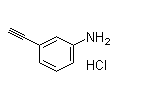
3-Ethynylbenzenamine hydrochloride CAS#: 207226-02-6
By great_watson-int,
Structure of 3-Ethynylaniline hydrochloride CAS 207226-02-6
IdentificationPhysical DataSpectra
Route of Synthesis (ROS)Safety and HazardsOther Data

Identification

英文名3-Ethynylbenzenamine hydrochloride
IUPAC Name3-ethynylaniline;hydrochloride
分子结构Structure of 3-Ethynylaniline hydrochloride CAS 207226-02-6
CAS编号 207226-02-6
EINECS NumberNo data available
MDL NumberMFCD12913913
Beilstein Registry NumberNo data available
别名3-Ethynylaniline hydrochloride; 3-Ethynylbenzenamine Hydrochloride; 3-Ethynylaniline HCl; Benzenamine, 3-ethynyl-, hydrochloride; AK119642; 3-aminophenylacetylene HCl; C8H7N.HCl; 3-ethynylaniline,hydrochloride; KSC005Q2R; SCHEMBL1507576; CTK9A5828; DTXSID70596526; CUNYDQJCQAWKLK-UHFFFAOYSA-N; BCP09426; KS-00000R1O; MFCD12913913; AKOS015890563; CS-W006161; DS-5694; AC-29720; SC-88382; SY046492; 3-Ethynylaniline–hydrogen chloride (1/1); AB0034101; AX8245058; X8201; Benzenamine, 3-ethynyl-, hydrochloride (1:1); J-013610; 3-ethynylaniline;hydrochloride; (3-ethynylphenyl)amine;hydrochloride
分子式C8H8ClN
分子量153.609
InChIInChI=1S/C8H7N.ClH/c1-2-7-4-3-5-8(9)6-7;/h1,3-6H,9H2;1H
InChI KeyCUNYDQJCQAWKLK-UHFFFAOYSA-N
Canonical SMILESC#Cc1cccc(c1)N.Cl
Patent Information
No data available

Physical Data

AppearanceWhite to cream color solid

Spectra

No data available

Route of Synthesis (ROS)

No data available

Safety and Hazards

Pictogram(s)exclamation-mark
SignalWarning
GHS Hazard StatementsH302+H312+H332 (33.33%): Harmful if swallowed, in contact with skin or if inhaled [Warning Acute toxicity, oral; acute toxicity, dermal; acute toxicity, inhalation]
H302 (33.33%): Harmful if swallowed [Warning Acute toxicity, oral]
H312 (33.33%): Harmful in contact with skin [Warning Acute toxicity, dermal]
H315 (66.67%): Causes skin irritation [Warning Skin corrosion/irritation]
H319 (33.33%): Causes serious eye irritation [Warning Serious eye damage/eye irritation]
H332 (33.33%): Harmful if inhaled [Warning Acute toxicity, inhalation]
H335 (33.33%): May cause respiratory irritation [Warning Specific target organ toxicity, single exposure; Respiratory tract irritation]
Information may vary between notifications depending on impurities, additives, and other factors.
Precautionary Statement CodesP261, P264, P270, P271, P280, P301+P312, P302+P352, P304+P312, P304+P340, P305+P351+P338, P312, P321, P322, P330, P332+P313, P337+P313, P362, P363, P403+P233, P405, and P501
(The corresponding statement to each P-code can be found at the GHS Classification page.)
For more detailed information, please visit ECHA C&L website

Source: European Chemicals Agency (ECHA)
License Note: Use of the information, documents and data from the ECHA website is subject to the terms and conditions of this Legal Notice, and subject to other binding limitations provided for under applicable law, the information, documents and data made available on the ECHA website may be reproduced, distributed and/or used, totally or in part, for non-commercial purposes provided that ECHA is acknowledged as the source: “Source: European Chemicals Agency, http://echa.europa.eu/”. Such acknowledgement must be included in each copy of the material. ECHA permits and encourages organisations and individuals to create links to the ECHA website under the following cumulative conditions: Links can only be made to webpages that provide a link to the Legal Notice page.
License URL: https://echa.europa.eu/web/guest/legal-notice
Record Name: (1-Cyano-2-ethoxy-2-oxoethylidenaminooxy)dimethylamino-morpholino-carbenium hexafluorophosphate
URL: https://echa.europa.eu/information-on-chemicals/cl-inventory-database/-/discli/details/213446
Description: The information provided here is aggregated from the “Notified classification and labelling” from ECHA’s C&L Inventory. Read more: https://echa.europa.eu/information-on-chemicals/cl-inventory-database


Other Data

TransportationNONH for all modes of transport
Under the room temperature and away from light
HS Code296200
StoragePreserve in well sealed container, store in cool and dried place, keep away from strong light and heat
Shelf Life1 year
Market PriceUSD
Use Pattern
3-Ethynylbenzenamine hydrochloride CAS#: 207226-02-6 is used to synthesize high-grade resins in the fields of aviation, aerospace, military and other fields.
3-Ethynylbenzenamine hydrochloride CAS#: 207226-02-6 is used as important intermediates for the synthesis of new anti-cancer drugs.

3-Aminophenylacetylene CAS#: 54060-30-9

By great_watson-int,
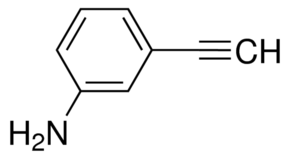
Structure of 3-Ethynylaniline CAS 54060-30-9
IdentificationPhysical DataSpectra
Route of Synthesis (ROS)Safety and HazardsOther Data

Identification

英文名3-Aminophenylacetylene
IUPAC Name3-ethynylaniline
分子结构Structure of 3-Ethynylaniline CAS 54060-30-9
CAS编号 54060-30-9
EINECS Number258-944-6
MDL NumberMFCD00014779
Beilstein Registry NumberNo data available
别名3-acetylenephenylamine, 3-Ethynylaniline, 3-ethynylaniline
分子式C8H7N
分子量117.148
InChIInChI=1S/C8H7N/c1-2-7-4-3-5-8(9)6-7/h1,3-6H,9H2
InChI KeyNNKQLUVBPJEUOR-UHFFFAOYSA-N
Canonical SMILESC#Cc1cccc(c1)N
Patent Information
Patent IDTitlePublication Date
CN109608394Nitrogen hetero-aromatic amines for synthesizing the compounds and nitrogen hetero-aromatic amine compound (by machine translation)2019
WO2019/117733THE USE OF ACETYLENE DERIVATIVES IN RUMINANTS2019
CN108440309A preparation method of between amino acetylene (by machine translation)2018
CN107827908A rapamycin three nitrogen azole derivative and its preparation and use (by machine translation)2018
CN106518849Aminoquin oxazolines and its preparation and use (by machine translation)2017

Physical Data

AppearanceAlmost colorless to yellow liquid
SolubilityInsoluble in water
Flash Point138 °F
Refractive index1.614-1.616
Melting Point, °C
27
Boiling Point, °CPressure (Boiling Point), Torr
128 – 1325
680.39
122 – 1241.8
118 – 12020
78 – 800.2
Refractive IndexWavelength (Refractive Index), nmTemperature (Refractive Index), °C
1.618658920
1.617358922
Chromatographic dataOriginal string
TLC (Thin layer chromatography)
HPLC (High performance liquid chromatography)
GC (Gas chromatography)R.T.(s) 2027.8

Spectra

Description (NMR Spectroscopy)Nucleus (NMR Spectroscopy)Solvents (NMR Spectroscopy)Frequency (NMR Spectroscopy), MHz
Chemical shifts, Spectrum1Hdimethylsulfoxide-d6400
Chemical shifts, Spectrum13Cdimethylsulfoxide-d6100
Chemical shifts1Hdimethylsulfoxide-d6400
Chemical shifts13Cdimethylsulfoxide-d6100
Chemical shifts1Hchloroform-d1400
1Hbenzene-d6
Chemical shifts1HCDCl3
Chemical shifts13CCDCl3
NMR
Description (IR Spectroscopy)Original Text (IR Spectroscopy)
in KBrIR (cm-1, KBr): 3443 s, 3362 s, 3287 s, 3047 m, 2107 m, 1622 s, 1530 m, 1488 s, 1446 s, 1316 s, 1285 s, 1156 s, 995 s, 932 s, 867 s, 788 s, 689 s, 533 s, 460 s
Description (Mass Spectrometry)Comment (Mass Spectrometry)
liquid chromatography mass spectrometry (LCMS), electrospray ionisation (ESI), spectrum
Molecular peak
Description (UV/VIS Spectroscopy)
Spectrum
Description (Other Spectroscopic Methods)
ESCA

Route of Synthesis (ROS)

Route of Synthesis (ROS) of 3-Aminophenylacetylene CAS 54060-30-9
ConditionsYield
With silver hexafluoroantimonate In methanol; water at 120℃; for 24h; Sealed tube;97%
With C22H20AuN3O2P(1+)*CF3O3S(1-); water; silver trifluoromethanesulfonate; acetic acid at 100℃; for 10h;91%
With water at 200℃; for 0.333333h; microwave irradiation;90%
With chloro(1,3-bis(2,6-di-i-propylphenyl)imidazol-2-ylidene)gold(I) In methanol; water at 110℃; for 6h; Schlenk technique; regioselective reaction;90%

Safety and Hazards

Pictogram(s)flameexclamation-mark
SignalWarning
GHS Hazard StatementsH226 (82.35%): Flammable liquid and vapor [Warning Flammable liquids]
H315 (98.04%): Causes skin irritation [Warning Skin corrosion/irritation]
H319 (98.04%): Causes serious eye irritation [Warning Serious eye damage/eye irritation]
H335 (86.27%): May cause respiratory irritation [Warning Specific target organ toxicity, single exposure; Respiratory tract irritation]
Information may vary between notifications depending on impurities, additives, and other factors.
Precautionary Statement CodesP210, P233, P240, P241, P242, P243, P261, P264, P271, P280, P302+P352, P303+P361+P353, P304+P340, P305+P351+P338, P312, P321, P332+P313, P337+P313, P362, P370+P378, P403+P233, P403+P235, P405, and P501
(The corresponding statement to each P-code can be found at the GHS Classification page.)

Other Data

TransportationClass 3; Packaging Group: III; UN Number: 1993C
Under the room temperature and away from light
HS Code292149
StorageUnder the room temperature and away from light
Shelf Life2 years
Market PriceUSD
Druglikeness
Lipinski rules component
分子量117.15
logP1.703
HBA1
HBD1
Matching Lipinski Rules4
Veber rules component
Polar Surface Area (PSA)26.02
Rotatable Bond (RotB)0
Matching Veber Rules2
Use Pattern
3-Aminophenylacetylene CAS#: 54060-30-9 is used as Pharmaceuticals
3-Aminophenylacetylene CAS#: 54060-30-9 is used as raw material for anticancer drugs
3-Aminophenylacetylene CAS#: 54060-30-9 is used as crosslinking agent
Adhesive
synthetic intermediate for nonlinear optical materials
luminescent material
light responsive devices
synthetic intermediate for thermosetting resins