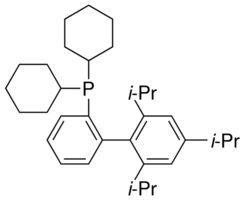
2-(Dicyclohexylphosphino)-2′,4′,6′-triisopropylbiphenyl CAS#: 564483-18-7
By great_watson-int,
Structure of 2-(Dicyclohexylphosphino)-2',4',6'-triisopropylbiphenyl CAS 564483-18-7
IdentificationPhysical DataSpectra
Route of Synthesis (ROS)Safety and HazardsOther Data

Identification

英文名2-(Dicyclohexylphosphino)-2′,4′,6′-triisopropylbiphenyl
IUPAC Namedicyclohexyl-[2-[2,4,6-tri(propan-2-yl)phenyl]phenyl]phosphane
分子结构
CAS编号 564483-18-7
MDL NumberMFCD04117682
别名XPhos, chloro(2-dicyclohexylphosphino-2’,4’,6’-triisopropyl-1,1‘-biphenyl)[2-(2’-amino-1,1‘-biphenyl)]palladium(II), dicyclohexyl(2’,4’,6’‐triisopropyl‐[1,1’‐biphenyl]‐2‐yl)phosphane, (2-dicyclohexylphosphino-2’,4’,6’-triisopropyl-1,1′-biphenyl)[2-(2-aminoethyl)phenyl]palladium(II)chloride, 2-(dicyclohexylphosphino)-3,6-dimethoxy-2′,4′,6′-triisopropyl-1,1′-biphenyl, dicyclohexyl[2′,4′,6′-tris(1-methylethyl)[1,1′-biphenyl]-2-yl]-phosphine, dicyclohexyl [2’,4’,6’-tris(1-methylethyl)[1,1′-biphenyl]-2-yl]phosphine; CAS#: 564483-18-7
分子式C33H49P
分子量476.716
InChIInChI=1S/C33H49P/c1-23(2)26-21-30(24(3)4)33(31(22-26)25(5)6)29-19-13-14-20-32(29)34(27-15-9-7-10-16-27)28-17-11-8-12-18-28/h13-14,19-25,27-28H,7-12,15-18H2,1-6H3
InChI KeyUGOMMVLRQDMAQQ-UHFFFAOYSA-N
Canonical SMILESCC(C)c1cc(c(c(c1)C(C)C)c2ccccc2P(C3CCCCC3)C4CCCCC4)C(C)C
Patent Information
Patent IDTitlePublication Date
EP2565182NOVEL AMIDE DERIVATIVE AND USE THEREOF AS MEDICINE2013
US2015/80628CATALYST AND PROCESS FOR THE CO-DIMERIZATION OF ETHYLENE AND PROPYLENE2015
US2011/15401Metal-Catalyzed Carbon-Fluorine Bond Formation2011
EP2062901FLUOROBORON COMPOUND HAVING AROMATIC RING OR SALT THEREOF, AND PROCESS FOR PRODUCTION OF COMPOUND HAVING CYCLIC ETHER-FUSED AROMATIC RING BY USING THE SAME2009
WO2009/106586QUINOLINES AS INHIBITORS OF FARNESYL PYROPHOSPHATE SYNTHASE2009

Physical Data

AppearanceWhite powder
SensitivityAir Sensitive
Melting Point, °C Solvent (Melting Point)
185.9
182 – 184
Description (Association (MCS))Partner (Association (MCS))
NMR spectrum of the complexCuCl
Comment (Solubility (MCS))
low solubility in DMF

Spectra

Description (NMR Spectroscopy)Nucleus (NMR Spectroscopy)Solvents (NMR Spectroscopy)Temperature (NMR Spectroscopy), °C Frequency (NMR Spectroscopy), MHz
Chemical shifts, Spectrum1Hchloroform-d1400
Chemical shifts, Spectrum31Pchloroform-d1
Chemical shifts31Pchloroform-d1
Chemical shifts31Pdimethylsulfoxide-d6
Chemical shifts, Spectrum31Pd(4)-methanol, (2)H8-toluene25162
Chemical shifts1Hbenzene-d6300
Chemical shifts13Cbenzene-d675
Chemical shifts31Pbenzene-d6121
Description (IR Spectroscopy)Solvent (IR Spectroscopy)
Bandsdichloromethane
Bandssolid

Route of Synthesis (ROS)

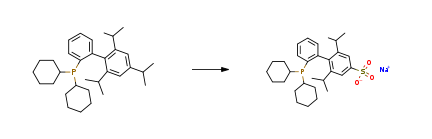
Route of Synthesis (ROS) of 2-(Dicyclohexylphosphino)-2',4',6'-triisopropylbiphenyl CAS# 564483-18-7
Route of Synthesis (ROS) of 2-(Dicyclohexylphosphino)-2′,4′,6′-triisopropylbiphenyl CAS# 564483-18-7
ConditionsYield
Stage #1: XPhos With sulfuric acid; sulfur trioxide In dichloromethane at 0 – 20℃; for 24h; Cooling with ice;
Stage #2: With sodium hydroxide In dichloromethane; water at 0℃; pH=~ 7.0; Cooling with ice;

Experimental Procedure
To an oven-dried 25 mL round bottom flask equipped with a Teflon-coated magnetic stir bar and rubber septum was added dicyclohexyl-(2′,4′,6′-triisopropyl-biphenyl-2-yl)-phosphane (476 mg, 1.00 mmol) and CH2Cl(1.0 mL). The solution was cooled to 0° C. using an ice/water bath and then concentrated H2SO(1.00 mL) and fuming sulfuric acid (3.0 mL, 20% SO3) were added dropwise. The solution was allowed to warm to room temperature and stir for 24 h. At this time it was cooled to 0° C. using an ice/water bath and crushed ice (10 g) was added. The solution turned cloudy and white in color. An aqueous solution of NaOH (6.0 M, 20.0 mL) was then added dropwise to the cooled solution until it became neutral (pH 7.0 as judged by pH paper). The aqueous solution was extracted with CH2Cl(3×50 mL) and concentrated under reduced pressure to give a beige solid. The crude material was then dissolved in a minimum amount of cold methanol (20 mL), filtered and concentrated (this cycle was repeated) to give sodium 2′-(dicyclohexyl-phosphanyl)-2,6-diisopropyl-biphenyl-4-sulfonate (4) as a beige solid (503 mg, 94%). Mp=>250° C. 1H NMR (400 MHz, CD3OD) δ: 7.52 (s, 2H), 7.46 (m, 1H), 7.22 (m, 2H), 6.90 (m, 1H), 2.24 (m, 1H), 0.71-1.83 (34H). 13C NMR (125 MHz, CD3OD) δ: 148.4, 147.9, 147.8, 147.5, 145.6, 142.8, 137.4, 137.2, 133.92, 133.91, 132.43, 132.42, 129.3, 128.1, 121.3, 121.0, 40.1, 39.9, 39.7, 39.5, 39.3, 38.8, 35.8, 35.7, 32.5, 32.3, 31.9, 30.8, 30.6, 28.7, 28.6, 28.4, 28.3, 27.7, 26.0, 25.9, 23.3, 23.1. 31P NMR (162 MHz, CD3OD) δ: -10.7. IR (neat, cm-1): 3459, 2927, 2851, 1634, 1463, 1447, 1184, 1078, 1040. Anal. Calcd for C30H42NaO3PS: C, 67.14; H, 7.89. Found: C, 66.93; H, 7.77.
94%
Stage #1: XPhos With sulfuric acid In dichloromethane at 0 – 20℃; for 24h;
Stage #2: With sodium hydroxide In dichloromethane; water pH=13;
53%

Safety and Hazards

Pictogram(s)exclamation-mark
SignalWarning
GHS Hazard StatementsH302 (18.18%): Harmful if swallowed [Warning Acute toxicity, oral]
H315 (72.73%): Causes skin irritation [Warning Skin corrosion/irritation]
H319 (72.73%): Causes serious eye irritation [Warning Serious eye damage/eye irritation]
H335 (63.64%): May cause respiratory irritation [Warning Specific target organ toxicity, single exposure; Respiratory tract irritation]
H413 (27.27%): May cause long lasting harmful effects to aquatic life [Hazardous to the aquatic environment, long-term hazard]
Information may vary between notifications depending on impurities, additives, and other factors.
Precautionary Statement CodesP261, P264, P270, P271, P273, P280, P301+P312, P302+P352, P304+P340, P305+P351+P338, P312, P321, P330, P332+P313, P337+P313, P362, P403+P233, P405, and P501
(The corresponding statement to each P-code can be found at the GHS Classification page.)

Other Data

TransportationNONH for all modes of transport
Under the room temperature and away from light
HS Code293190
StorageThe product will be slowly oxidized in the air, stored for a long time, it needs to be sealed and dried below 0℃
Market PriceUSD
Druglikeness
Lipinski rules component
分子量476.726
logP12.392
HBA0
HBD0
Matching Lipinski Rules3
Veber rules component
Polar Surface Area (PSA)
13.59
Rotatable Bond (RotB)7
Matching Veber Rules2
Bioactivity
In vitro: Efficacy
Quantitative Results
pXParameterValue (qual)Value (quant)Unit
1IC5030µM
Toxicity/Safety Pharmacology
Quantitative Results
pXParameterValue (qual)Value (quant)UnitEffect
3.82inhibition rate(of cell proliferation)<50%antiproliferative agent
Use Pattern
2-(Dicyclohexylphosphino)-2′,4′,6′-triisopropylbiphenyl CAS#: 564483-18-7 component of transition-metal catalyst for synthesis of 2H-indazoles
2-(Dicyclohexylphosphino)-2′,4′,6′-triisopropylbiphenyl CAS#: 564483-18-7 as Ligand
Palladium-catalyzed Negishi cross coupling between alkyl sulfones and aryl halides is used to prepare functionalized benzyl sulfones.
Ligands used in Pd-catalyzed Suzuki coupling reactions to generate Vindoline C-15 analogs.
Direct cyclization of 2-haloaniline to Pd-catalyzed indole and tryptophan. [2] Regioregular synthesis of polythiophene.
The Sonogashira coupling ligand used in TPGS-750-M is more environmentally friendly.

Carbonyldihydrotris(triphenylphosphine)ruthenium CAS#: 25360-32-1

By great_watson-int,
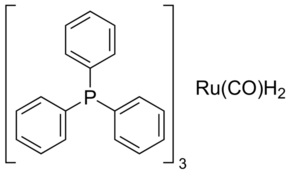
Structure of Carbonyldihydridotris(triphenylphosphine)ruthenium CAS 25360-32-1
IdentificationPhysical DataSpectra
Route of Synthesis (ROS)Safety and HazardsOther Data

Identification

英文名Carbonyldihydrotris(triphenylphosphine)ruthenium
IUPAC Nameformaldehyde;ruthenium dihydride;triphenylphosphane
分子结构Structure of Carbonyldihydridotris(triphenylphosphine)ruthenium CAS 25360-32-1
CAS编号 25360-32-1
别名carbonyl bis(hydrido)tris(triphenylphosphine)ruthenium(II), carbonyl(dihydrido)tris(triphenylphosphine)ruthenium(II), carbonyl(dihydro)tris(triphenylphosphine)ruthenium(II), carbonyl(dihydrido)tris(triphenylphosphine)ruthenium, carbonyldihydridotris(triphenylphosphine)ruthenium, Ru(PPh3)3(CO)H2, [RuH2(CO)(PPh3)3]
CAS No: 25360-32-1
分子式C55H47OP3Rh
分子量919.788
InChIInChI=1S/3C18H15P.CO.Rh.2H/c31-4-10-16(11-5-1)19(17-12-6-2-7-13-17)18-14-8-3-9-15-18;1-2;;;/h31-15H;;;;
InChI KeyWBIIBWMSHZJFCB-UHFFFAOYSA-N
Canonical SMILES[C-]#[O+].c1ccc(cc1)P(c2ccccc2)c3ccccc3.c1ccc(cc1)P(c2ccccc2)c3ccccc3.c1ccc(cc1)P(c2ccccc2)c3ccccc3.[RhH2]
Patent Information
Patent IDTitlePublication Date
WO2015/109451SYNTHESIS OF COMPOUNDS CONTAINING 8-OXA-3-AZABICYCLO (3.2.1)OCTANE RING2015
WO2014/198658RUTHENIUM- OR OSMIUM-BASED COMPLEX CATALYSTS2014
US2004/92759Process for making haloalkylalkoxysilanes2004
EP1176136PROCESS FOR PRODUCING FUMARIC ESTER2002

Physical Data

AppearanceGrey white to dark gray crystalline powder
SolubilityInsoluble in water.
SensitivityMoisture Sensitive
Comment (Solubility (MCS))
sparingly sol. in CH2Cl2 and CHCl3; slightly sol. in C6H6;

Spectra

Description (NMR Spectroscopy)Nucleus (NMR Spectroscopy)Solvents (NMR Spectroscopy)Frequency (NMR Spectroscopy), MHz
Chemical shifts1Hbenzene-d6500
Chemical shifts31Pbenzene-d6202
Chemical shifts, Spectrum31Pbenzene-d6
Chemical shifts, Spectrum1Hbenzene-d6600
Chemical shifts, Spectrum1H(2)H8-toluene400
Chemical shifts1Hchloroform-d1400
2D-NMR, Spectrum1H, 13Cbenzene-d6
Spectrum1HC6D5CD3=toluene-d8
1HCDCl3
1Hnot given
Description (IR Spectroscopy)Solvent (IR Spectroscopy)Comment (IR Spectroscopy)
Spectrumtoluene14.85 – 54.85
Bands, Spectrumbenzene-d6
Intensity of IR bands, Bands, Spectrum
Bandsneat (no solvent)1867 cm**-1 – 1960 cm**-1
Bandspotassium bromide
Bandsnot given
BandsKBr1935 cm**-1 – 1960 cm**-1
Bandsnujol1900 cm**-1 – 1960 cm**-1
Description (UV/VIS Spectroscopy)Solvent (UV/VIS Spectroscopy)
Spectrumchloroform

Route of Synthesis (ROS)

Route of Synthesis (ROS) of Carbonyldihydrotris(triphenylphosphine)ruthenium CAS# 25360-32-1
ConditionsYield
In benzene at 70℃; for 12h; Inert atmosphere; Schlenk technique;

Experimental Procedure
2.1. Substrate preparation and reaction conditions
General procedure: Complexes A, B and C were prepared under similar condi-tions. The complex A was prepared as follows: The mixtureof RuH2(CO)(PPh3)3, imine 13 and triethoxyvinylsilane in ben-zene was prepared under nitrogen atmosphere in a Schlenk tube (Ru/imine/silane = 1/3/3) and heated at 70C for 12 h. After cool-ing, the reaction mixture was concentrated in vacuo and to theresi due hexane was added to precipitate the complex. The pre-cipitates were washed with hexane 2 times to give pale yellow powders. The obtained complex was applied to NMR, FAB-MS andIR analysis. Complex B was prepared by the reaction at 110C for 12 h.
95%

Safety and Hazards

Pictogram(s)exclamation-mark
SignalWarning
GHS Hazard StatementsH302 (97.78%): Harmful if swallowed [Warning Acute toxicity, oral]
H312 (84.44%): Harmful in contact with skin [Warning Acute toxicity, dermal]
H315 (13.33%): Causes skin irritation [Warning Skin corrosion/irritation]
H319 (13.33%): Causes serious eye irritation [Warning Serious eye damage/eye irritation]
H332 (84.44%): Harmful if inhaled [Warning Acute toxicity, inhalation]
H335 (13.33%): May cause respiratory irritation [Warning Specific target organ toxicity, single exposure; Respiratory tract irritation]
Information may vary between notifications depending on impurities, additives, and other factors.
Precautionary Statement CodesP261, P264, P270, P271, P280, P301+P312, P302+P352, P304+P312, P304+P340, P305+P351+P338, P312, P321, P322, P330, P332+P313, P337+P313, P362, P363, P403+P233, P405, and P501
(The corresponding statement to each P-code can be found at the?GHS Classification?page.)

Other Data

TransportationNONH for all modes of transport
Under the room temperature and away from light
HS Code284390
StorageStored at low temperature after vacuum packaging, can not be operated in air.
Shelf Life2 years
Market PriceUSD
Druglikeness
Lipinski rules component
分子量917.969
HBA1
HBD0
Matching Lipinski Rules2
Veber rules component
Polar Surface Area (PSA)0
Rotatable Bond (RotB)12
Matching Veber Rules1
Bioactivity
In vitro: Efficacy
Quantitative Results
1?of?1Resultsphysiological behaviour discussed
Use Pattern
Catalyst for converting 1,4-alkanediol to pyrrole; Catalyst for oxidation of primary alcohol to methyl ester; Catalyst for rearrangement of oxime to amide; Catalyst for C-C coupling by directional C-H activation; Catalyst for cyclopentane cyclization.

2-Dicyclohexylphosphino-2′,6′-dimethoxybiphenyl CAS#: 657408-07-6

By great_watson-int,
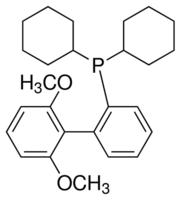
Structure of 2-Dicyclohexylphosphino-2',6'-dimethoxybiphenyl CAS 657408-07-6
IdentificationPhysical DataSpectra
Route of Synthesis (ROS)Safety and HazardsOther Data

Identification

英文名2-Dicyclohexylphosphino-2′,6′-dimethoxybiphenyl
IUPAC Namedicyclohexyl-[2-(2,6-dimethoxyphenyl)phenyl]phosphane
分子结构Structure of 2-Dicyclohexylphosphino-2',6'-dimethoxybiphenyl CAS 657408-07-6
CAS编号 657408-07-6
MDL NumberMFCD05861611
别名dicyclohexyl-(2′,6′-dimethoxybiphenyl-2-yl)-phosphane, dicyclohexyl({2′,6’‐dimethoxy‐[1,1’‐biphenyl]‐2‐yl})phosphane, 2–dicyclohexylphosphino–2′,6’–dimethoxy–1,1’–biphenyl, dicyclohexyl (2’,6’-dimethoxy-[1,1’-biphenyl]-2-yl)phosphine, dicyclohexyl(2’,6’-dimethoxy-[ 1,1’-biphenyl]-2-yl)phosphine, tert 2-dicyclohexylphosphino-2′,6′-dimethoxybiphenyl-butoxycarbonyl, (2’,6’-dimethoxy-[1,1’-biphenyl]-2-yl)dicyclohexylphosphine
CAS#: 657408-07-6;CAS Number: 657408-07-6;CAS No: 657408-07-6
分子式C26H35O2P
分子量410.529
InChIInChI=1S/C26H35O2P/c1-27-23-17-11-18-24(28-2)26(23)22-16-9-10-19-25(22)29(20-12-5-3-6-13-20)21-14-7-4-8-15-21/h9-11,16-21H,3-8,12-15H2,1-2H3
InChI KeyVNFWTIYUKDMAOP-UHFFFAOYSA-N
Canonical SMILESCOc1cccc(c1c2ccccc2P(C3CCCCC3)C4CCCCC4)OC
Patent Information
Patent IDTitlePublication Date
US2009/143586Method for producing alkyl-substituted aromatic and heteroaromatic compounds by cross-coupling alkyl boronic acids with aryl-or heteroaryl-halogenides or sulfonates under Pd catalysis in the presence of a ligand2009
US2006/173186Transition-metal-catalyzed carbon-nitrogen and carbon-carbon bond-forming reactions2006

Physical Data

AppearanceWhite crystal
SensitivityAir Sensitive
Melting Point, °C Solvent (Melting Point)
162 – 163
163 – 165acetone
162 – 162.5acetone
Description (Association (MCS))Partner (Association (MCS))
NMR spectrum of the complexCuCl

Spectra

Description (NMR Spectroscopy)Nucleus (NMR Spectroscopy)Solvents (NMR Spectroscopy)Temperature (NMR Spectroscopy), °C Frequency (NMR Spectroscopy), MHz
Spectrum1H
Spectrum31Pchloroform-d1243
Chemical shifts, Spectrum1Hbenzene-d6400
Chemical shifts, Spectrum31Pbenzene-d6161
Chemical shifts31P202.5
Chemical shifts, Spectrum1Hchloroform-d119.64600
Chemical shifts, Spectrum13Cchloroform-d121.04151
Chemical shifts, Spectrum31Pchloroform-d126.8481
Chemical shifts1Hchloroform-d1400
Chemical shifts31Pchloroform-d1162
Chemical shifts13Cbenzene-d675
Chemical shifts31Pbenzene-d6121
Description (IR Spectroscopy)Solvent (IR Spectroscopy)Original Text (IR Spectroscopy)Signals, cm-1
in KBr IR (KBr): υ=3000, 2923, 2851, 1588, 1471, 1442, 1428, 1108 cm-13000, 2923, 2851, 1588, 1471, 1442, 1428, 1108
Bandssolid
Description (Mass Spectrometry)
HRMS (High resolution mass spectrometry), TOFMS (Time of flight mass spectrum), EI (Electron impact), Spectrum

Route of Synthesis (ROS)

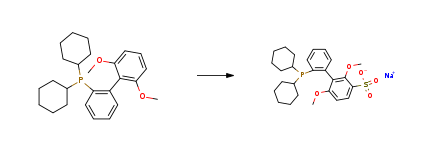
Route of Synthesis (ROS) of 2-Dicyclohexylphosphino-2',6'-dimethoxybiphenyl CAS# 657408-07-6
Route of Synthesis (ROS) of 2-Dicyclohexylphosphino-2′,6′-dimethoxybiphenyl CAS# 657408-07-6
ConditionsYield
Stage #1: dicyclohexyl-(2′,6′-dimethoxybiphenyl-2-yl)-phosphane With sulfuric acid In dichloromethane at 0 – 40℃; for 24h;
Stage #2: With sodium hydroxide In dichloromethane; water at 0℃; pH=~ 7.0; Cooling with ice;

Experimental Procedure
To an oven-dried 25 mL round bottom flask equipped with a Teflon-coated magnetic stir bar and rubber septum was added 2-dicyclohexylphosphino-2’6’dimethoxybiphenyl (5.13 g, 12.5 mmol) and CH2Cl(5 mL). The solution was cooled to 0° C. using an ice/water bath and then concentrated H2SO(32.5 mL, 625 mmol) was added dropwise. The solution slowly turned yellow in color. The solution was heated to 40° C. in a preheated oil bath and was allowed stir for 24 h. At this time it was cooled to 0° C. using an ice/water bath and crushed ice (50 g) was added. The solution turned cloudy and white in color. An aqueous solution of NaOH (6.0 M, 200 mL) was then added dropwise to the cooled solution until it became neutral (pH 7.0 as judged by pH paper). The aqueous solution was extracted with CH2Cl(3×300 mL) and concentrated under reduced pressure to give a light yellow solid. The crude material was then dissolved in a minimum amount of cold methanol (20 mL), filtered and concentrated (this cycle was repeated) to give sodium 2-dicyclohexylphosphino-2′,6′-dimethoxybiphenyl-3′-sulfonate (2) as a light yellow solid (6.35 g, 99%). Mp=165° C. (turned red, dec.) 1H NMR (400 MHz, CD3OD) δ: 7.88 (d, 1H, J=8.8 Hz), 7.60 (m, 1H), 7.36 (m, 2H), 7.22 (m, 1H), 6.76 (d, 1H, J=8.8 Hz) 3.70 (s, 3H), 3.39 (s, 3H), 1.14-2.01 (m, 22H). 13C NMR (125 MHz, CD3OD) δ: 161.3, 157.1, 143.3, 142.9, 137.9, 137.8, 133.7, 133.6, 133.3, 133.2, 131.9, 130.0, 129.3, 128.0, 127.9, 127.8, 105.9, 61.6, 56.1, 50.0, 37.0, 36.9, 34.8, 34.6, 31.7, 31.6, 31.5, 31.2, 31.0, 30.8, 30.7, 28.9, 28.8, 28.7, 28.4, 28.34, 28.31, 28.2, 27.8, 27.7. 31P NMR (162 MHz, CD3OD) δ: -8.02. IR (neat, cm-1): 3453, 2925, 2849, 1577, 1462, 1448, 1400, 1229, 1191, 1099, 1053, 736. Anal. Calcd for C26H34NaO5PS: C, 60.92; H, 6.69. Found: C, 60.40; H, 6.85. 1H NMR (d4-MeOH/D2O) is shown in FIG. 7. 31P NMR (d4-MeOH) is shown in FIG. 7.
99%
Stage #1: dicyclohexyl-(2′,6′-dimethoxybiphenyl-2-yl)-phosphane With sulfuric acid In dichloromethane at 0 – 40℃; for 24.7h; Inert atmosphere;
Stage #2: With sodium hydroxide In dichloromethane; water at 0℃; pH=13;
62%

Safety and Hazards

Pictogram(s)exclamation-mark
SignalWarning
GHS Hazard StatementsH302+H312+H332 (11.11%): Harmful if swallowed, in contact with skin or if inhaled [Warning Acute toxicity, oral; acute toxicity, dermal; acute toxicity, inhalation]
H302 (55.56%): Harmful if swallowed [Warning Acute toxicity, oral]
H312 (22.22%): Harmful in contact with skin [Warning Acute toxicity, dermal]
H315 (88.89%): Causes skin irritation [Warning Skin corrosion/irritation]
H317 (33.33%): May cause an allergic skin reaction [Warning Sensitization, Skin]
H319 (88.89%): Causes serious eye irritation [Warning Serious eye damage/eye irritation]
H332 (22.22%): Harmful if inhaled [Warning Acute toxicity, inhalation]
H335 (55.56%): May cause respiratory irritation [Warning Specific target organ toxicity, single exposure; Respiratory tract irritation]
Information may vary between notifications depending on impurities, additives, and other factors.
Precautionary Statement CodesP261, P264, P270, P271, P272, P280, P301+P312, P302+P352, P304+P312, P304+P340, P305+P351+P338, P312, P321, P322, P330, P332+P313, P333+P313, P337+P313, P362, P363, P403+P233, P405, and P501
(The corresponding statement to each P-code can be found at the GHS Classification page.)

Other Data

TransportationNONH for all modes of transport
Under the room temperature and away from light
StorageThe product will be slowly oxidized in the air, stored for a long time, it needs to be sealed and dried below 0℃
Market PriceUSD
Druglikeness
Lipinski rules component
分子量410.536
logP8.007
HBA0
HBD0
Matching Lipinski Rules3
Veber rules component
Polar Surface Area (PSA)32.05
Rotatable Bond (RotB)6
Matching Veber Rules2
Toxicity/Safety Pharmacology
Quantitative Results
pXParameterValue (qual)Value (quant)UnitDose
4.5inhibition rate(of cell proliferation)100%600 μM
3.82inhibition rate(of cell proliferation)<50%150 μM
Use Pattern
Palladium-catalyzed Suzuki-Miyaura cross-coupling reaction between Boc-protected aminomethyl trifluoroborate and aryl chloride or heteroaryl chloride to form the corresponding Aminomethyl aromatic hydrocarbons.
Palladium-catalyzed Suzuki-Miyaura cross-coupling reaction between 4-methyl substituted piperidinyl zinc reagent and different aryl or heteroaryl iodides to form various substituted piperidines.
Intramolecular Suzuki-Miyaura coupling during the multi-step synthesis of riccardin C to form an 18-membered macrocycle. Used with palladium to produce a highly active catalyst for C-N bond formation.
Highly versatile ligand for Suzuki-Miyaura coupling reaction; aryl chloride, sterically hindered diaryl, heterodiaryl compounds.