Carboxymethyl chitosan CAS#: 83512-85-0
Identification
| 英文名 | Carboxymethyl chitosan |
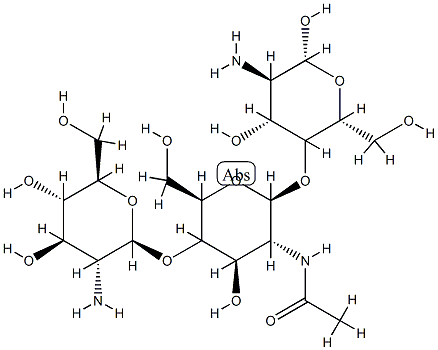
| IUPAC Name | N-[(2S,3R,4R,6R)-5-[(2S,3R,4R,5S,6R)-3-amino-4,5-dihydroxy-6-(hydroxymethyl)oxan-2-yl]oxy-2-[(2R,4R,5R,6R)-5-amino-4,6-dihydroxy-2-(hydroxymethyl)oxan-3-yl]oxy-4-hydroxy-6-(hydroxymethyl)oxan-3-yl]acetamide |
| 分子结构 |  |
| CAS编号 | 83512-85-0 |
| 别名 | Carboxymethyl chitosan 83512-85-0 N-[(2S,3R,4R,6R)-5-[(2S,3R,4R,5S,6R)-3-amino-4,5-dihydroxy-6-(hydroxymethyl)oxan-2-yl]oxy-2-[(2R,4R,5R,6R)-5-amino-4,6-dihydroxy-2-(hydroxymethyl)oxan-3-yl]oxy-4-hydroxy-6-(hydroxymethyl)oxan-3-yl]acetamide MFCD00677440 N-Acetylchitosan YC29683 |
| 分子式 | C20H37N3O14 |
| 分子量 | 543.5 |
| InChI | InChI=1S/C20H37N3O14/c1-5(27)23-11-15(31)17(36-19-10(22)13(29)12(28)6(2-24)34-19)8(4-26)35-20(11)37-16-7(3-25)33-18(32)9(21)14(16)30/h6-20,24-26,28-32H,2-4,21-22H2,1H3,(H,23,27)/t6-,7-,8-,9-,10-,11-,12-,13-,14-,15-,16?,17?,18-,19+,20+/m1/s1 |
| InChI Key | HGNQXZLWHDQLRE-XADFZESNSA-N |
| Isomeric SMILES | CC(=O)N[C@@H]1[C@H](C([C@H](O[C@H]1OC2[C@H](O[C@H]([C@@H]([C@H]2O)N)O)CO)CO)O[C@H]3[C@@H]([C@H]([C@@H]([C@H](O3)CO)O)O)N)O |
Physical Data
| Appearance | White to light yellow, Free Flowing Powder |
Spectra
No data available
Route of Synthesis (ROS)
No data available
Safety and Hazards
| Pictogram(s) |  |
| Signal | Warning |
| GHS Hazard Statements | H315 (50%): Causes skin irritation [Warning Skin corrosion/irritation] H319 (50%): Causes serious eye irritation [Warning Serious eye damage/eye irritation] H335 (50%): May cause respiratory irritation [Warning Specific target organ toxicity, single exposure; Respiratory tract irritation] |
| Precautionary Statement Codes | P261, P264, P264+P265, P271, P280, P302+P352, P304+P340, P305+P351+P338, P319, P321, P332+P317, P337+P317, P362+P364, P403+P233, P405, and P501 (The corresponding statement to each P-code can be found at the GHS Classification page.) |
Other Data
| Storage | Stored at room temperature for long time; Sealed and keep away from light. |
| Shelf Life | 2 year |
| Use Pattern |
| Carboxymethyl chitosan CAS#: 83512-85-0 exhibits excellent water solubility, superior film-forming properties, and strong heavy metal chelation capabilities. Carboxymethyl chitosan has been utilized as a drug release agent, a plant growth enhancer, and a heavy metal chelating agent. Widely applied in the cosmetics industry, it helps reduce skin oxidative damage, delay aging, and retain skin moisture. |