TETRAKIS(DIETHYLAMINO)ZIRCONIUM CAS#: 13801-49-5
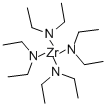
Identification
| 英文名 | TETRAKIS(DIETHYLAMINO)ZIRCONIUM |
| IUPAC Name | diethylazanide;zirconium(4+) |
| 分子结构 |  |
| CAS编号 | 13801-49-5 |
| 别名 | Tetrakis(diethylamino)zirconium 13801-49-5 diethylazanide;zirconium(4+) Tetrakis(diethylamino) zirconium(IV) Zirconium, tetrakis(diethylamino)- Tetrakis(diethylamido)zirconium(IV) MFCD00015649 SCHEMBL77355 tetrakis(diethylamido)zirconium zirconium tetra(diethyl amide) GOVWJRDDHRBJRW-UHFFFAOYSA-N AKOS025243719 CS-0111450 Ethanamine, N-ethyl-, zirconium(4+) salt (4:1) Tetrakis(diethylamido)zirconium(IV), electronic grade, >=99.99% trace metals basis |
| 分子式 | C16H40N4Zr |
| 分子量 | 379.74 |
| InChI | InChI=1S/4C4H10N.Zr/c4*1-3-5-4-2;/h4*3-4H2,1-2H3;/q4*-1;+4 |
| InChI Key | GOVWJRDDHRBJRW-UHFFFAOYSA-N |
| Isomeric SMILES | CC[N-]CC.CC[N-]CC.CC[N-]CC.CC[N-]CC.[Zr+4] |
Physical Data
| Appearance | Light yellow liquid |
Spectra
| Description (NMR Spectroscopy) | Nucleus (NMR Spectroscopy) | Solvents (NMR Spectroscopy) |
| Chemical shifts, Spectrum | 1H | [(2)H5]pyridine |
| Chemical shifts, Spectrum | 13C | [(2)H5]pyridine |
| Description (IR Spectroscopy) | Solvent (IR Spectroscopy) |
| Intensity of IR bands, Bands, Spectrum | potassium bromide |
Route of Synthesis (ROS)

| Conditions | Yield |
| In pentane at -30℃; for 12h; Inert atmosphere; Experimental Procedure 2.3. Synthesis of Zr(NEt2)2[MeC(NiPr)2]2 (2) Zr(NEt2)4 (2.344 g, 6.171 mmol) in pentane (50 mL) at 30 °C was added dropwise with stirring iPrN(H)C(Me) = NiPr (1.761 g, 12.38 mmol) in pentane (50 mL). The solution was stirred for 12 h and volatiles removed in vacuo affording an analytically pure yellow solid of 2 (2.954 g, 5.702 mmol, 92.4% yield). 1H NMR (benzene-d6, 400.17 MHz, 23 °C ): δ 3.71 (br, 8H, N(CH2CH3)2), 3.46(br, 4H, CHMe2), 1.59 (s, 6H, NC(Me)N), 1.20 (br, 24H, CHMe2),1.10 (t, 12H, N(CH2CH3)2). 13C{1H} NMR (benzene-d6,100.62 MHz, 23 °C ): δ 173.35 (NC(Me)N), 48.04 (CHMe2), 41.67(N(CH2CH3)2), 25.62 (CHMe2), 13.69 (N(CH2CH3)2), 11.90(NC(Me)N). 1H NMR (toluene-d8, 400.08 MHz, 23 °C ): δ 3.68 (br,8H, N(CH2CH3)2), 3.46 (br, 4H, CHMe2), 1.61 (s, 6H, NC(Me)N),1.26 (br, 24H, CHMe2), 1.09 (t, 12H, N(CH2CH3)2). 13C{1H} NMR(toluene-d8, 100.60 MHz, 23 °C ): δ 172.64 (NC(Me)N), 48.27 (br,CHMe2), 41.65 (N(CH2CH3)2), 25.67 (br, CHMe2), 13.68 (N(CH2-CH3)2), 11.81 (NC(Me)N). 1H NMR (toluene-d8, 400.08 MHz,60 °C ): δ 3.95 (m, 4H, N(CH2CH3)2), 3.62 (m, 4H, N(CH2CH3)2),3.47 (m, 2H, CHMe2), 3.32 (m, 2H, CHMe2), 1.53 (s, 6H, NC(Me)N),1.42 (d, 6H, CHMe2), 1.36 (d, 6H, CHMe2), 1.14 (d, 6H, CHMe2),1.13 (d, 6H, CHMe2), 1.13 (t, 12H, N(CH2CH3)2). 13C{1H} NMR(toluene-d8, 100.60 MHz, 60 °C ): δ 173.14 (NC(Me)N), 48.15(CHMe2), 47.55 (CHMe2), 41.11 (N(CH2CH3)2), 25.93 (CHMe2),25.91 (CHMe2), 25.53 (CHMe2), 23.52 (CHMe2), 13.30 (N(CH2CH3)2),11.27 (NC(Me)N). The 1H and 13C{1H} NMR assignments were confirmedby HMBC (23 C) and HSQC (213 K) experiments. Anal.Calcd: C, 55.65; H, 10.51; N, 16.23. Found: C, 55.49; H, 10.40; N,16.17. | 92.4% |
Safety and Hazards
| Pictogram(s) |  |
| Signal | Danger |
| GHS Hazard Statements | H225 (93.85%): Highly Flammable liquid and vapor [Danger Flammable liquids] H226 (40%): Flammable liquid and vapor [Warning Flammable liquids] H261 (60%): In contact with water releases flammable gas [Danger Substances and mixtures which in contact with water, emit flammable gases] H314 (41.54%): Causes severe skin burns and eye damage [Danger Skin corrosion/irritation] H315 (58.46%): Causes skin irritation [Warning Skin corrosion/irritation] H319 (58.46%): Causes serious eye irritation [Warning Serious eye damage/eye irritation] H335 (100%): May cause respiratory irritation [Warning Specific target organ toxicity, single exposure; Respiratory tract irritation] |
| Precautionary Statement Codes | P210, P231+P232, P233, P240, P241, P242, P243, P260, P261, P264, P264+P265, P271, P280, P301+P330+P331, P302+P352, P302+P361+P354, P303+P361+P353, P304+P340, P305+P351+P338, P305+P354+P338, P316, P319, P321, P332+P317, P337+P317, P362+P364, P363, P370+P378, P402+P404, P403+P233, P403+P235, P405, and P501 (The corresponding statement to each P-code can be found at the GHS Classification page.) |
Other Data
No data available
| Druglikeness | |
| Lipinski rules component | |
| 分子量 | 379.744 |
| HBA | 1 |
| HBD | 0 |
| Matching Lipinski Rules | 3 |
| Veber rules component | |
| Polar Surface Area (PSA) | 0 |
| Rotatable Bond (RotB) | 0 |
| Matching Veber Rules | 2 |
| Use Pattern |
| TETRAKIS(DIETHYLAMIDO)ZIRCONIUM CAS 13801-49-5 may be used as a precursor for synthesizing other zirconium compounds. By employing appropriate reaction conditions, it is possible to synthesize zirconium compounds with different properties. |