Tungsten hexacarbonyl CAS#: 14040-11-0
Identification
| 英文名 | Tungsten hexacarbonyl |
| IUPAC Name | carbon monoxide;tungsten |
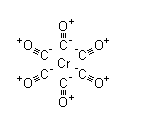
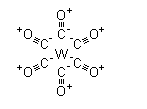
| 分子结构 |  |
| CAS编号 | 14040-11-0 |
| EINECS Number | 237-880-2 |
| MDL Number | MFCD00011462 |
| Beilstein Registry Number | No data available |
| 别名 | tungsten hexacarbonyl, hexa-carbonyltungstate(0), hexacarbonyl tungsten(0), tungsten(0) hexacarbonyl, hexacarbonyltungsten(0), hexacarbonyltungsten(O), hexacarbonyl tungsten;CAS Number: 14040-11-0;CAS No.: 14040-11-0 |
| 分子式 | C6O6W |
| 分子量 | 351.9 |
| InChI | InChI=1S/6CO.W/c6*1-2; |
| InChI Key | FQNHWXHRAUXLFU-UHFFFAOYSA-N |
| Canonical SMILES | [C-]#[O+].[C-]#[O+].[C-]#[O+].[C-]#[O+].[C-]#[O+].[C-]#[O+].[W] |
| Patent Information | ||
| Patent ID | Title | Publication Date |
| US2016/24119 | ELECTRONIC DEVICE COMPRISING METAL COMPLEXES | 2016 |
| EP2733148 | Tungsten complexes with di-dentate ligands | 2014 |
Physical Data
| Appearance | White crystalline powder |
| Solubility | insoluble |
| Flash Point | 200°C |
| Sensitivity | 4: no reaction with water under neutral conditions |
| Density, g·cm-3 | Measurement Temperature, °C | Type (Density) |
| 2.65 | 19.84 | crystallographic |
| Description (Association (MCS)) |
| Association with compound |
Spectra
| Description (NMR Spectroscopy) | Nucleus (NMR Spectroscopy) | Solvents (NMR Spectroscopy) | Temperature (NMR Spectroscopy), °C |
| Spectrum | 13C | benzene-d6 | |
| Chemical shifts | 13C | benzene-d6 | 21.84 |
| 13C | chloroform-d1 | 25 | |
| 13C | not given | ||
| Spectrum | 13C | (2)H8-toluene | -30 |
| Linewidth of NMR absorption | 13C | CDCl3 | 30 |
| Linewidth of NMR absorption | 17O | CDCl3 | 21 |
| Spectrum | 183W | solid |
| Description (IR Spectroscopy) | Solvent (IR Spectroscopy) | Temperature (IR Spectroscopy), °C | Signals, cm-1 |
| ATR (attenuated total reflectance), Bands | |||
| Bands | hexane | ||
| Intensity of IR bands, Bands | potassium bromide | ||
| Bands | hexane | 1983 | |
| Bands | KBr | 1977 | |
| Bands | potassium bromide | 1982 | |
| Bands | gas | 1.84 – 151.84 | |
| Bands | polyethylene | -83.16 | 1980.3 |
| Description (Mass Spectrometry) | Comment (Mass Spectrometry) |
| electron impact (EI), spectrum | |
| Spectrum | Fragmentation pattern |
| Spectrum | Molecular peak, Fragmentation pattern |
| Fragmentation pattern | |
| Molecular peak | |
| Molecular peak, Fragmentation pattern |
| Description (UV/VIS Spectroscopy) | Solvent (UV/VIS Spectroscopy) | Comment (UV/VIS Spectroscopy) | Absorption Maxima (UV/VIS), nm |
| Spectrum | hexane | 195 nm – 500 nm | |
| Spectrum | tetrahydrofuran | 300 nm – 450 nm | |
| Spectrum, Band assignment | hexane | 375 nm – 720 nm | |
| Band assignment | methylene chloride=methylene dichloride | 226 nm – 286 nm | |
| Spectrum, Band assignment | cyclohexane | 100 nm – 355 nm | |
| Band assignment | methylene chloride=methylene dichloride | 288.6 | |
| Spectrum, Band assignment | methyl cyclohexane | 300 nm – 600 nm | |
| Spectrum, Band assignment | acetonitrile | 212.766 nm – 322.581 nm |
| Description (Raman Spectroscopy) |
| Bands |
| Raman |
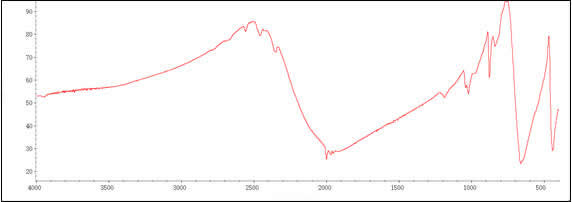
| Tungsten hexacarbonyl CAS#: 14040-11-0 IR | 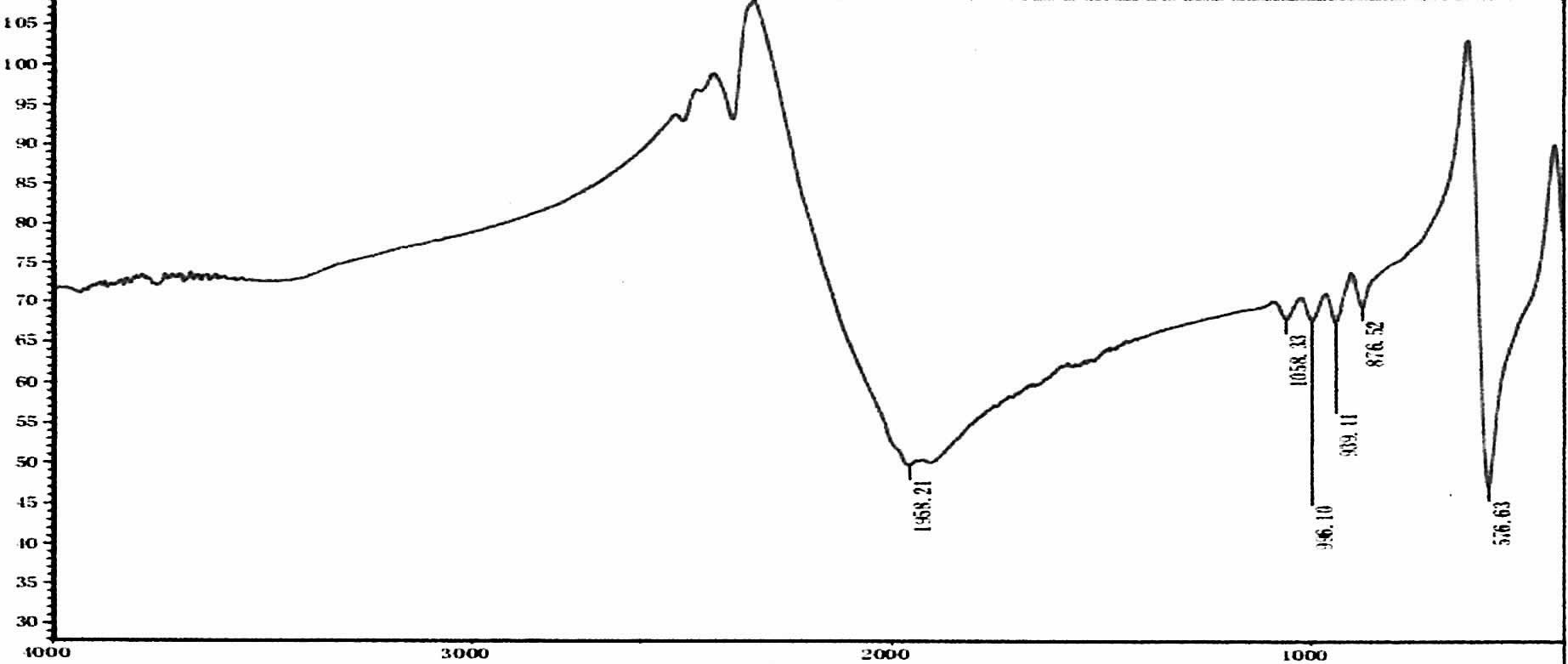 |
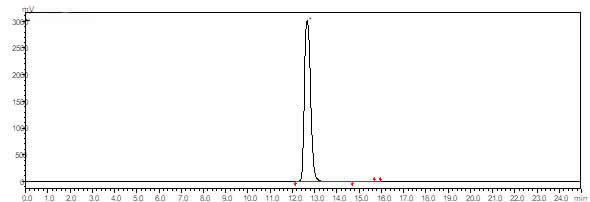
| Tungsten hexacarbonyl CAS#: 14040-11-0 XRD |  |
Route of Synthesis (ROS)
| Conditions | Yield |
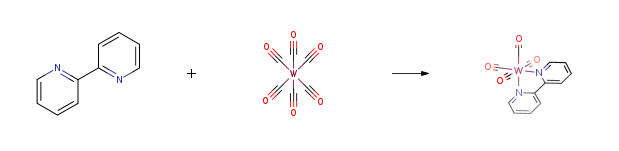
| With trimethylamine-N-oxide In methanol; benzene byproducts: CO; addn. of soln. of TMNO in methanol to soln. of W(CO)6 in benzene, stirring, then addn. of bipy, stirring, 18h, 28°C, evapn., filtration; recrystn. from CH2Cl2/hexane; elem. anal.; | 97% |
| In hexane Irradiation (UV/VIS); under N2, excess 2,2′-bipyridine, photolysis with a 200 W Hg lamp; pptn. washed with n-hexane, column chromy. on alumina, recrystn. (CH2Cl2/hexane); | 80% |
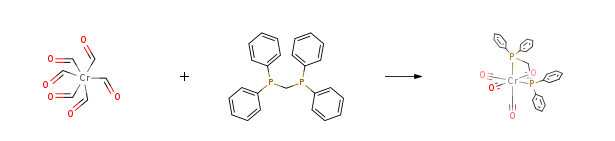
| With sodium tetrahydroborate In butan-1-ol at 105℃; under 760.051 Torr; for 0.333333h; Microwave irradiation; Inert atmosphere; Green chemistry; Experimental Procedure General Preparation of Mo(CO)4dppe, 2c General procedure: The reactions were run in a CEM Corp. MARS microwave fitted with a fiber optic temperature probe and a port on top for a reflux condenser.1 mmol of Mo(CO)6 and dppe (0.425 g, 1.1 mmol) were combined with 20 mL of 1-propanol in a two-neck 100 mL RB flask. To this mixture was added NaBH4 (0.128 g, 3.3 mmol). The flaskwas placed in themicrowave and a reflux condenser attached through a hole in the top of the microwave. The mixture was sparged with nitrogen. The mixture was heated under nitrogen at 400 W for 1.5 min to reach reflux temperature. Once the reflux temperature was reached the microwave power was reduced and the temperature maintained for 18 min. The mixture was cooled to room temperature and 2-4 mL of water was added to the reaction to dissolve excess NaBH4 and promote product precipitation. The reaction was cooled -10 °C for several hours. The light yellow complex was filtered in air and washed with 2×5 mL of petroleum ether/diethyl ether(1:1) mixture resulting in 580 mg of Mo(CO)4dppe after drying, a 95% yield. | 80% |
Safety and Hazards
| GHS Hazard Statements | Not Classified |
| SDS Download | English Version |
Other Data
| Transportation | Class 6.1; Packaging Group: III; UN Number: 3466 |
| Under the room temperature and away from light | |
| HS Code | 293190 |
| Storage | Under the room temperature and away from light |
| Shelf Life | 1 year |
| Market Price | USD |
| Druglikeness | |
| Lipinski rules component | |
| 分子量 | 351.912 |
| HBA | 6 |
| HBD | 0 |
| Matching Lipinski Rules | 3 |
| Veber rules component | |
| Polar Surface Area (PSA) | 0 |
| Rotatable Bond (RotB) | 0 |
| Matching Veber Rules | 2 |
| Use Pattern |
| Chemical processes/laboratory use |
| catalyst in method of making a 2-(2,3-epoxypropyl)phenol |
| Contrast agent in diagnostic imaging |
| Contrast agent in X-ray imaging of atherosclerotic plaque |
| Contrast agent in X-ray imaging of liver tumors |
| X-ray contrast agent |
| Contrast agent in vivo imaging of kupffer cells |
| Purity Calculation |
| Tungsten hexacarbonyl partially dissolves in mixed acids and cannot be directly determined by ICP for the tungsten content in the product. Therefore, impurities in tungsten hexacarbonyl are first dissolved out by mixed acids, and the impurity content in the pure tungsten hexacarbonyl is tested by ICP. The purity of tungsten hexacarbonyl is obtained using the impurity reduction method. |
| The theoretical content of tungsten in tungsten hexacarbonyl is |
| 52.23% [183.8 (AW of tungsten) / 351.9 (MW of tungsten hexacarbonyl)] |