Anti-C-Reactive Protein (CRP) Antibody
By great_watson-int,
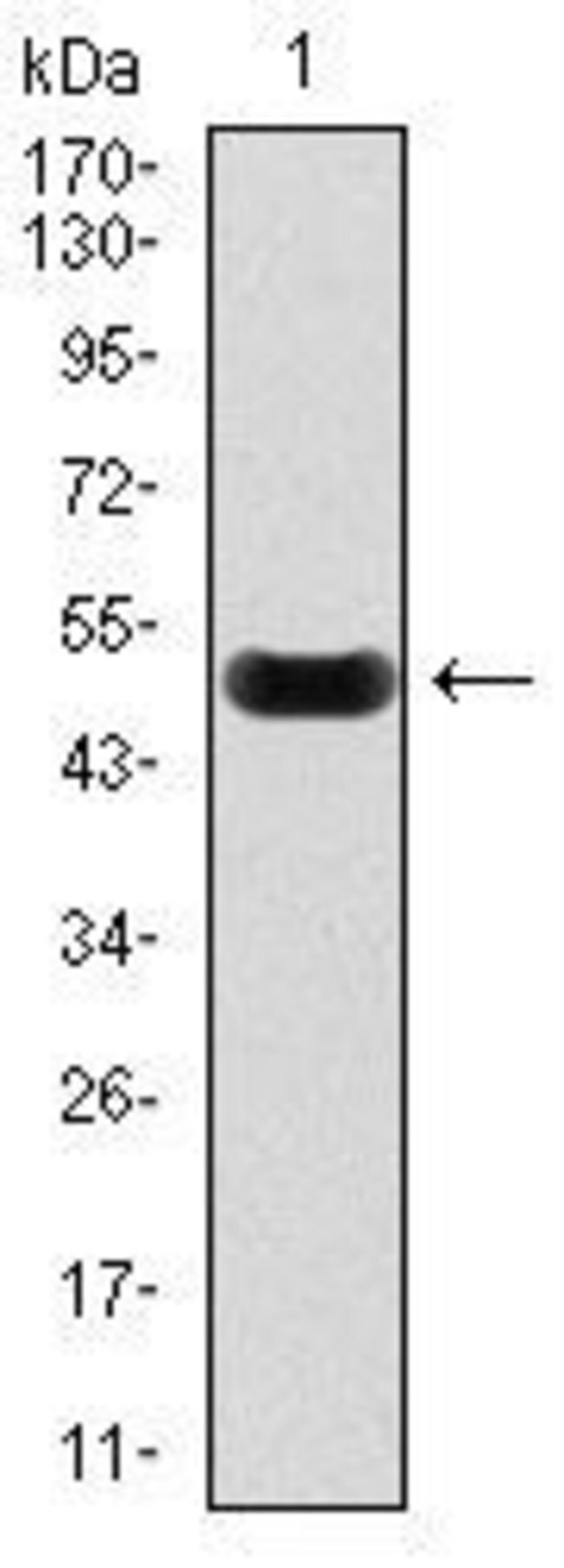
Anti-C-Reactive Protein (CRP) Antibody WB
AntigenDescriptionProperties
Safety InformationImagesOther Info

Antigen

NameC-Reactive Protein (CRP)
别名CRP; PTX1; C-reactive protein; pentraxin-related; pentraxin 1

Description

NameAnti-C-Reactive Protein (CRP) Antibody
别名C-Reactive Protein; C-reactive protein, pentraxin-related; CRP; MGC88244; pentraxin 1
HostMouse; Goat; Rabbit
ReactivityAll species
Antibody Product Type  Primary
UseDetection; Capture
Conjugate Unconjugated; Biotin; APC; Alkaline Phosphatase (AP); FITC; HRP; PE
SpecifityThe antibody is raised against CRP. It has been selected for its ability to recognize CRP.
ApplicationELISA; Immunohistochemistry (IHC); Western Blotting (WB); Immunofluorescence (fixed cells) (IF/ICC); Immunoprecipitation (IP); Cell-ELISA (cELISA); Immunoassay (IA); Immunocytochemistry (ICC)

Properties

FormLiquid/Lyophilized
HandlingThe antibody solution should be gently mixed before use.
Storage ConditionStore at 4°C for frequent use. Stored at -20°C in a manual defrost freezer for a year without detectable loss of activity. Avoid repeated freeze-thaw cycles.
ClonalityMonoclonal/Polyclonal
IsotypeIgG

Safety Information

RIDADRNONH for all modes of transport
Flash Point(F) Not applicable
Flash Point(C) Not applicable

Images

Anti-C-Reactive Protein (CRP) Antibody in WBAnti-C-Reactive Protein (CRP) Antibody WB
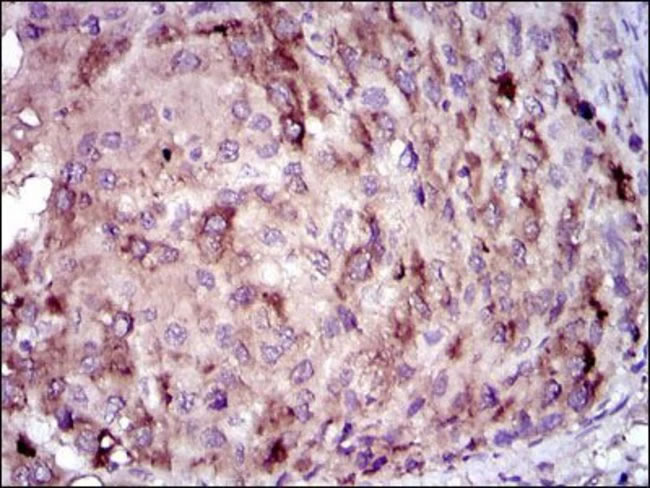
Anti-C-Reactive Protein (CRP) Antibody in IHCAnti-C-Reactive Protein (CRP) Antibody IHC
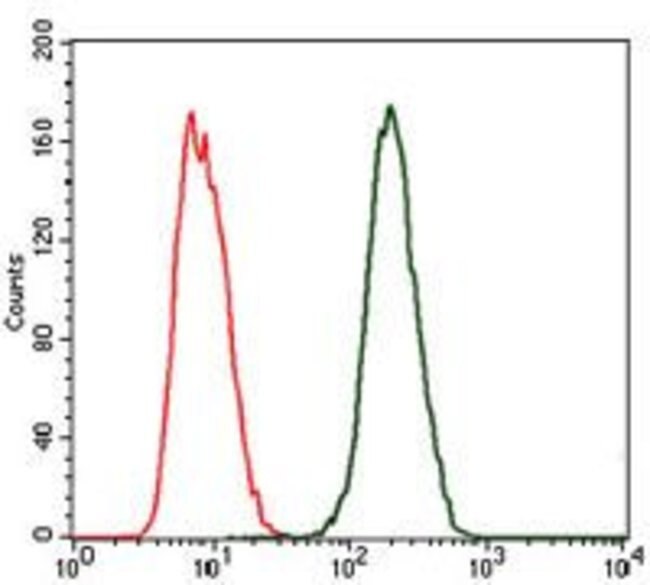
Anti-C-Reactive Protein (CRP) Antibody in flowAnti-C-Reactive Protein (CRP) Antibody in flow

Other Info

About the antigenCRP is a plasma protein involved in host defense by promoting agglutination, bacterial capsular swellling, phagocytosis and complement fixation through its calcium-dependent binding to phosphorylcholine. It also scavenges nuclear material released from damaged circulating cells. The concentration of CRP in plasma increases greatly during acute phase response to tissue injury, infection or other inflammatory stimuli. CRP has two isoforms produced by alternative splicing. CRP is synthesized by the liver in response to factors released by fat cells. It is a member of the pentraxin family of proteins. The levels of CRP rise in response to inflammation. Human C-reactive protein (CRP) is the classical acute phase reactant, the circulating concentration of which rises rapidly and extensively in a cytokine-mediated response to tissue injury, infection and inflammation. Serum CRP values are routinely measured, empirically, to detect and monitor many human diseases. However, CRP is likely to have important host defence, scavenging and metabolic functions through its capacity for calcium-dependent binding to exogenous and autologous molecules containing phosphocholine (PC) and then activating the classical complement pathway. CRP may also have pathogenic effects and the recent discovery of a prognostic association between increased CRP production and coronary atherothrombotic events is of particular interest.

Anti-Serum Amyloid A (SAA) Antibody

By great_watson-int,
Anti-Serum Amyloid A (SAA) Antibody WB
AntigenDescriptionProperties
Safety InformationImagesOther Info

Antigen

NameSerum Amyloid A (SAA)
别名SAA; PIG4; SAA2; TP53I4

Description

NameAnti-Serum Amyloid A (SAA) Antibody
别名Anti-SAA1; Serum Amyloid A Antibody IHC-plus; Serum amyloid A protein; Serum Amyloid A; Serum amyloid A-1 protein; SAA; Serum amyloid A1; PIG4; Human SAA1; SAA; Serum Amyloid A
HostMouse; Goat; Rabbit
ReactivityAll species
Antibody Product Type  Primary
UseDetection; Capture
Conjugate Unconjugated; Biotin; APC; Alkaline Phosphatase (AP); FITC; HRP; PE
SpecifityRecognizes natural and recombinant human SAA. Does not show any cross-reactivity with other human cytokines or growth factors tested such as IL-1b, IL-8, MCAF, TGF-b and EGF.
ApplicationELISA; Immunohistochemistry (IHC); Western Blotting (WB); Immunofluorescence (fixed cells) (IF/ICC); Immunoprecipitation (IP); Cell-ELISA (cELISA); Immunoassay (IA); Immunocytochemistry (ICC)

Properties

FormLiquid/Lyophilized
HandlingThe antibody solution should be gently mixed before use.
Storage ConditionStore at 4°C for frequent use. Stored at -20°C in a manual defrost freezer for a year without detectable loss of activity. Avoid repeated freeze-thaw cycles.
ClonalityMonoclonal/Polyclonal
IsotypeIgG

Safety Information

RIDADRNONH for all modes of transport
Flash Point(F) Not applicable
Flash Point(C) Not applicable

Images

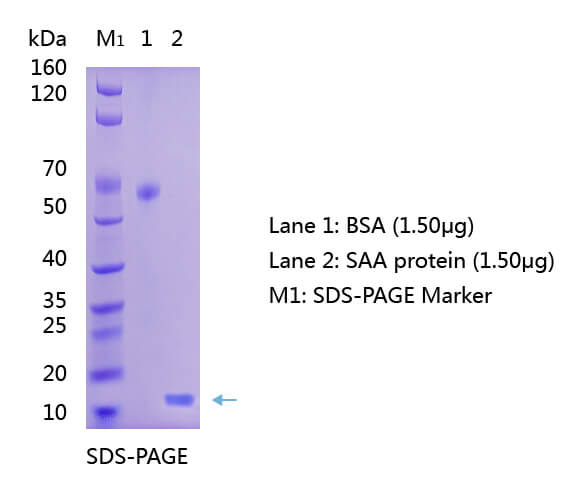
Anti-Serum Amyloid A Antibody WBAnti-Serum Amyloid A (SAA) Antibody WB
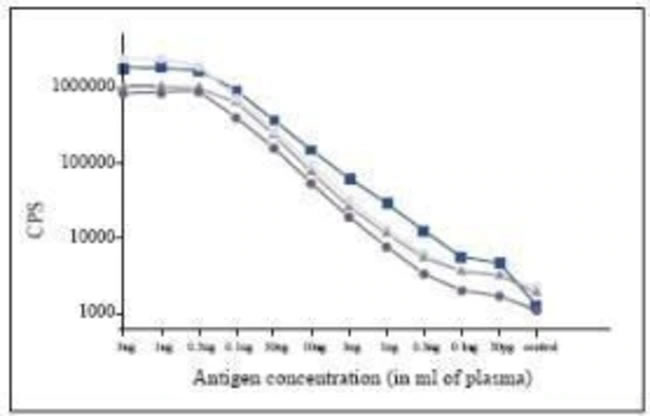
Turbidimetric Fit CurveSAA turbidimetric fit curve
Anti-Serum Amyloid A Antibody IHCAnti-Serum Amyloid A (SAA) Antibody IHC

Other Info

About the antigenSerum amyloid A proteins are a family of apolipoproteins associated with high-density lipoprotein (HDL) in plasma. Different isoforms are expressed constitutively at different levels or in response to inflammatory stimuli. The serum amyloid A family comprises a number of differentially expressed apolipoproteins, acute-phase SAA1 and SAA2, the former being the major component in plasma and constitutive SAAs. Although the liver is the primary site of synthesis of both SAA types extrahepatic production has been reported. The in vivo concentrations increase by as much as 1000 fold during inflammation. Several studies have expressed its importance in the diagnosis and monitoring of various diseases. Pathological SAA values are often detected in association with normal CRP concentrations; It rises earlier and more sharply than CRP. Recently, a broader view of SAA expression and function has been emerging.

Anti-PCT (Procalcitonin CAS#: 56645-65-9) antibody

By great_watson-int,
Anti-PCT antibody in ELISA
AntigenDescriptionProperties
Safety InformationImagesOther Info

Antigen

NamePCT (Procalcitonin)
别名KC; CGRP-I; Calcitonin gene-related peptide 1; CGRP1; CALC1; Calcitonin gene-related peptide I; Alpha-type CGRP; CGRP; CT; calcitonin-related polypeptide alpha; Anti-PCT antibody
SequenceAPFRSALESSPADPATLSEDEARLLLAALVQDYVQMKASELEQEQEREGSSLDSPRSKRCGNLSTCMLGTYTQDFNKFHTFPQTAIGVGAPGKKRDMSSDLERDHRPHVSMPQNAN

Description

NameAnti-PCT antibody
别名Procalcitonin antibody; Anti-Procalcitonin antibody; PCT antibody; PCT antibody; Procalcitonin receptor antibody; Procalcitonin receptor antibody; Procalcitonin antibody; Anti Procalcitonin antibody
HostMouse; Goat; Rabbit
ReactivityAll species
Antibody Product Type  Primary
UseDetection; Capture
Conjugate Unconjugated; Biotin; APC; Alkaline Phosphatase (AP); FITC; HRP; PE
SpecifityThe antibody is an antibody raised against PCT. It has been selected for its ability to recognize PCT.
ApplicationELISA; Immunohistochemistry (IHC); Western Blotting (WB); Immunofluorescence (fixed cells) (IF/ICC); Immunoprecipitation (IP); Cell-ELISA (cELISA); Immunoassay (IA); Immunocytochemistry (ICC)

Properties

FormLiquid/Lyophilized
HandlingThe antibody solution should be gently mixed before use.
Storage ConditionStore at 4°C for frequent use. Stored at -20°C in a manual defrost freezer for a year without detectable loss of activity. Avoid repeated freeze-thaw cycles.
ClonalityMonoclonal/Polyclonal
IsotypeIgG

Safety Information

RIDADRNONH for all modes of transport
Flash Point(F) Not applicable
Flash Point(C) Not applicable

Images

Anti-PCT antibody in ELISAAnti-PCT antibody in ELISA
Anti-PCT antibody in WBAnti-PCT antibody in WB

Other Info

About the antigenProcalcitonin (PCT) is a 116 amino acid residue peptide with molecular weight of about 13 kDa. PCT itself has no known hormonal activity. PCT belongs to a group of related proteins including calcitonin gene-related peptides I and II, amylin, adrenomodulin and calcitonin (CAPA peptide family). PCT, like other peptides of CAPA family, appears from the common precursor pre-procalcitonin consisting of 141 amino acids by removal of 25 amino acids from the N-terminus. PCT undergoes successive cleavages to form three molecules: N-terminal fragment (55 a.a.), calcitonin (32 a.a.) and katacalcin (21 a.a.). Under normal metabolic conditions, PCT is only present in the C cells of the thyroid gland. In bacterial infection and sepsis, however, intact PCT is found in the blood and, more importantly, its level is related to the severity of bacterial sepsis. Today, PCT is considered to be one of the earliest and most specific markers of sepsis.