Z-8-Dodecenyl acetate/E-8-Dodecenyl acetate/Z-8-Dodecenol
By Janice Zhang,
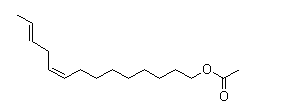
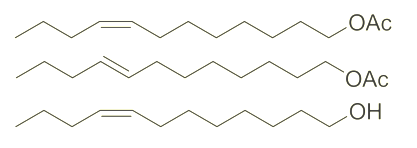
Structure of Z-8-Dodecenyl acetateE-8-Dodecenyl acetateZ-8-Dodecenol CAS WPNA-0001
IdentificationPhysical DataSpectra
Route of Synthesis (ROS)Safety and HazardsOther Data

Identification

英文名Z-8-Dodecenyl acetate/E-8-Dodecenyl acetate/Z-8-Dodecenol
IUPAC NameNo data available
分子结构Structure of Z-8-Dodecenyl acetateE-8-Dodecenyl acetateZ-8-Dodecenol CAS WPNA-0001
CAS编号 None
MDL NumberNo data available
别名8Z-12Ac/8E-12Ac/8Z-12OH
分子式C16H26O2
分子量250.376
InChINo data available
InChI KeyNo data available
Canonical SMILESNo data available
Patent Information
No data available

Physical Data

AppearanceColorless or light yellow oil

Spectra

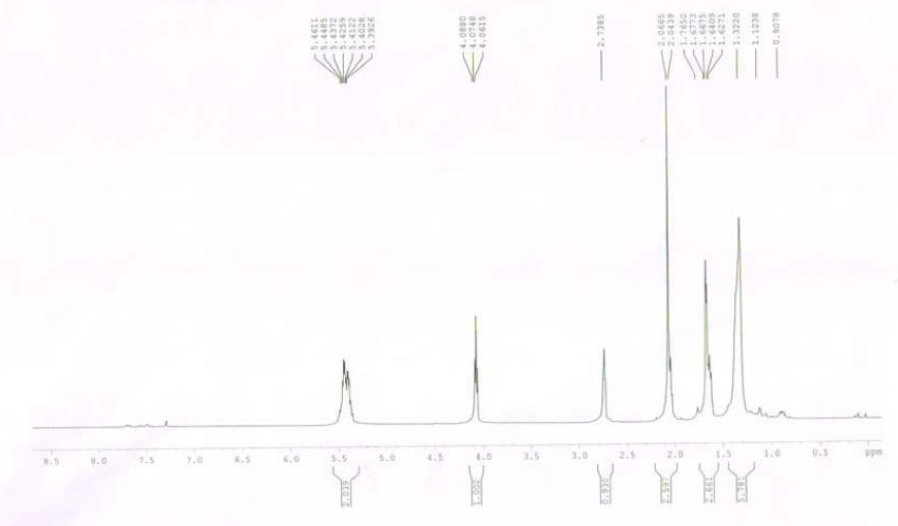
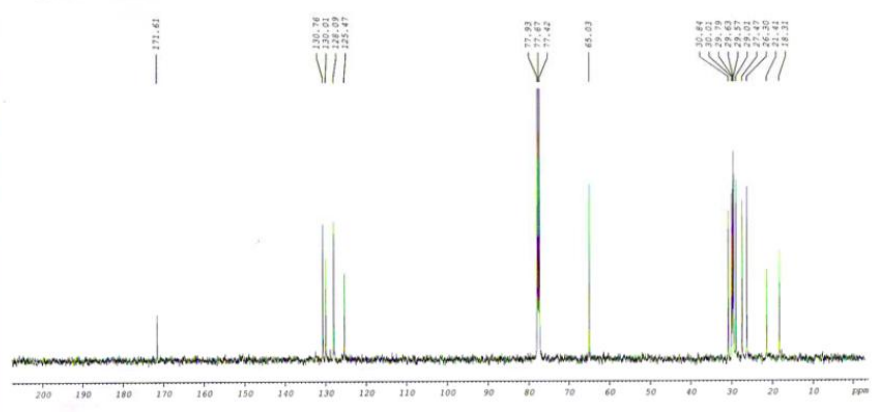
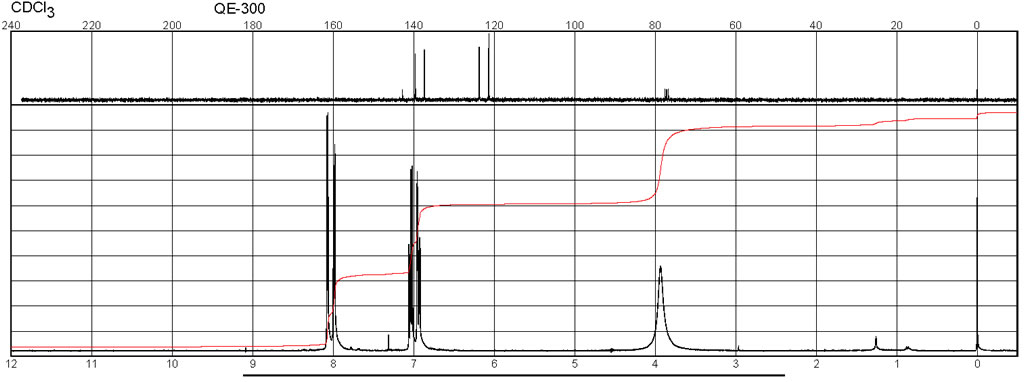
Z-8-Dodecenyl acetate/E-8-Dodecenyl acetate/Z-8-Dodecenol GCGC of Z-8-Dodecenyl acetateE-8-Dodecenyl acetateZ-8-Dodecenol CAS WPNA-0001

Route of Synthesis (ROS)

No data available

Safety and Hazards

GHS Hazard StatementsNot Classified
For more detailed information, please visit ECHA C&L website
Source: European Chemicals Agency (ECHA)
License Note: Use of the information, documents and data from the ECHA website is subject to the terms and conditions of this Legal Notice, and subject to other binding limitations provided for under applicable law, the information, documents and data made available on the ECHA website may be reproduced, distributed and/or used, totally or in part, for non-commercial purposes provided that ECHA is acknowledged as the source: “Source: European Chemicals Agency, http://echa.europa.eu/”. Such acknowledgement must be included in each copy of the material. ECHA permits and encourages organisations and individuals to create links to the ECHA website under the following cumulative conditions: Links can only be made to webpages that provide a link to the Legal Notice page.
License URL: https://echa.europa.eu/web/guest/legal-notice
Record Name: (1-Cyano-2-ethoxy-2-oxoethylidenaminooxy)dimethylamino-morpholino-carbenium hexafluorophosphate
URL: https://echa.europa.eu/information-on-chemicals/cl-inventory-database/-/discli/details/213446
Description: The information provided here is aggregated from the “Notified classification and labelling” from ECHA’s C&L Inventory. Read more: https://echa.europa.eu/information-on-chemicals/cl-inventory-database

Other Data

TransportationNot dangerous goods
Under the room temperature and away from light
StorageUnder the room temperature and away from light
Market PriceUSD
Use Pattern
Z-8-Dodecenyl acetate/E-8-Dodecenyl acetate/Z-8-Dodecenol is used as a pheromone, used in Oriental fruit moth, Carambola fruit borer, Macadamia borer, False codling moth, Plum fruit moth, Small fruit tortrix, as well as other lepidoptera…

Peachflure CAS#: 63408-44-6

By great_watson-int,
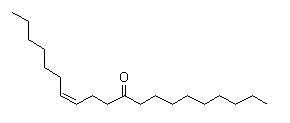
Structure of Peachflure CAS 63408-44-6
IdentificationPhysical DataSpectra
Route of Synthesis (ROS)Safety and HazardsOther Data

Identification

英文名Peachflure
IUPAC Name(Z)-icos-13-en-10-one
分子结构Structure of Peachflure CAS 63408-44-6
CAS编号 63408-44-6
别名(13Z)-eicos-13-en-10-one, (Z)-13-eicosene-10-one, Z-icos-13-en-10-one, eicos-13c-en-10-one, cis-7-eicosen-11-one, Z-13-icosane-10-one
分子式C20H38O
分子量294.515
InChIInChI=1S/C20H38O/c1-3-5-7-9-11-13-15-17-19-20(21)18-16-14-12-10-8-6-4-2/h13,15H,3-12,14,16-19H2,1-2H3/b15-13-
InChI KeyHVUBXNQWXJBVHB-SQFISAMPSA-N
Canonical SMILESO=C(CCCCCCCCC)CC\C=C/CCCCCC
Patent Information
No data available

Physical Data

AppearanceColorless or light yellow oil
Boiling Point172 °C(Press: 1 Torr)
Melting Point, °C
21~22
Boiling Point, °CPressure (Boiling Point), Torr
155 – 1584-5
1590.7
1600.7
1610.7
1721
135-1400.4
Refractive IndexWavelength (Refractive Index), nmTemperature (Refractive Index), °C
1.454558920
1.454458920
1.454658920
1.460858920
1.454258920

Spectra

Description (NMR Spectroscopy)Nucleus (NMR Spectroscopy)Solvents (NMR Spectroscopy)Frequency (NMR Spectroscopy), MHz
Chemical shifts, Spectrum1Hchloroform-d1400
Chemical shifts, Spectrum13Cchloroform-d1100
Chemical shifts1Hchloroform-d1300
Chemical shifts13Cchloroform-d175
Chemical shifts1HCDCl3
Chemical shifts13CCDCl3
Chemical shifts1HCCl4
Chemical shifts13CCCl4
Spin-spin coupling constantsCCl4
Spin-spin coupling constantsCDCl3
NMR
Peachflure CAS#: 63408-44-6 HNMRHNMR of Peachflure CAS 63408-44-6
Peachflure CAS#: 63408-44-6 CNMRCNMR of Peachflure CAS 63408-44-6
Description (IR Spectroscopy)Solvent (IR Spectroscopy)Comment (IR Spectroscopy)
BandsCHCl33020 – 720 cm**(-1)
Bandsneat (no solvent)1725 cm**(-1)
BandsCCl43015 – 1725 cm**(-1)
Bandsneat (no solvent)1720 – 730 cm**(-1)
IR
Description (Mass Spectrometry)
spectrum
gas chromatography mass spectrometry (GCMS), spectrum
spectrum, electron impact (EI)

Route of Synthesis (ROS)

Route of Synthesis (ROS) of Peachflure CAS 63408-44-6
ConditionsYield
With hydrogen In hexane; ethyl acetate at 20℃;

Experimental Procedure
General procedure: To a solution of 20a-b (0.2 mmol) and quinolone (0.4 mmol) in ethyl acetate/hexane (5 mL/5 mL) atroom temperature was added 5% Pd/CaCO3 (0.02 mmol), and this was stirred under a H2 atmosphere.The reaction was monitored by 1H NMR, and when it was completed, the mixture was filtered andconcentrated under reduced pressure to afford 16a-b.
97%

Safety and Hazards

GHS Hazard StatementsNot Classified
For more detailed information, please visit ECHA C&L website
Source: European Chemicals Agency (ECHA)
License Note: Use of the information, documents and data from the ECHA website is subject to the terms and conditions of this Legal Notice, and subject to other binding limitations provided for under applicable law, the information, documents and data made available on the ECHA website may be reproduced, distributed and/or used, totally or in part, for non-commercial purposes provided that ECHA is acknowledged as the source: “Source: European Chemicals Agency, http://echa.europa.eu/”. Such acknowledgement must be included in each copy of the material. ECHA permits and encourages organisations and individuals to create links to the ECHA website under the following cumulative conditions: Links can only be made to webpages that provide a link to the Legal Notice page.
License URL: https://echa.europa.eu/web/guest/legal-notice
Record Name: (1-Cyano-2-ethoxy-2-oxoethylidenaminooxy)dimethylamino-morpholino-carbenium hexafluorophosphate
URL: https://echa.europa.eu/information-on-chemicals/cl-inventory-database/-/discli/details/213446
Description: The information provided here is aggregated from the “Notified classification and labelling” from ECHA’s C&L Inventory. Read more: https://echa.europa.eu/information-on-chemicals/cl-inventory-database

Other Data

TransportationNo data available
Under the room temperature and away from light
StorageUnder the room temperature and away from light
Market PriceUSD
Druglikeness
Lipinski rules component
分子量294.521
logP8.71
HBA1
HBD0
Matching Lipinski Rules3
Veber rules component
Polar Surface Area (PSA)17.07
Rotatable Bond (RotB)16
Matching Veber Rules1
Bioactivity
In vitro: Efficacy
Quantitative Results
1 of 1Resultscomponent of sex pheromone of peach moth Carposina niponensis W.
Use Pattern
Often used as a pheromone
used in Peach Fruit Moth.
used in Carposina niponensis.

TRANS-7, CIS-9-DODECADIENYL ACETATE CAS#: 55774-32-8

By great_watson-int,
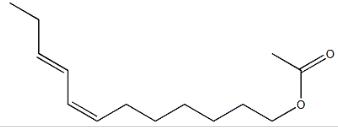
Structure of TRANS-7, CIS-9-DODECADIENYL ACETATE CAS# 55774-32-8
IdentificationPhysical DataSpectra
Route of Synthesis (ROS)Safety and HazardsOther Data

Identification

英文名TRANS-7, CIS-9-DODECADIENYL ACETATE
IUPAC Name[(7Z,9E)-dodeca-7,9-dienyl] acetate
分子结构Structure of TRANS-7, CIS-9-DODECADIENYL ACETATE CAS# 55774-32-8
CAS编号 55774-32-8
EINECS Number259-812-0
MDL NumberMFCD00009870
别名(7Z,9E)-7,9-dodecadien-1-yl acetate, (7Z, 9E)-dodecadien-1-yl acetate, (7Z,9E)-7,9-dodecadienyl acetate, (7Z,9E)-7,9-Dodecadienylacetat, (Z,E)-7,9-Dodecadienyl acetate, (7Z,9E)-dodecadienyl acetate, 7,9-dodecadienyl acetate;CAS Number: 55774-32-8
分子式C14H24O2
分子量224.339
InChIInChI=1S/C14H24O2/c1-3-4-5-6-7-8-9-10-11-12-13-16-14(2)15/h4-7H,3,8-13H2,1-2H3/b5-4-,7-6+
InChI KeyLLRZUAWETKPZJO-SCFJQAPRSA-N
Canonical SMILESCC/C=C\C=C\CCCCCCOC(=O)C
Patent Information
No data available

Physical Data

AppearanceColorless or light yellow oil
Solubility2.0 mg l-1(20 °C, est.)
Flash Point61ºC
Boiling Point309.6±21.0 °C(Predicted)

Spectra

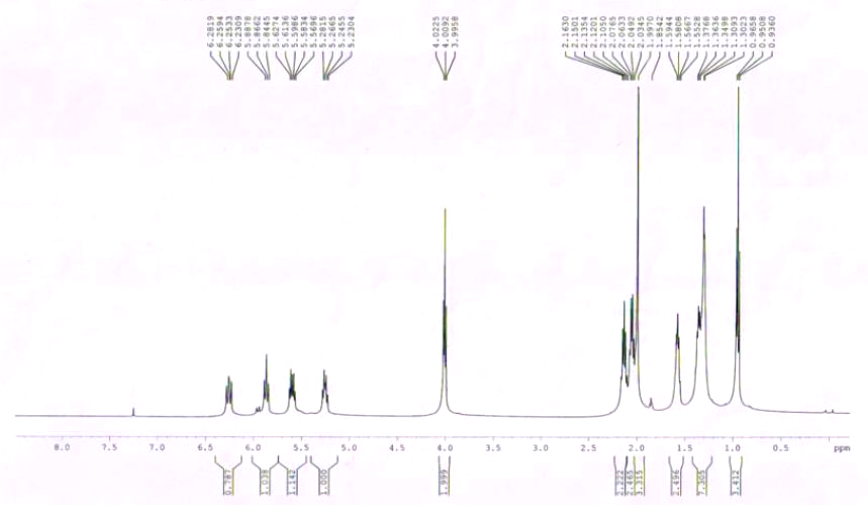
TRANS-7, CIS-9-DODECADIENYL ACETATE CAS# 55774-32-8 NMRHNMR of TRANS-7, CIS-9-DODECADIENYL ACETATE CAS# 55774-32-8
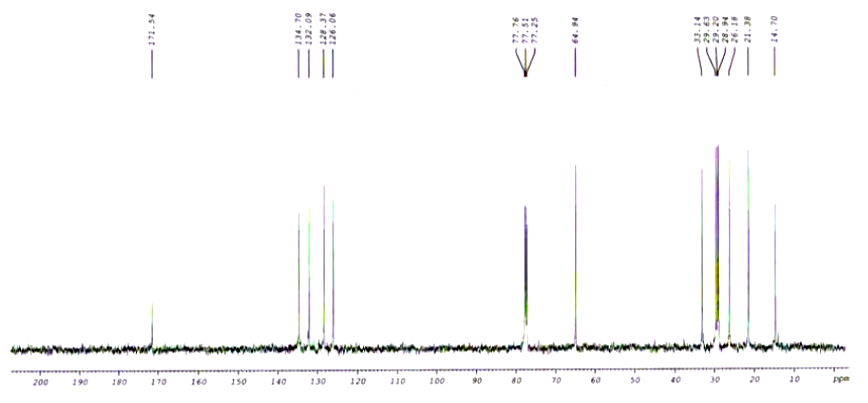
TRANS-7, CIS-9-DODECADIENYL ACETATE CAS# 55774-32-8 CNMRCNMR of 7E, 9Z-TRANS-7, CIS-9-DODECADIENYL ACETATE CAS# 55774-32-8
Description (Mass Spectrometry)
high resolution mass spectrometry (HRMS), spectrum
Spectrum
electron impact (EI), spectrum

Route of Synthesis (ROS)

Route of Synthesis (ROS) of TRANS-7, CIS-9-DODECADIENYL ACETATE CAS# 55774-32-8
ConditionsYield
With dmap; triethylamine at 20℃; for 3h; Overall yield = 43 %; Overall yield = 0.95 g;

Experimental Procedure
1.5 Step 5
In a flask, (7E, 9Z) -dodeca-7,9-dien-1-ol (1.60 g) obtained in Step 4 was added.Acetic anhydride (0.99 g),Triethylamine (0.98 g),4-Dimethylaminopyridine (1.1 mg) was added and stirred at room temperature for 3 hours. After adding water and stirring for 30 minutes, t-butyl methyl ether (ml) was added to separate the solution, and the organic layer was washed with water, dried over sodium sulfate, filtered, and the filtrate was concentrated under reduced pressure using an evaporator. Obtained (GC purity 67%, yield 58%). Subsequently, the mixture was purified by silica gel column chromatography (silica gel 60 (68 ml), heptane / ethyl acetate = 10/1), and an isomer mixture containing (7E, 9Z) -dodec-7,9-dien-1-yl acetate (0. 95 g, GC purity 90%) was obtained with a yield of 43%.Isomer ratio is 7Z9E: 7E9Z: 7Z9Z: 7E9E = 12: 36: 41: 11It was.
99%

Safety and Hazards

Pictogram(s)exclamation-markenvironment
SignalWarning
GHS Hazard StatementsH315 (100%): Causes skin irritation [Warning Skin corrosion/irritation]
H319 (50.56%): Causes serious eye irritation [Warning Serious eye damage/eye irritation]
H411 (96.11%): Toxic to aquatic life with long lasting effects [Hazardous to the aquatic environment, long-term hazard]
Information may vary between notifications depending on impurities, additives, and other factors.
Precautionary Statement CodesP264, P273, P280, P302+P352, P305+P351+P338, P321, P332+P313, P337+P313, P362, P391, and P501
(The corresponding statement to each P-code can be found at the GHS Classification page.)
For more detailed information, please visit ECHA C&L website
Source: European Chemicals Agency (ECHA)
License Note: Use of the information, documents and data from the ECHA website is subject to the terms and conditions of this Legal Notice, and subject to other binding limitations provided for under applicable law, the information, documents and data made available on the ECHA website may be reproduced, distributed and/or used, totally or in part, for non-commercial purposes provided that ECHA is acknowledged as the source: “Source: European Chemicals Agency, http://echa.europa.eu/”. Such acknowledgement must be included in each copy of the material. ECHA permits and encourages organisations and individuals to create links to the ECHA website under the following cumulative conditions: Links can only be made to webpages that provide a link to the Legal Notice page.
License URL: https://echa.europa.eu/web/guest/legal-notice
Record Name: (1-Cyano-2-ethoxy-2-oxoethylidenaminooxy)dimethylamino-morpholino-carbenium hexafluorophosphate
URL: https://echa.europa.eu/information-on-chemicals/cl-inventory-database/-/discli/details/213446
Description: The information provided here is aggregated from the “Notified classification and labelling” from ECHA’s C&L Inventory. Read more: https://echa.europa.eu/information-on-chemicals/cl-inventory-database

Other Data

TransportationNo data available
Under the room temperature and away from light
HS CodeNo data available
StorageUnder the room temperature and away from light
Shelf Life1 year
Market PriceUSD
Druglikeness
Lipinski rules component
分子量224.343
logP5.183
HBA2
HBD0
Matching Lipinski Rules3
Veber rules component
Polar Surface Area (PSA)26.3
Rotatable Bond (RotB)10
Matching Veber Rules2
Bioactivity
In vitro: Efficacy
Quantitative Results
1 of 1Assay DescriptionEffect : pheromone activity
Target : Idaea biselata, geometrid moth
Bioassay : delta traps hung ca. 1 m above the ground and set at least 2 m apart; traps hung on the tree twigs or placed in low bushes and checked once a week; red rubber septa as dispensers field trapping tests; in hexane; in the Hagadal and Nasten regions of Uppsala in south-central Sweden from July 4 to August 21, 1993
ResultsI. biselata captured: 5
Use Pattern
Insect attractant
pheromone
chemical attractant

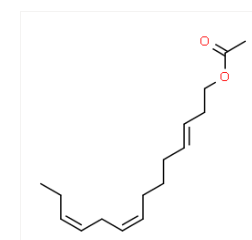
E3,Z8,Z11-Tetradecatriene acetate CAS#: 163041-94-9

By great_watson-int,
Structure of E3,Z8,Z11-Tetradecatriene acetate CAS 163041-94-9
IdentificationPhysical DataSpectra
Route of Synthesis (ROS)Safety and HazardsOther Data

Identification

英文名E3,Z8,Z11-Tetradecatriene acetate
IUPAC Name[(3E,8Z,11Z)-tetradeca-3,8,11-trienyl] acetate
分子结构Structure of E3,Z8,Z11-Tetradecatriene acetate CAS 163041-94-9
CAS编号 163041-94-9
MDL NumberMFCD22581574
别名[(3E,8Z,11Z)-tetradeca-3,8,11-trienyl] acetate
UNII-6CQR9SPA87; (3E,8Z,11Z)-Tetradeca-3,8,11-trienyl acetate; 6CQR9SPA87; (3E,8Z,11Z)-3,8,11-tetradecatrien-1-yl acetate; Tetradeca-3,8,11-trienyl acetate, (3E,8Z,11Z)-; 3E,8Z,11Z-Tetradecatrienyl acetate; (3E,8Z,11Z)-Tetradeca-3,8,11-trien-1-yl acetate; 3,8,11-Tetradecatrien-1-ol, 1-acetate, (3E,8Z,11Z)-; (E,Z,Z)-3,8,11-Tetradecatrien-1-ol acetate; SCHEMBL1301147; DTXSID50700624; HWPJPNQEVWTZSJ-XBZOLNABSA-N; LMFA07010306; ZINC59725211; (E,Z,Z)-3,8,11-Tetradecatrienyl acetate; Q27264506; [(3E,8Z,11Z)-tetradeca-3,8,11-trienyl] acetate; acetic acid [(3E,8Z,11Z)-tetradeca-3,8,11-trienyl] ester; [(3E,8Z,11Z)-tetradeca-3,8,11-trienyl] ethanoate
分子式C16H26O2
分子量250.376
InChIInChI=1S/C16H26O2/c1-3-4-5-6-7-8-9-10-11-12-13-14-15-18-16(2)17/h4-5,7-8,12-13H,3,6,9-11,14-15H2,1-2H3/b5-4-,8-7-,13-12+
InChI KeyHWPJPNQEVWTZSJ-XBZOLNABSA-N
Canonical SMILESCC/C=C\C/C=C\CCC/C=C/CCOC(=O)C
Patent Information
No data available

Physical Data

AppearancePale yellow liquid
Density0.903±0.06 g/cm3
Boiling point333.6±31.0 °C

Spectra

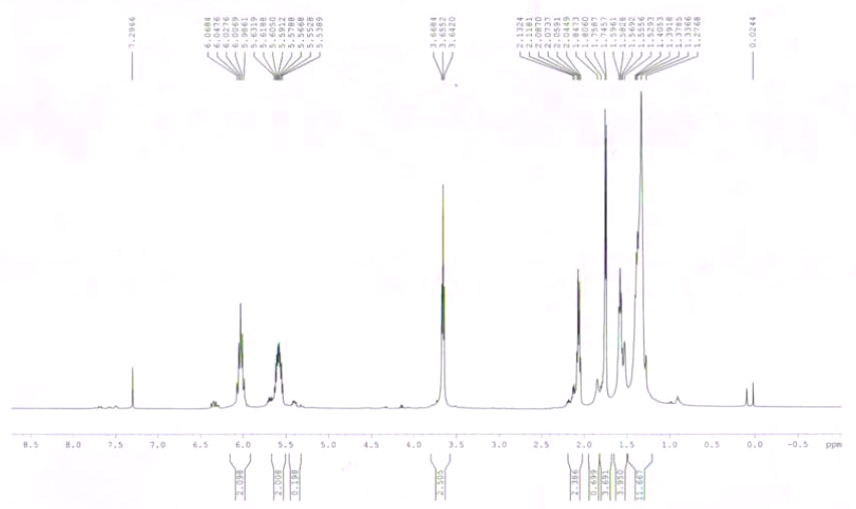
E3,Z8,Z11-Tetradecatriene acetate CAS#: 163041-94-9 HNMRHNMR of E3,Z8,Z11-Tetradecatriene acetate CAS 163041-94-9
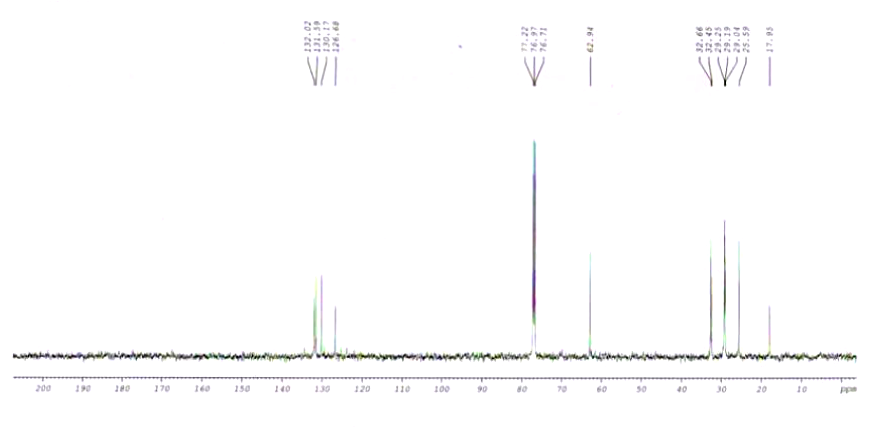
E3,Z8,Z11-Tetradecatriene acetate CAS#: 163041-94-9 CNMRCNMR of E3,Z8,Z11-Tetradecatriene acetate CAS 163041-94-9

Route of Synthesis (ROS)

No data available

Safety and Hazards

Pictogram(s)exclamation-mark
SignalWarning
GHS Hazard StatementsH315 (100%): Causes skin irritation [Warning Skin corrosion/irritation]
Information may vary between notifications depending on impurities, additives, and other factors.
Precautionary Statement CodesP264, P280, P302+P352, P321, P332+P313, and P362
(The corresponding statement to each P-code can be found at the GHS Classification page.)
For more detailed information, please visit ECHA C&L website
Source: European Chemicals Agency (ECHA)
License Note: Use of the information, documents and data from the ECHA website is subject to the terms and conditions of this Legal Notice, and subject to other binding limitations provided for under applicable law, the information, documents and data made available on the ECHA website may be reproduced, distributed and/or used, totally or in part, for non-commercial purposes provided that ECHA is acknowledged as the source: “Source: European Chemicals Agency, http://echa.europa.eu/”. Such acknowledgement must be included in each copy of the material. ECHA permits and encourages organisations and individuals to create links to the ECHA website under the following cumulative conditions: Links can only be made to webpages that provide a link to the Legal Notice page.
License URL: https://echa.europa.eu/web/guest/legal-notice
Record Name: (1-Cyano-2-ethoxy-2-oxoethylidenaminooxy)dimethylamino-morpholino-carbenium hexafluorophosphate
URL: https://echa.europa.eu/information-on-chemicals/cl-inventory-database/-/discli/details/213446
Description: The information provided here is aggregated from the “Notified classification and labelling” from ECHA’s C&L Inventory. Read more: https://echa.europa.eu/information-on-chemicals/cl-inventory-database

Other Data

TransportationNot dangerous goods
Under the room temperature and away from light
StorageStore in a cold place for long time, sealed and protected from light.
Market PriceUSD 15000/kg
Use Pattern
E3,Z8,Z11-Tetradecatriene acetate CAS#: 163041-94-9 used as insect pheromone and sex attractant.

8,10-DODECADIEN-1-OL CAS#: 33956-49-9

By great_watson-int,
IdentificationPhysical DataSpectra
Route of Synthesis (ROS)Safety and HazardsOther Data

Identification

英文名8,10-DODECADIEN-1-OL
IUPAC Name(8E,10E)-dodeca-8,10-dien-1-ol
分子结构Structure of 8E, 10E-dodecadien-1-ol CAS 33956-49-9
CAS编号 33956-49-9
别名(8E,10E)-dodeca-8,10-dienol;CAS Number: 33956-49-9; CAS NO:.33956-49-9
分子式C12H22O
分子量182.30
InChIInChI=1S/C12H22O/c1-2-3-4-5-6-7-8-9-10-11-12-13/h2-5,13H,6-12H2,1H3/b3-2+,5-4+
InChI KeyCSWBSLXBXRFNST-MQQKCMAXSA-N
Canonical SMILESC/C=C/C=C/CCCCCCCO
Patent Information
Patent IDTitlePublication Date
US2010/113837Production of pheromones and fragrances from substituted and unsubstituted 1-alken-3yl alkylates2010
US2006/88563Use of spray adjuvant to enhance the movement of pesticides through plant canopies to the target2006
US6838576Process for preparing functional group-containing olefinic compounds2005

Physical Data

AppearanceColorless or light yellow crystalline
Refractive index1.5050 (estimate)
Melting Point, °C Solvent (Melting Point)
29 – 30
27 – 28.5
31 – 32pentane
28 – 29petroleum ether
Boiling Point, °CPressure (Boiling Point), Torr
98 – 1010.5
90 – 920.001
120 – 1220.5
120 – 1211
1220.5
1050.1
80 – 900.01

Spectra

Description (NMR Spectroscopy)Nucleus (NMR Spectroscopy)Solvents (NMR Spectroscopy)
Spectrum13C
Spectrum1H
Chemical shifts1HCDCl3
Chemical shifts13CCDCl3
Chemical shifts1HCCl4
Chemical shifts1Hbenzene-d6
Chemical shifts13Cbenzene-d6
Spin-spin coupling constantsCDCl3
Spin-spin coupling constantsbenzene-d6
8,10-DODECADIEN-1-OL CAS#: 33956-49-9 HNMRHNMR of 8E, 10E-dodecadien-1-ol CAS 33956-49-9
8,10-DODECADIEN-1-OL CAS#: 33956-49-9 CNMRCNMR of 8E, 10E-dodecadien-1-ol CAS 33956-49-9
Description (IR Spectroscopy)Solvent (IR Spectroscopy)Comment (IR Spectroscopy)
Bandsneat (no solvent)3320 – 920 cm**(-1)
BandsCHCl32930 – 990 cm**(-1)
Bandsneat (no solvent)3350 – 990 cm**(-1)
BandsKBr3350 cm**(-1)
Bands3340 – 985 cm**(-1)
IR
Description (Mass Spectrometry)
spectrum
spectrum, electron impact (EI)
spectrum, chemical ionization (CI)
fragmentation pattern, spectrum
electron impact (EI), spectrum
Description (UV/VIS Spectroscopy)Solvent (UV/VIS Spectroscopy)Comment (UV/VIS Spectroscopy)Absorption Maxima (UV/VIS), nmExt./Abs. Coefficient, l·mol-1cm-1
Spectrum205 – 300 nm
Absorption maximaaq. ethanol229.928000
Absorption maximahexane22922800
UV/VIS

Route of Synthesis (ROS)

Route of Synthesis (ROS) of 8,10-DODECADIEN-1-OL CAS# 33956-49-9
ConditionsYield
Stage #1: (E,E)-sorbyl acetate; trimethylsilyl 6-chloro-1-hexyl ether With sodium In toluene at 0 – 80℃; for 12h; Inert atmosphere; Green chemistry;
Stage #2: With sulfuric acid In water; toluene at 0 – 20℃; for 1h; Temperature; Green chemistry;

Experimental Procedure
1.C; 2.C Target product synthesis Example 1: E8, E10-dodecadien-1-ol
In a 1500L dry clean enamel reactor, enter 400kg of metered toluene, replace with nitrogen, put 46kg of chopped clean metal sodium, heat up to 80 ° C, cool under stirring, cool with ice water, cool to 10 ° C, drop by A mixture of intermediate B137 kg and intermediate C208.5 kg.Control 0-10 ° C drop, add dropwise, warm to 60 ° C, heat preservation reaction for 12 hours,Cool to 0 ° C, add 300 kg of water, 98 kg of sulfuric acid, control hydrolysis temperature 20 ° C, hydrolysis and stirring for 1 hour, check the water layer pH 3-4, layering, 200 kg of organic layer washed once, separate the water layer, organic layer negative pressure Concentrated to the solvent without, the remaining liquid enters the rectification column rectification, collecting 10mmHg, 118-120 ° C fraction, as shown in Figure 1,Detecting the E, E-isomer content of 99.5%,The quantity is: 141kg. The yield was 77.47%.The total yield was: 68%.
77.47%

Safety and Hazards

Pictogram(s)exclamation-markhealth-hazardenvironment
SignalDanger
GHS Hazard StatementsH315 (100%): Causes skin irritation [Warning Skin corrosion/irritation]
H317 (64.62%): May cause an allergic skin reaction [Warning Sensitization, Skin]
H334 (29.23%): May cause allergy or asthma symptoms or breathing difficulties if inhaled [Danger Sensitization, respiratory]
H400 (99.23%): Very toxic to aquatic life [Warning Hazardous to the aquatic environment, acute hazard]
H410 (63.85%): Very toxic to aquatic life with long lasting effects [Warning Hazardous to the aquatic environment, long-term hazard]
Information may vary between notifications depending on impurities, additives, and other factors.
Precautionary Statement CodesP261, P264, P272, P273, P280, P285, P302+P352, P304+P341, P321, P332+P313, P333+P313, P342+P311, P362, P363, P391, and P501
(The corresponding statement to each P-code can be found at the GHS Classification page.)

Other Data

TransportationClass 8; Packaging Group: III; UN Number: 3082
Under the room temperature and away from light
StorageUnder the room temperature and away from light
Market PriceUSD
Druglikeness
Lipinski rules component
分子量182.306
logP4.548
HBA1
HBD1
Matching Lipinski Rules4
Veber rules component
Polar Surface Area (PSA)20.23
Rotatable Bond (RotB)8
Matching Veber Rules2
Bioactivity
In vitro: Efficacy
Quantitative Results
1 of 10Biological materialcat
SV-CISM-2 cell line
Assay DescriptionIncrease in cGMP formation in SV-CISM-2 cells relative to control upon treatment with the compound at 10e-4M
ResultsActivity not calculated
MeasurementActivity
2 of 10 TargetMultidrug resistance protein 1:Wild
Substance action on targetInhibitor
Assay DescriptionInhibitory activity against P-glycoprotein mediated compound efflux was determined
3 of 10Biological materialcat
SV-CISM-2 cell line
Assay DescriptionFormation of cGMP in SV-CISM-2 cells upon treatment with the compound at 10e-4M
ResultsActivity not calculated
MeasurementActivity
4 of 10Biological materialcat
SV-CISM-2 cell line
Assay DescriptionFormation of cGMP in SV-CISM-2 cells upon treatment with the compound at 10e-6M
ResultsActivity not calculated
MeasurementActivity
5 of 10 Biological materialcat
SV-CISM-2 cell line
Assay DescriptionIncrease in cGMP formation in SV-CISM-2 cells relative to control upon treatment with the compound at 10e-8M
ResultsActivity not calculated
MeasurementActivity
6 of 10Biological materialcat
SV-CISM-2 cell line
Assay DescriptionIncrease in cGMP formation in SV-CISM-2 cells relative to control upon treatment with the compound at 10e-6M
ResultsActivity not calculated
MeasurementActivity
7 of 10Biological materialcat
SV-CISM-2 cell line
Assay DescriptionFormation of cGMP in SV-CISM-2 cells upon treatment with the compound at 10e-8M
ResultsActivity not calculated
MeasurementActivity
8 of 10EffectBehavioural Symptoms
Assay DescriptionTarget : Ascogaster quadridentata
Bioassay : bioassays conducted between hrs 2 and 12 of insects’ photophase (16:8 h light:dark cycle); parasitoids reaching filter paper contain. title comp. within 15 min classed as responders in vivo; vertical Y-shaped Pyrex glass olfactometers; 25-27 deg C; relat. humid. 50-70 percent; fluorescent “daylight”+wide-spectrum grow light; air drawn through apparatus; responses of walking of flying insects to odor sources record.
9 of 10Biological materialCydia pomonella
Assay DescriptionEffect : pheromone activity
Bioassay : dispensers: a piece of cotton dental roll (0.3-300 ng) and gray elastomer septa (0.1-30.0 μg); effect: upwind flights culminating in contact with the dispenser flight tunnel bioassay; males for bioassays were used three days after eclosion and 0.25-2.5 hr after darkening the room; flight tunnel: 210 cm in length, air speed 12 cm/sec, 23 deg C, dimly lighted overhead by red lights controlled by a rheostat
Resultsresponse: gray elastomer septa: ca. 10 to ca. 85 percent, cotton dental roll: 0 to ca. 70 percent
10 of 10Biological materialCydia pomonella
Assay DescriptionEffect : pheromone activity
Bioassay : effect: the number of males making a circling motion while wing fanning wing-flutter bioassay; pint fruit jar; males for bioassays were used 3 days after eclosion and 0.25-2.5 hr after darkening the room; the test room was dimly lighted by red lights; 3-mm-diameter glass rod with title comp. was inserted into the jar
Resultsresponse: 20.5-96.5 percent
Use Pattern
General chemicals
guest material for slow-release pheromon composition comprising mesoporous molecular sieve as host material
Chemical processes/laboratory use
synthesizing a sex pheromone of the codling moth
Agricultural use
method of controlling chestnut tortrix (Cydia splendana)
composition for controlling undesired insect infestation
Insect attractant

4-(4-Acetoxyphenyl)-2-butanone CAS#: 3572-06-3

By great_watson-int,
Structure of 4-[4-(acetyloxy)phenyl]-2-butanone CAS 3572-06-3
IdentificationPhysical DataSpectra
Route of Synthesis (ROS)Safety and HazardsOther Data

Identification

英文名4-(4-Acetoxyphenyl)-2-butanone
IUPAC Name[4-(3-oxobutyl)phenyl] acetate
分子结构Structure of 4-[4-(acetyloxy)phenyl]-2-butanone CAS 3572-06-3
CAS编号 3572-06-3
别名4-(p-hydroxyphenyl)-2-butanone acetate, 4-(4-acetoxyphenyl)butan-2-one, 4-(p-acetoxyphenyl)-2-butanone, 4-(3-oxobutyl)phenyl acetate, cue lure, 4-(4-acetoxyphenyl)-2-butanone, cuelure
分子式C12H14O3
分子量206.238
InChIInChI=1S/C12H14O3/c1-9(13)3-4-11-5-7-12(8-6-11)15-10(2)14/h5-8H,3-4H2,1-2H3
InChI KeyUMIKWXDGXDJQJK-UHFFFAOYSA-N
Canonical SMILESCC(=O)CCc1ccc(cc1)OC(=O)C
Patent Information
Patent IDTitlePublication Date
CN108191651Thio carboxylic acid-mediated visible photocatalytic […] reaction synthetic phenol preparation method (by machine translation)2018

Physical Data

AppearanceColorless or light yellow oil
Refractive indexn20/D 1.509(lit.)
Boiling Point, °CPressure (Boiling Point), Torr
123 – 1240.2
107.5 – 109
Density, g·cm-3Reference Temperature, °CMeasurement Temperature, °C
1.096420
Refractive IndexWavelength (Refractive Index), nmTemperature (Refractive Index), °C
1.506158925
1.505958925
1.507858922

Spectra

Description (NMR Spectroscopy)Nucleus (NMR Spectroscopy)Solvents (NMR Spectroscopy)Frequency (NMR Spectroscopy), MHz
Chemical shifts1Hchloroform-d1500
Chemical shifts13Cchloroform-d1125
Chemical shifts1Hchloroform-d1200
Chemical shifts13Cchloroform-d150
4-(4-Acetoxyphenyl)-2-butanone CAS#: 3572-06-3 GCMSGCMS of 4-(4-Acetoxyphenyl)-2-butanone CAS# 3572-06-3
4-(4-Acetoxyphenyl)-2-butanone CAS#: 3572-06-3 GC MSGC MS of 4-(4-Acetoxyphenyl)-2-butanone CAS# 3572-06-3

Route of Synthesis (ROS)

Route of Synthesis (ROS) of 4-(4-Acetoxyphenyl)-2-butanone CAS 3572-06-3
ConditionsYield
With PS-TN lipase; hydrogen; (c-C5Ph4O)2H[Ru(CO)2]2H In toluene at 70℃; under 760.051 Torr; for 72h; Enzymatic reaction;92%

Safety and Hazards

GHS Hazard StatementsNot Classified

Other Data

TransportationNONH for all modes of transport
Under the room temperature and away from light
HS Code291470
StorageUnder the room temperature and away from light
Shelf Life1 year
Market PriceUSD
Druglikeness
Lipinski rules component
分子量206.241
logP1.668
HBA2
HBD0
Matching Lipinski Rules4
Veber rules component
Polar Surface Area (PSA)43.37
Rotatable Bond (RotB)5
Matching Veber Rules2
Bioactivity
In vitro: Efficacy
Quantitative Results
pXParameterValue (quant)UnitTarget
4.05activation percentage(relative to standard agonist)91.8%Transient receptor potential cation channel subfamily V member 1 [human]:WildTransient receptor potential cation channel subfamily A member 1 [human]:Wild
3.16activation percentage(relative to standard agonist)51.9%Transient receptor potential cation channel subfamily V member 1 [human]:Wild
Quantitative Results
1 of 1TargetCystic fibrosis transmembrane conductance regulator:Wild
Assay DescriptionAbility to modulate the extracellular transport of thiol containing compound by increasing the activity of cystic fibrosis transmembrane conductance regulator
Measurementextracellular transport
Use Pattern
male-specific attractant for insecticide formulation
Attractant
Pheromone

cis-9-Tricosene CAS#: 27519-02-4

By great_watson-int,
IdentificationPhysical DataSpectra
Route of Synthesis (ROS)Safety and HazardsOther Data

Identification

英文名cis-9-Tricosene
IUPAC Name(Z)-tricos-9-ene
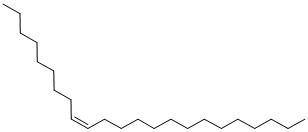
分子结构Structure of cis-9-Tricosene CAS# 27519-02-4
CAS编号 27519-02-4
别名
(Z)-tricos-9-ene, cis-tricos-9-ene, (Z)-9-Tricosene, 9-(Z)-tricosene, cis-9-tricosene, 9-tricosene, muscalure; CAS Number: 27519-02-4
分子式C23H46
分子量322.611
InChIInChI=1S/C23H46/c1-3-5-7-9-11-13-15-17-19-21-23-22-20-18-16-14-12-10-8-6-4-2/h17,19H,3-16,18,20-23H2,1-2H3/b19-17-
InChI KeyIGOWHGRNPLFNDJ-ZPHPHTNESA-N
Canonical SMILESCCCCCCCCCCCCC/C=C\CCCCCCCC
Patent Information
Patent IDTitlePublication Date
US4670250Durable controlled release microcapsules1987
US5888930Asymmetric microporous beads for controlled release1999
US5399344Synergistic fly attractant composition1995

Physical Data

AppearanceColorless or light yellow oil
SolubilityMiscible with water and hexane. Immiscible with alcohol.
Refractive indexn20/D 1.453(lit.)
Melting Point, °C
4
27 – 28
-1
Boiling Point, °CPressure (Boiling Point), Torr
156 – 1570.1
70 – 900.1
1700.1
1801
140 – 1420.01
148 – 1500.04
136 – 1400.1
Refractive IndexWavelength (Refractive Index), nmTemperature (Refractive Index), °C
1.451558926
1.454358920
1.455958920
1.452258920
1.448858920
1.454558920
1.453258923

Spectra

Description (NMR Spectroscopy)Nucleus (NMR Spectroscopy)Solvents (NMR Spectroscopy)Frequency (NMR Spectroscopy), MHz
Chemical shifts1Hchloroform-d1300
Chemical shifts13Cchloroform-d175
Spin-spin coupling constantsCDCl3
Chemical shifts1HCDCl3200
Chemical shifts13CCDCl322.5
Chemical shifts1HCCl4
Spectrum1HCDCl3
NMR
Description (IR Spectroscopy)Solvent (IR Spectroscopy)Comment (IR Spectroscopy)
Bandsfilm
SpectrumKBrdiagram
Bandsneat (no solvent)3006 – 721 cm**(-1)
Bandsneat (no solvent)735 cm**(-1)
Bandsneat (no solvent)1650 – 712 cm**(-1)
IR
Description (Mass Spectrometry)
gas chromatography mass spectrometry (GCMS), electron impact (EI), spectrum
gas chromatography mass spectrometry (GCMS), spectrum
high resolution mass spectrometry (HRMS), electron impact (EI), spectrum
spectrum, electron impact (EI)
spectrum, chemical ionization (CI)
chemical ionization (CI), spectrum
electron impact (EI), spectrum
cis-9-Tricosene CAS#: 27519-02-4 GCMSGCMS of cis-9-Tricosene CAS# 27519-02-4
cis-9-Tricosene CAS#: 27519-02-4 GC MSGC MS of cis-9-Tricosene CAS# 27519-02-4

Route of Synthesis (ROS)

Route of Synthesis (ROS) of cis-9-Tricosene CAS 27519-02-4
ConditionsYield
With hydrogen; Pd-Pb-CaCO3 (Lindlar catalyst) In hexane
With 9-borabicyclo[3.3.1]nonane dimer; acetic acid 1) THF, 0 deg C, 24 h, 2) reflux, 5 h; Yield given. Multistep reaction;
With methanol; 9-borabicyclo[3.3.1]nonane dimer; acetic acid 1.) THF, 0 deg C, 48 h, 2.) 25 deg C, 1 h; Yield given. Multistep reaction;
With quinoline; hydrogen; Pd-BaSO4 In Petroleum ether Ambient temperature;
With iron(II) acetylacetonate; hydrogen; diisobutylaluminium hydride In tetrahydrofuran; toluene at 30℃; under 975.098 Torr; for 12h; Sealed tube; stereoselective reaction;n/a

Safety and Hazards

Pictogram(s)exclamation-mark
SignalWarning
GHS Hazard StatementsH317: May cause an allergic skin reaction [Warning Sensitization, Skin]
Information may vary between notifications depending on impurities, additives, and other factors.
Precautionary Statement CodesP261, P272, P280, P302+P352, P321, P333+P313, P363, and P501
(The corresponding statement to each P-code can be found at the?GHS Classification?page.)

Other Data

TransportationNONH for all modes of transport
Under the room temperature and away from light
HS Code290129
StorageUnder the room temperature and away from light
Shelf Life1 year
Market PriceUSD
Druglikeness
Lipinski rules component
分子量322.618
logP12.911
HBA0
HBD0
Matching Lipinski Rules3
Veber rules component
Polar Surface Area (PSA)0
Rotatable Bond (RotB)19
Matching Veber Rules1
Bioactivity
In vitro: Efficacy
Quantitative Results
1?of?6Assay DescriptionEffect : electrophysiological
Target : Idea leuconoe, giant danaine butterfly
Bioassay : electroantennography; antennae of 10- to 14-day-old adults; 2 ml odor puff; continuous airflow (350 ml/min); 1 cm from the antennal preparation; EAG response relative to 1-hexanol (100 percent); n = 10-11
Resultsrelative response: ca. 30 percent at 0.1 μg, ca. 35 percent at 1.0 μg
2?of?6Assay DescriptionEffect : electrophysiological
Target : Idea leuconoe, giant danaine butterfly
Bioassay : electroantennography; antennae of 10- to 14-day-old adults; 2 ml odor puff; continuous airflow (350 ml/min); 1 cm from the antennal preparation; EAG response relative to 1-hexanol (100 percent); n = 10-14
Resultsrelative response: ca. 35 percent at 0.1 μg, ca. 42 percent at 1.0 μg
3?of?6Effectpheromone
Assay DescriptionTarget : Lygocoris pabulinus (L.), green capsid bug
Bioassay : vibration of abdomen of male bugs observed; controls: extract of legs of male bugs; this extract + 5 μg (Z)-9-heptacosene; positive control: extract of legs of female bugs virgin bug 6-9 days old (N=32); legs of male bugs loaded with 1 μg title comp. and 5 μg (Z)-9-pentacosene placed in Petri dish; one male per dish introduced; 19 – 23 deg C
4?of?6EffectReproductive Effect
Assay DescriptionTarget : Varroa destructor Anderson and Trueman, mite
Bioassay : inhibition of reproduction of Varroa destructor mite reared on Apis mellifera larva in artificial cells studied; control: hexane; RH: relative humidity title comp. applied to interior of 6.5 mm gelatin cells, then 1 mite and bee larva inserted into each cell; incubator, 34.5 deg C, 75 percent RH, 10 days; then cells opened; presence and number of offsprings per mite in each cell noted
5?of?6Effectrepellent agent
Assay DescriptionTarget : Bombus lapidarius (L.), bumblebee
Bioassay : controls: not treated flowers and treated with pentane test comp. dilution 10-12?μg/5 ml pentane; appled to Melitotus officinalis flowers; offered to bumblebees
Resultsrejection of flowers by B. lapidarius (diagram)
6?of?6Resultssex pheromone of Musca domestica
In vivo: Animal Model
Quantitative Results
pXParameterValue (qual)Biological Species
1Percentage change(of % courtship and amount of courtship behaviour)Not activeDrosophila suzukii
1percentage decrease(of copulation)ActiveDrosophila suzukii
Use Pattern
Agricultural use
inhibits mating
pest control agent against Drosophila suzukii
Attractant for fly gel
Attractant for an insect trap functions
arresting effect on insects
Fights against social, sub-social or gregarious insects
pheromone
chemical attractant

(Z,E)-9,12-TETRADECADIENYLACETATE CAS#: 30507-70-1

By great_watson-int,
Structure of (Z,E)-9,12-TETRADECADIENYLACETATE CAS# 30507-70-1
IdentificationPhysical DataSpectra
Route of Synthesis (ROS)Safety and HazardsOther Data

Identification

英文名(Z,E)-9,12-TETRADECADIENYLACETATE
IUPAC Nametetradeca-9,12-dienyl acetate
分子结构Structure of (Z,E)-9,12-TETRADECADIENYLACETATE CAS# 30507-70-1
CAS编号 30507-70-1
别名Tetradec-9Z,12E-dien-1-yl Acetate;CAS Number: 30507-70-1
分子式C16H28O2
分子量252.392
InChIInChI=1S/C16H28O2/c1-3-4-5-6-7-8-9-10-11-12-13-14-15-18-16(2)17/h3-4,6-7H,5,8-15H2,1-2H3/b4-3-,7-6+
InChI KeyZZGJZGSVLNSDPG-WWVFNRLHSA-N
Canonical SMILESC/C=C\C/C=C/CCCCCCCCOC(=O)C
Patent Information
Patent IDTitlePublication Date
US2013/231499SYNTHESIS OF Z-OLEFIN-CONTAINING LEPIDOPTERAN INSECT PHEROMONES2013
US4666767Dispensers for the controlled release of pest controlling agents and method for combatting pest therewith1987
US6593299Compositions and methods for controlling pests2003
US4296042Preparation of unsaturated aliphatic insect pheromones using cyclic phosphonium ylids1981

Physical Data

AppearanceColorless or light yellow oil
Flash Point102.3±20.4℃
Boiling Point334.8±21.0℃ (760 Torr)

Spectra

Description (NMR Spectroscopy)Nucleus (NMR Spectroscopy)Coupling NucleiSolvents (NMR Spectroscopy)Frequency (NMR Spectroscopy), MHz
Chemical shifts1H1Hchloroform-d1300
Chemical shifts13Cchloroform-d176
Chemical shifts, Spectrum1Hchloroform-d1500
Chemical shifts, Spectrum13Cchloroform-d1125
Chemical shifts1HCDCl3400
Chemical shifts13CCDCl3
SpectrumCDCl3400
Chemical shifts1HCCl4
Spin-spin coupling constantsCCl4
Spin-spin coupling constantsCDCl3
NMR
(Z,E)-9,12-TETRADECADIENYLACETATE CAS#: 30507-70-1 NMRHNMR of (Z,E)-9,12-TETRADECADIENYLACETATE CAS# 30507-70-1
(Z,E)-9,12-TETRADECADIENYLACETATE CAS#: 30507-70-1 CNMRCNMR of (Z,E)-9,12-TETRADECADIENYLACETATE CAS# 30507-70-1
Description (IR Spectroscopy)Solvent (IR Spectroscopy)Comment (IR Spectroscopy)
Bandsgas3017 – 964 cm**(-1)
Bandsneat (no solvent)2960 – 730 cm**(-1)
BandsCCl43010 – 720 cm**(-1)
Bandsneat (no solvent)2950 – 730 cm**(-1)
Bandsneat (no solvent)1745 cm**(-1)
Bandsneat (no solvent)3010 – 720 cm**(-1)
IR
Description (Mass Spectrometry)
gas chromatography mass spectrometry (GCMS), electron impact (EI), spectrum
high resolution mass spectrometry (HRMS), fast atom bombardment (FAB), spectrum
spectrum, chemical ionization (CI)
spectrum
Description (UV/VIS Spectroscopy)
UV/VIS

Route of Synthesis (ROS)

Route of Synthesis (ROS) of (Z,E)-9,12-TETRADECADIENYLACETATE CAS# 30507-70-1
ConditionsYield
With hydrogen; sodium tetrahydroborate; nickel diacetate; ethylenediamine In ethanol Ambient temperature;85%
With quinoline; hydrogen; Lindlar’s catalyst In hexane at -10℃;55.5%
With hydrogen; P-2Ni
With quinoline; hydrogen; Lindlar’s catalyst In hexane at -10℃; Yield given;

Safety and Hazards

Pictogram(s)exclamation-mark
SignalWarning
GHS Hazard StatementsH315 (100%): Causes skin irritation [Warning Skin corrosion/irritation]
H319 (50.56%): Causes serious eye irritation [Warning Serious eye damage/eye irritation]
Information may vary between notifications depending on impurities, additives, and other factors.
Precautionary Statement CodesP264, P280, P302+P352, P321, P332+P313, and P362
(The corresponding statement to each P-code can be found at the GHS Classification page.)
For more detailed information, please visit ECHA C&L website
Source: European Chemicals Agency (ECHA)
License Note: Use of the information, documents and data from the ECHA website is subject to the terms and conditions of this Legal Notice, and subject to other binding limitations provided for under applicable law, the information, documents and data made available on the ECHA website may be reproduced, distributed and/or used, totally or in part, for non-commercial purposes provided that ECHA is acknowledged as the source: “Source: European Chemicals Agency, http://echa.europa.eu/”. Such acknowledgement must be included in each copy of the material. ECHA permits and encourages organisations and individuals to create links to the ECHA website under the following cumulative conditions: Links can only be made to webpages that provide a link to the Legal Notice page.
License URL: https://echa.europa.eu/web/guest/legal-notice
Record Name: (1-Cyano-2-ethoxy-2-oxoethylidenaminooxy)dimethylamino-morpholino-carbenium hexafluorophosphate
URL: https://echa.europa.eu/information-on-chemicals/cl-inventory-database/-/discli/details/213446
Description: The information provided here is aggregated from the “Notified classification and labelling” from ECHA’s C&L Inventory. Read more: https://echa.europa.eu/information-on-chemicals/cl-inventory-database

Other Data

TransportationNo data available
Under the room temperature and away from light
HS CodeNo data available
StorageUnder the room temperature and away from light
Shelf Life1 year
Market PriceUSD
Druglikeness
Lipinski rules component
分子量252.397
logP6.543
HBA2
HBD0
Matching Lipinski Rules3
Veber rules component
Polar Surface Area (PSA)26.3
Rotatable Bond (RotB)12
Matching Veber Rules1
Bioactivity
In vitro: Efficacy
Quantitative Results
pXParameterValue (quant)Unit
5.12Ki (inhibition constant)7.58μM
percentage(Relative fluorescence)38.09%
1 of 11Effectpheromone
Assay DescriptionEffect : EAG response
Target : antenna of Lacinipolia renigera, bristly cutworm
Bioassay : title comp. isolated from volatile subst. emitted by adult female bolas spiders Mastophora hutchinsoni and collected during the period of mid-August through October, 1998, between 8 and 10 PM; gas chromatography (GC); electroantennography (EAG) proximal end of a male L. renigera antenna was placed into a pool of an insect saline solution; EAG response to title comp. was recorded and compared with simultaneously obtained GC data; effects of title comp. of synthetic and natural origins compared
ResultsGC-EAG peak of title comp. was identified using DB-Wax and DB-5 capillary columns
2 of 11Biological materialEphestia kuehniella
Assay DescriptionEffect : insect attractant
Example 7; Exosex2 SPL was formulated from 1% pheromone (Z9E12-14Ac) , 0.5% flow agent, 19.5% paraffin wax and 79% carnauba wax. This powder was compacted into Ig pellets.In a commercial flour mill in Andover, UK the following 2 treatments were compared during the control of theMediterranean
Results45.91% mean trap catches at 0 DAT (26.33% in control); 26.55% mean trap catches at 60 DAT (26.0% in control); 4.27% mean trap catches at 136 DAT (54.0% in control)
3 of 11Biological materialEphestia kuehniella
Assay DescriptionEffect : insect attractant
Bioassay : Example 7; Exosex2 SPL was formulated from 1% pheromone (Z9E12-14Ac) , 0.5% flow agent, 19.5% paraffin wax and 79% carnauba wax. This powder was compacted into Ig pellets.In a commercial flour mill in Andover, UK the following 2 treatments were compared during the control of theMediterranean
Results45.91% mean trap catches at 0 DAT (26.33% in control); 26.55% mean trap catches at 60 DAT (26.0% in control); 4.27% mean trap catches at 136 DAT (54.0% in control) potential area of application: agro
4 of 11Assay DescriptionEffect : electrophysiological
Target : Spodoptera littoralis, Egyptian armyworm
Bioassay : single sensillum recording (SRR); whole insect preparations; standard tip recording technique
Resultssignificant response; recording
5 of 11EffectBehavioural Symptoms
Assay DescriptionTarget : Spodoptera littoralis, Egyptian armyworm
Bioassay : behavior: close approach to the lure (ca. 10 cm) laboratory colony; insects on first and second scotophase; glass wind tunnel 180 cm long, 55 cm wide, and 50 cm high; 58-W red fluorescence light; light intensity: 3 lux; airspeed 45-55 cm/sec; 22 deg C; 60 percent RH
Resultsresponse: ca. 5 to 55 percent; max. effect at 1000 μg
6 of 11Assay DescriptionEffect : electrophysiological
Target : Spodoptera descoinsi Lalanne-Cassou & Silvain, noctuid moth
Bioassay : responses of 10 males measured Lepidoptera: Noctuidae; electrophysiological activity of male antenna measured by electroantenographic technique (EAG); pure air as control; experiments were carried out on whole insect preparations
Resultscorrected EAG response: 2.0 (control: ca. 0.8)
7 of 11Assay DescriptionEffect : electrophysiological
Target : Spodoptera descoinsi Lalanne-Cassou & Silvain, noctuid moth
Bioassay : responses of 10 males measured; LM: 11-40 hairs, MH: 2-3 hairs Lepidoptera: Noctuidae; electrophysiological activity of male antenna measured by single sensillum recordings in long lateral – LM (A and B cells) and short medial hairs (MH); air as control; experiments were carried out on whole insect preparations
Resultsresponse profile; action potentials (mV)/s: LM: <10 (B cells), ca. 37 (A cells), MH: ca. 40 (control: <10)
8 of 11Assay DescriptionEffect : electrophysiological
Target : Spodoptera latifascia (Walker), noctuid moth
Bioassay : responses of 10 males measured Lepidoptera: Noctuidae; electrophysiological activity of male antenna measured by electroantenographic technique (EAG); pure air as control; experiments were carried out on whole insect preparations
Resultscorrected EAG response: 2.5 (control: ca. 0.8)
9 of 11Assay DescriptionEffect : electrophysiological
Target : Spodoptera latifascia (Walker), noctuid moth
Bioassay : responses of 10 males measured; LM: 11-30 hairs, MH: 10-22 hairs Lepidoptera: Noctuidae; electrophysiological activity of male antenna measured by single sensillum recordings in long lateral – LM (A and B cells) and short medial hairs (MH); air as control; experiments were carried out on whole insect preparations
Resultsresponse profile; action potentials (mV)/s: LM: ca. 37 (A cells), <10 (B cells), MH: 20 (control: <10)
10 of 11Resultspheromone of Cadra cautella (almond moth) and Plodia interpunctalla (Indian meal moth)
11 of 11Resultspheromone component of various butterflys, inhibitor effects of various butterflys
Use Pattern
(Z,E)-9,12-TETRADECADIENYLACETATE CAS#: 30507-70-1 Controlling Parapediasia teterrella
(Z,E)-9,12-TETRADECADIENYLACETATE CAS#: 30507-70-1 Controlling Spodoptera exempta