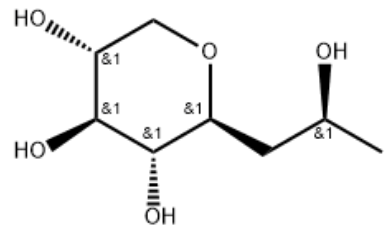
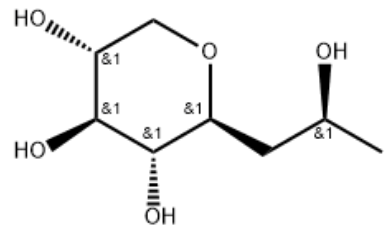
Pro-xylane CAS#: 439685-79-7
Identification
| 英文名 | Pro-xylane |
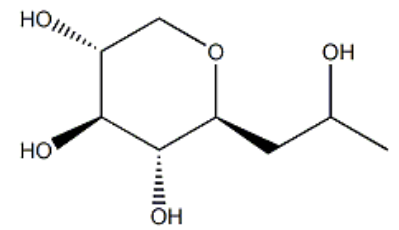
| IUPAC Name | (2S,3R,4S,5R)-2-(2-hydroxypropyl)oxane-3,4,5-triol |
| 分子结构 |  |
| CAS编号 | 439685-79-7 |
| 别名 | Pro-xylane 439685-79-7 Hydroxypropyl tetrahydropyrantriol Mexoryl SBB Pro-xylane (pharmaceutical) (2S,3R,4S,5R)-2-(2-hydroxypropyl)tetrahydro-2H-pyran-3,4,5-triol 4U3GMG1OT1 (2S,3R,4S,5R)-2-(2-hydroxypropyl)oxane-3,4,5-triol UNII-4U3GMG1OT1 CHEMBL479843 SCHEMBL1660373 L-Gluco-octitol, 1,5-anhydro-6,8-dideoxy-, (7XI)- DTXSID10196004 WLZ2819 KOGFZZYPPGQZFZ-QVAPDBTGSA-N ER4017 AKOS040742450 DB13121 ER-4017 c-beta-d-xylopyranoside-2-hydroxypropane TS-08006 HY-108036 CS-0027204 HYDROXYPROPYL TETRAHYDROPYRANTRIOL [INCI] pro-xylane pound>>Hydroxypropyl tetrahydropyrantriol Nano Liposomal HYDROXYPROPYL TETRAHYDROPYRANTRIOL Q27260499 (2S,3R,4S,5R)-2-(2-hydroxypropyl)oxane-3,4,5-trio L-GLUCO-OCTITOL, 1,5-ANHYDRO-6,8-DIDEOXY-, (7.XI.)- |
| 分子式 | C8H16O5 |
| 分子量 | 192.21 |
| InChI | InChI=1S/C8H16O5/c1-4(9)2-6-8(12)7(11)5(10)3-13-6/h4-12H,2-3H2,1H3/t4?,5-,6+,7+,8+/m1/s1 |
| InChI Key | KOGFZZYPPGQZFZ-QVAPDBTGSA-N |
| Isomeric SMILES | CC(C[C@H]1[C@@H]([C@H]([C@@H](CO1)O)O)O)O |
| Patent Information | ||
| Patent ID | Title | Publication Date |
| WO2018/114850 | COSMETIC COMPOSITION COMPRISING ONE OR MORE POLAR OIL(S), A C2-C6 ALIPHATIC MONOALCOHOL AND A POLYOL, AT LEAST ONE HYDROPHILIC ACTIVE AGENT, AND COMPRISING LESS THAN 7% BY WEIGHT OF WATER | 2018 |
| WO2017/68068 | USE OF GLYCOSIDES TO INCREASE HAIR MASS | 2017 |
| US2008/3191 | Composition combining a C-glycoside derivative and an emulsifying polymer | 2008 |
| WO2008/4165 | USE OF C-GLYCOSIDE DERIVATIVES AS PRO-DESQUAMATING ACTIVE AGENTS | 2008 |
Physical Data
| Appearance | 30% pro-xylane solution |
Spectra
| Description (NMR Spectroscopy) | Nucleus (NMR Spectroscopy) | Solvents (NMR Spectroscopy) |
| Chemical shifts, Spectrum | 1H | water-d2 |
| Chemical shifts | 1H | water-d2 |
| Spectrum | 13C | |
| Chemical shifts, Spectrum | 13C | |
| Chemical shifts | 1H |
Route of Synthesis (ROS)

| Conditions | Yield |
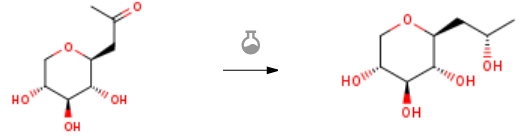
| With Pd(OH)2/C; hydrogen In ethyl acetate at 20℃; under 620.594 Torr; Schlenk technique; Experimental Procedure 1-6 Step c, Synthesis of Bosein (2S,3R,4S,5R)-2-(2-hydroxypropyl)tetrahydro-2H-pyran-3,4,5-triol: Add 20% Pd(OH) to the Schlenk bottle2/C(30mg), replaced with nitrogen three times, vacuumed, the 1-((2S,3S,4S,5R)-3,4,5-tris(benzyloxy)tetrahydro-2H-pyran-2- Ethyl) propan-2-ol (3.0g, 6.5mmol) in ethyl acetate (30mL) was added to the Schlenk flask, reacted at room temperature under hydrogen (12psi) atmosphere for 10 hours, filtered, concentrated to obtain a syrupy (2S, 3R ,4S,5R)-2-(2-hydroxypropyl)tetrahydro-2H-pyran-3,4,5-triol (1.24g, yield 99%). | 99% |
| With Pd/C; hydrogen Experimental Procedure (3)The benzyl group in the product obtained in step (2) is removed by catalytic hydrogenation with palladium carbon to obtain Bosein, (2S,3R,4S,5R)-2-(2-hydroxypropyl)tetrahydro-2H-pyran -3,4,5-triol. | |
Safety and Hazards
| Pictogram(s) | |
| Signal | |
| GHS Hazard Statements | Not Classified |
| Precautionary Statement Codes |
Other Data
| Druglikeness | |
| Lipinski rules component | |
| 分子量 | 192.212 |
| logP | -1.202 |
| HBA | 5 |
| HBD | 4 |
| Matching Lipinski Rules | 4 |
| Veber rules component | |
| Polar Surface Area (PSA) | 90.15 |
| Rotatable Bond (RotB) | 2 |
| Matching Veber Rules | 2 |
| Use Pattern |
| Anti-aging, promotes skin cell renewal, helps repair and rebuild the skin’s collagen and glycosaminoglycans, thereby reducing wrinkles and fine lines. Moisturizing and nourishing, promotes the synthesis of collagen, repairs damaged skin; enhances overall skin health. |