Methylamido Dihydro Noralfaprostal (MDN) CAS#: 155206-01-2
By great_watson-int,
IdentificationPhysical DataSpectra
Route of Synthesis (ROS)Safety and HazardsOther Data

Identification

英文名Methylamido Dihydro Noralfaprostal
IUPAC Name(Z)-7-[(1R,2R,3R,5S)-3,5-dihydroxy-2-[(E,3S)-3-hydroxy-5-phenylpent-1-enyl]cyclopentyl]-N-methylhept-5-enamide
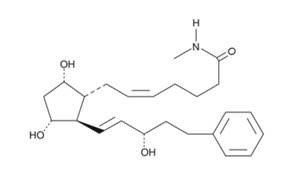
分子结构
CAS编号 155206-01-2
别名(5Z)-7-{(1R,2R,3R,5S)-3,5-Dihydroxy-2-[(1E,3S)-3-hydroxy-5-phenyl-1-penten-1-yl]cyclopentyl}-N-methyl-5-heptenamid [German] [ACD/IUPAC Name]; (5Z)-7-{(1R,2R,3R,5S)-3,5-Dihydroxy-2-[(1E,3S)-3-hydroxy-5-phenyl-1-penten-1-yl]cyclopentyl}-N-methyl-5-heptenamide [ACD/IUPAC Name]; (5Z)-7-{(1R,2R,3R,5S)-3,5-Dihydroxy-2-[(1E,3S)-3-hydroxy-5-phényl-1-pentén-1-yl]cyclopentyl}-N-méthyl-5-hepténamide [French] [ACD/IUPAC Name]; 5-Heptenamide, 7-[(1R,2R,3R,5S)-3,5-dihydroxy-2-[(1E,3S)-3-hydroxy-5-phenyl-1-penten-1-yl]cyclopentyl]-N-methyl-, (5Z)- [ACD/Index Name]; (5Z)-7-[(1R,2R,3R,5S)-3,5-dihydroxy-2-[(1E,3S)-3-hydroxy-5-phenyl-1-penten-1-yl]cyclopentyl]-N-methyl-5-heptenamide; 17-phenyl trinor Prostaglandin F2? methyl amide; MDN; MeBMP; 17- Phenyl Trinor Prostaglandin F2α Methyl Amide
分子式C24H35NO4
分子量401.5
InChIInChI=1S/C24H35NO4/c1-25-24(29)12-8-3-2-7-11-20-21(23(28)17-22(20)27)16-15-19(26)14-13-18-9-5-4-6-10-18/h2,4-7,9-10,15-16,19-23,26-28H,3,8,11-14,17H2,1H3,(H,25,29)/b7-2-,16-15+/t19-,20+,21+,22-,23+/m0/s1
InChI KeyUWIWNJFBNIMMGY-FDBOBMRISA-N
Canonical SMILESCNC(=O)CCCC=CCC1C(CC(C1C=CC(CCC2=CC=CC=C2)O)O)O
Isomeric SMILESCNC(=O)CCC/C=C\C[C@H]1[C@H](C[C@H]([C@@H]1/C=C/[C@H](CCC2=CC=CC=C2)O)O)O
Patent Information
Patent IDTitlePublication Date
No data available

Physical Data

AppearanceOff-white to light yellow solid or light yellow to yellow oily liquid
Flash Point>70°C
Boiling Point621.5 °C at 760 mmHg
Vapor Pressure43 mmHg
Autoignition Temperature363 °C

Spectra

Description (NMR Spectroscopy)Nucleus (NMR Spectroscopy)
Chemical shifts1H
Chemical shifts13C
Methylamido Dihydro Noralfaprostal (MDN) CAS#: 155206-01-2 HNMRMethylamido Dihydro Noralfaprostal (MDN) CAS 155206-01-2 HNMR
Methylamido Dihydro Noralfaprostal (MDN) CAS#: 155206-01-2 CNMR Methylamido Dihydro Noralfaprostal (MDN) CAS 155206-01-2 CNMR
Methylamido Dihydro Noralfaprostal (MDN) CAS#: 155206-01-2 COSY Methylamido Dihydro Noralfaprostal (MDN) CAS 155206-01-2 COSY
Methylamido Dihydro Noralfaprostal (MDN) CAS#: 155206-01-2 DEPT Methylamido Dihydro Noralfaprostal (MDN) CAS 155206-01-2 DEPT
Methylamido Dihydro Noralfaprostal (MDN) CAS#: 155206-01-2 HMBCMethylamido Dihydro Noralfaprostal (MDN) CAS 155206-01-2 HMBC
Methylamido Dihydro Noralfaprostal (MDN) CAS#: 155206-01-2 HSQCMethylamido Dihydro Noralfaprostal (MDN) CAS 155206-01-2 HSQC

Route of Synthesis (ROS)

No data available

Safety and Hazards

Pictogram(s)exclamation-markhealth-hazard
SignalDanger
GHS Hazard StatementsH302: Harmful if swallowed [Warning Acute toxicity, oral]
H312: Harmful in contact with skin [Warning Acute toxicity, dermal]
H319: Causes serious eye irritation [Warning Serious eye damage/eye irritation]
H340: May cause genetic defects [Danger Germ cell mutagenicity]
H360: May damage fertility or the unborn child [Danger Reproductive toxicity]
H361: Suspected of damaging fertility or the unborn child [Warning Reproductive toxicity]
Information may vary between notifications depending on impurities, additives, and other factors.
For more detailed information, please visit ECHA C&L website
Precautionary Statement CodesP201, P202, P264, P270, P280, P281, P301+P312, P302+P352, P305+P351+P338, P308+P313, P312, P322, P330, P337+P313, P363, P405, and P501
(The corresponding statement to each P-code can be found at the GHS Classification page.)

Other Data

TransportationNot dangerous goods
Under 2-8℃ for shipment
HS Code293750
StorageUnder -20℃ for long time storage
Shelf Life1 year
Market PriceUSD 750/g
Use Pattern
17-Phenyl Trinor Prostaglandin F2alpha-Methyl Amide is a stable analog of PGF2alpha and is a potent agonist of for the FP receptor. Analog of Bimatoprost.

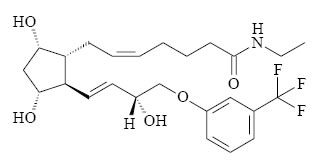
TrifluoroMethyl Dechloro CAS#: 1005193-64-5

By great_watson-int,
TrifluoroMethyl Dechloro CAS 1005193-64-5
IdentificationPhysical DataSpectra
Route of Synthesis (ROS)Safety and HazardsOther Data

Identification

英文名TrifluoroMethyl Dechloro
IUPAC Name7-[3,5-dihydroxy-2-[3-hydroxy-4-[3-(trifluoromethyl)phenoxy]but-1-enyl]cyclopentyl]-N-ethylhept-5-enamide
分子结构TrifluoroMethyl Dechloro CAS 1005193-64-5
CAS编号 1005193-64-5
别名DECHLORO ETHYLCLOPROSTENOLAMIDE; TrifluoroMethyl Dechloro;Trifluoromethyl Dechloro Ethylcloprostenolamid;(5Z)-7-[(1R,2R,3R,5S)-3,5-Dihydroxy-2-[(1E,3R)-3-hydroxy-4-[3-(trifluoromethyl)phenoxy]-1-buten-1-yl]cyclopentyl]-N-ethyl-5-heptenamide;Trifluoromethyl Dechloro Ethylprostenolamide;Trifluoromethyl Dechloro Ethylcloprostenolamide; (Z)-7-((1S,2R,3R,5S)-3,5-dihydroxy-2-((E)-3-hydroxy-4-(3-(trifluoromethyl)phenoxy)but-1-en-1-yl)cyclopentyl)-N-ethylhept-5-enamide; 7-[3,5-Dihydroxy-2-(3-Hydroxy-4-Phenoxy-But-1-Enyl)-Cyclopentyl-5Z-Heptenoic Acid Ethylamide
分子式C25H34F3NO5
分子量485.5425
InChIInChI=1S/C25H34F3NO5/c1-2-29-24(33)11-6-4-3-5-10-20-21(23(32)15-22(20)31)13-12-18(30)16-34-19-9-7-8-17(14-19)25(26,27)28/h3,5,7-9,12-14,18,20-23,30-32H,2,4,6,10-11,15-16H2,1H3,(H,29,33)/b5-3-,13-12+/t18-,20-,21-,22+,23-/m1/s1
InChI KeyGAAVJEMZITUZOC-UHFFFAOYSA-N
Canonical SMILESCCNC(=O)CCCC=CCC1C(CC(C1C=CC(COC2=CC=CC(=C2)C(F)(F)F)O)O)O
Patent Information
No data available

Physical Data

AppearanceA pale yellow to colorless oil
Flash Point>70°C

Spectra

Description (NMR Spectroscopy)Nucleus (NMR Spectroscopy)
Chemical shifts1H
Chemical shifts 13C

Route of Synthesis (ROS)

No data available

Safety and Hazards

Pictogram(s)exclamation-markhealth-hazard
SignalDanger
GHS Hazard StatementsH302: Harmful if swallowed [Warning Acute toxicity, oral]
H315: Causes skin irritation [Warning Skin corrosion/irritation]
H319: Causes serious eye irritation [Warning Serious eye damage/eye irritation]
H335: May cause respiratory irritation [Warning Specific target organ toxicity, single exposure; Respiratory tract irritation]
H360: May damage fertility or the unborn child [Danger Reproductive toxicity]
H361: Suspected of damaging fertility or the unborn child [Warning Reproductive toxicity]
H362: May cause harm to breast-fed children [Reproductive toxicity, effects on or via lactation]
Information may vary between notifications depending on impurities, additives, and other factors. 
Precautionary Statement CodesP201, P202, P260, P261, P263, P264, P270, P271, P280, P281, P301+P312, P302+P352, P304+P340, P305+P351+P338, P308+P313, P312, P321, P330, P332+P313, P337+P313, P362, P403+P233, P405, and P501
(The corresponding statement to each P-code can be found at the GHS Classification page.)
For more detailed information, please visit ECHA C&L website
Source: European Chemicals Agency (ECHA)
License Note: Use of the information, documents and data from the ECHA website is subject to the terms and conditions of this Legal Notice, and subject to other binding limitations provided for under applicable law, the information, documents and data made available on the ECHA website may be reproduced, distributed and/or used, totally or in part, for non-commercial purposes provided that ECHA is acknowledged as the source: “Source: European Chemicals Agency, http://echa.europa.eu/”. Such acknowledgement must be included in each copy of the material. ECHA permits and encourages organisations and individuals to create links to the ECHA website under the following cumulative conditions: Links can only be made to webpages that provide a link to the Legal Notice page.
License URL: https://echa.europa.eu/web/guest/legal-notice
Description: The information provided here is aggregated from the “Notified classification and labelling” from ECHA’s C&L Inventory. Read more: https://echa.europa.eu/information-on-chemicals/cl-inventory-database

Other Data

TransportationProper shipping name: FLAMMABLE LIQUID, TOXIC, N.O.S.;
Class 3 (6.1); Packaging Group: II; UN Number: 1992
Under 2°C ~ 8°C for long time, in container tightly sealed; Protect from light
HS Code293750
StorageUnder 2°C ~ 8°C for long time, in container tightly sealed; Protect from light
Shelf Life2 years
Market PriceUSD 1200/g
Use Pattern
TrifluoroMethyl Dechloro CAS#: 1005193-64-5 is used in cosmetics and usually in ingredient to lengthen eyelashes

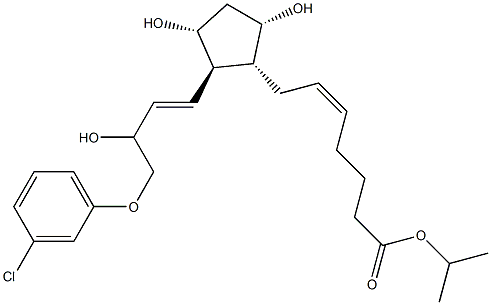
(+)-Cloprostenol isopropyl ester CAS#: 157283-66-4

By great_watson-int,
IdentificationPhysical DataSpectra
Route of Synthesis (ROS)Safety and HazardsOther Data

Identification

英文名(+)-Cloprostenol isopropyl ester
IUPAC Namepropan-2-yl (Z)-7-[(1R,2R,3R,5S)-2-[(E,3R)-4-(3-chlorophenoxy)-3-hydroxybut-1-enyl]-3,5-dihydroxycyclopentyl]hept-5-enoate
分子结构
CAS编号 157283-66-4
EINECS Number682-025-2
别名Isopropyl Cloprostenate; (5Z)-7-[(1R,2R,3R,5S)-2-[(1E,3R)-4-(3-Chlorophenoxy)-3-hydroxy-1-buten-1-yl]-3,5-dihydroxycyclopentyl]-5-heptenoic Acid 1-Methylethyl Ester; [1R-[1α(Z),2β(1E,3R*),3α,5α]]-7-[2-[4-(3-Chlorophenoxy)-3-hydroxy-1-butenyl]-3,5-dihydroxycyclopentyl]-5-heptenoic Acid 1-Methylethyl Ester; CPG 6112-95; Cloprostenol Isopropyl Ester; (+)-5-cis Cloprostenol isopropyl ester; (+)-16-m-chlorophenoxy tetranor Prostaglandin F2α isopropyl ester
分子式C25H35ClO6
分子量467
InChIInChI=1S/C25H35ClO6/c1-17(2)32-25(30)11-6-4-3-5-10-21-22(24(29)15-23(21)28)13-12-19(27)16-31-20-9-7-8-18(26)14-20/h3,5,7-9,12-14,17,19,21-24,27-29H,4,6,10-11,15-16H2,1-2H3/b5-3-,13-12?/t19-,21-,22-,23+,24-/m1/s1
InChI KeyOCNSAYQJDKJOLH-AHTXBMBWSA-N
Canonical SMILESCC(C)OC(=O)CCCC=CCC1C(CC(C1C=CC(COC2=CC(=CC=C2)Cl)O)O)O
Isomeric SMILESCC(C)OC(=O)CCC/C=C\C[C@H]1[C@H](C[C@H]([C@@H]1/C=C/[C@H](COC2=CC(=CC=C2)Cl)O)O)O
INCI Information
INCI NameIsopropyl Cloprostenate
Originchemically
DefinitionIsopropyl cloprostenate is a synthetic analog of a prostaglandin
INCI FunctionHair conditioning: Leaves hair easy to comb, flexible, soft and shiny and / or gives volume, lightness and shine
Patent Information
No data available

Physical Data

AppearanceColorless to Yellow oil
Flash Point>70°C
Water SolubilitySoluble in methanol, ethanol (95%); Pratically insoluble in water

Spectra

Description (NMR Spectroscopy)Nucleus (NMR Spectroscopy)
Chemical shifts1H
Chemical shifts 13C
(+)-Cloprostenol isopropyl ester CAS#: 157283-66-4 HNMR(+)-Cloprostenol isopropyl ester CAS#: 157283-66-4 HNMR
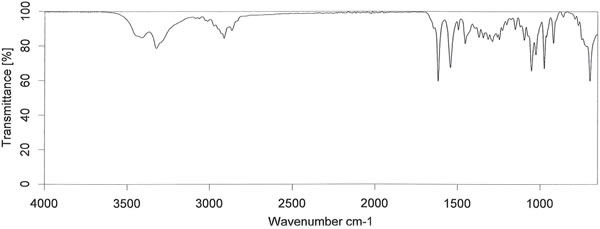
(+)-Cloprostenol isopropyl ester CAS#: 157283-66-4 IR(+)-Cloprostenol isopropyl ester CAS#: 157283-66-4 IR
(+)-Cloprostenol isopropyl ester CAS#: 157283-66-4 MSCloprostenol-isopropyl-ester-CAS-157283-66-4-MS

Route of Synthesis (ROS)

Route of Synthesis (ROS) of (+)-Cloprostenol isopropyl ester CAS 157283-66-4

Safety and Hazards

Pictogram(s)exclamation-mark
SignalWarning
GHS Hazard StatementsH302 (100%): Harmful if swallowed [Warning Acute toxicity, oral]
Precautionary Statement CodesP264, P270, P301+P312, P330, and P501
(The corresponding statement to each P-code can be found at the GHS Classification page.)
For more detailed information, please visit ECHA C&L website

Other Data

TransportationNot dangerous goods
2-8 °C away from light
HS Code293750
Storage-20 °C for long term storage
Shelf Life2 years
Market PriceUSD 780/g
Use Pattern
(+)-Cloprostenol is a synthetic analog of prostaglandin F2α (PGF2α). It is an FP receptor agonist and a potent luteolytic agent in rats and hamsters. (+)-Cloprostenol is the optically active, 15(R) enantiomer of cloprostenol responsible for the majority of its biological activity. It is 200 times more potent than PGF2α in terminating pregnancy when given subcutaneously at a daily dose of 0.125 μg/kg in rats and hamsters, without the side effects associated with PGF2α.1 (+)-Cloprostenol was also shown to be a potent inhibitor of rat adipose precursor differentiation in primary cultures with an IC50 value of 3 x 10-12 M.2 Cloprostenol isopropyl ester is a more lipid soluble form of cloprostenol.

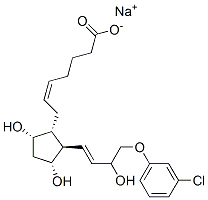
(+)-Cloprostenol sodium CAS#: 62561-03-9

By great_watson-int,
Cloprostenol-sodium-CAS-62561-03-9
IdentificationPhysical DataSpectra
Route of Synthesis (ROS)Safety and HazardsOther Data

Identification

英文名(+)-Cloprostenol sodium
IUPAC Namesodium;(Z)-7-[(1R,2R,3R,5S)-2-[(E,3R)-4-(3-chlorophenoxy)-3-hydroxybut-1-enyl]-3,5-dihydroxycyclopentyl]hept-5-enoate
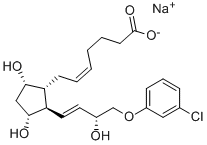
分子结构Cloprostenol-sodium-CAS-62561-03-9
CAS编号 62561-03-9
别名D-Cloprostenol Sodium; sodium [1alpha(z),2beta(1e,3r*),3alpha,5alpha]-(+/-)-7-[2-[4-(3-chlorophenoxy)-3-hydroxybut-1-enyl]-3,5-dihydroxycyclopentyl]hept-5-enoate;(+)-16-M-CHLOROPHENOXY TETRANOR PROSTAGLANDIN F2ALPHA SODIUM SALT;16-(M-CHLOROPHENOXY)-TETRANOR-PROSTAGLANDIN-F2ALPHA, SODIUM SALT;16-(3-CHLOROPHENOXY)-9,11,15R-TRIHYDROXY-17,18,19,20-TETRANORPROSTA-5Z,13E-DIEN-1-OIC ACID SODIUM SALT;(5Z)-REL-7-[(1R,2R,3R,5S)-2-[(1E,3R)-4-(3-CHLOROPHENOXY)-3-HYDROXY-1-BUTENYL]-3,5-DIHYDROXYCYCLOPENTYL]-5-HEPTENOIC ACID MONOSODIUM SALT;(+)-9ALPHA,11ALPHA,15R-TRIHYDROXY-16-(3-CHLOROPHENOXY)-17,18,19,20-TETRANOR-PROSTA-5Z,13E-DIEN-1-OIC ACID, SODIUM SALT;CLOPROSTENOL NA;(+)-CLOPROSTENOL SODIUM SALT
分子式C22H28ClO6*Na
分子量446.9
InChIInChI=1S/C22H29ClO6.Na/c23-15-6-5-7-17(12-15)29-14-16(24)10-11-19-18(20(25)13-21(19)26)8-3-1-2-4-9-22(27)28;/h1,3,5-7,10-12,16,18-21,24-26H,2,4,8-9,13-14H2,(H,27,28);/q;+1/p-1/b3-1-,11-10+;/t16-,18-,19-,20+,21-;/m1./s1
InChI KeyIFEJLMHZNQJGQU-KXXGZHCCSA-M
Canonical SMILESC1C(C(C(C1O)C=CC(COC2=CC(=CC=C2)Cl)O)CC=CCCCC(=O)[O-])O.[Na+]
Isomeric SMILESC1[C@@H]([C@@H]([C@H]([C@@H]1O)/C=C/[C@H](COC2=CC(=CC=C2)Cl)O)C/C=C\CCCC(=O)[O-])O.[Na+]
Patent Information
No data available

Physical Data

AppearanceWhite to off-white amorphous powder
Flash Point>70 °C

Spectra

Description (NMR Spectroscopy)Nucleus (NMR Spectroscopy)Frequency (NMR Spectroscopy), MHz
Spectrum1H500.13
Chemical shifts13C125.75

Route of Synthesis (ROS)

No data available

Safety and Hazards

Pictogram(s)exclamation-markhealth-hazard
SignalDanger
GHS Hazard StatementsH302: Harmful if swallowed [Warning Acute toxicity, oral]
H334: May cause allergy or asthma symptoms or breathing difficulties if inhaled [Danger Sensitization, respiratory]
H360: May damage fertility or the unborn child [Danger Reproductive toxicity]
Information may vary between notifications depending on impurities, additives, and other factors. 
Precautionary Statement CodesP201, P202, P261, P264, P270, P281, P285, P301+P312, P304+P341, P308+P313, P330, P342+P311, P405, and P501
(The corresponding statement to each P-code can be found at the GHS Classification page.)
For more detailed information, please visit ECHA C&L website

Other Data

TransportationNot dangerous goods
At 2~8 °C , in container tightly sealed; Protect from light
HS Code293750
StorageUnder -20°C for long term, in container tightly sealed; Protect from light
Shelf Life2 years
Market PriceUSD 350/g
Use Pattern
(+)-Cloprostenol sodium CAS#: 62561-03-9 has been used in studying its influence in oestrus synchronisation and uterine development in mice.
(+)-Cloprostenol sodium CAS#: 62561-03-9 is a potent FP prostanoid receptor agonist. It is 2- to 3-fold more potent than fluprostenol but less selective. Cloprostenol is similar in potency to PGF2α at EP and TP prostanoid receptors. It is used for the treatment of infertility in sows and gilts.
Cloprostenol is a synthetic analogue of prostaglandin F2α (PGF). Cloprostenol contributes to the induction of estrus in animals and has uterotonic activity. Cloprostenol induces abortion in animals.
This product is easily to absorb moisture which makes it possibly stick to the bottle. Please ensure to reduce the environment humidity to lower than 40% before opening the bottle and seal it again for future use. For the adhesive some to the bottle, solvent (Usually Water) can be used to get it out.
Preservative agent for compositions for treatment of mastitis
Surface coating systems
Fertiliser for agricultural compositions

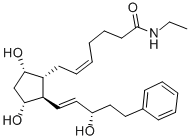
Bimatoprost CAS#: 155206-00-1

By great_watson-int,
IdentificationPhysical DataSpectra
Route of Synthesis (ROS)Safety and HazardsOther Data

Identification

英文名Bimatoprost
IUPAC Name(Z)-7-[(1R,2R,3R,5S)-3,5-dihydroxy-2-[(E,3S)-3-hydroxy-5-phenylpent-1-enyl]cyclopentyl]-N-ethylhept-5-enamide
分子结构
CAS编号 155206-00-1
别名bimatoprost, lumigan; (Z)-7-[(1R,2R,3R,5S)-3,5-dihydroxy-2-[(1E,3S)-3-hydroxy-5-phenyl-1-pentenyl]cyclopentenyl]-5-N-ethylheptenamide, Bimatoprost, cyclopentane N-ethyl-heptenamide-5-cis-2-(3α-hydroxy-5-phenyl-1-trans-pentenyl)-3,5-dihydroxy, [1α,2β,3α,5α], (5Z)-7-[(1R,2R,3R,5S)-3,5-dihydroxy-2-[(1E,3S)-3-hydroxy-5-phenylpent-1-en-1-yl]cyclopentyl]-N-ethylhept-5-enamide, (5Z)-N-ethyl-7-[(1R,2R,3R,5S)-3,5-dihydroxy-2-[(1E,3S)-3-hydroxy-5-phenyl-1-pentenyl]-cyclopentyl]hept-5-enamide, (Z)-7-((1R,2R,3R,5S)-3,5-dihydroxy-2-((3S,E)-3-hydroxy-5-phenylpent-1-en-1-yl)cyclopentyl)-N-ethylhept-5-enamide
分子式C25H37NO4
分子量415.573
InChIInChI=1S/C25H37NO4/c1-2-26-25(30)13-9-4-3-8-12-21-22(24(29)18-23(21)28)17-16-20(27)15-14-19-10-6-5-7-11-19/h3,5-8,10-11,16-17,20-24,27-29H,2,4,9,12-15,18H2,1H3,(H,26,30)/b8-3-,17-16+/t20-,21+,22+,23-,24+/m0/s1
InChI KeyAQOKCDNYWBIDND-FTOWTWDKSA-N
Canonical SMILESCCNC(=O)CCCC=CCC1C(CC(C1C=CC(CCC2=CC=CC=C2)O)O)O
Isomeric SMILESCCNC(=O)CCC/C=C\C[C@H]1[C@H](C[C@H]([C@@H]1/C=C/[C@H](CCC2=CC=CC=C2)O)O)O
Patent Information
Patent IDTitlePublication Date
KR2017/25682Novel method for preparing Prostaglandin derivatives2017
US2015/51410PROCESSES AND INTERMEDIATES FOR THE PREPARATIONS OF ISOMER FREE PROSTAGLANDINS2015
US2015/158837Compound And Method2015
US2015/31898PROCESS FOR PREPARATION OF PROSTAGLANDIN F2 ALPHA ANALOGUES2015
US2014/135503NOVEL PROCESSES FOR THE PREPARATION OF PROSTAGLANDIN AMIDES2014
WO2013/133730PROCESS FOR PREPARATION OF PROSTAGLANDIN F ANALOGUES2013
WO2012/11128PREPARATION OF PROSTAGLANDIN DERIVATIVES2012
WO2012/112451ESTER DERIVATIVES OF BIMATOPROST COMPOSITIONS AND METHODS2012
WO2011/46569PROCESS FOR THE PREPARATION OF F-SERIES PROSTAGLANDINS2011
WO2011/55377A NOVEL PROCESS FOR THE PREPARATION OF PROSTAGLANDINS AND INTERMEDIATES THEREOF 2011
US2007/286890Eyelash applicator and method2007
US2005/69507Method for imparting artificial tan to human skin2005
US2005/58614Methods for the treatment of gray hair using cyclopentane(ene) heptan(en)oic acid amides 2005

Physical Data

AppearanceWhite powder
Water SolubilitySlightly soluble(1.87e-02 g/L)
Melting Point, °C Solvent (Melting Point)
65.7 – 72.7ethyl acetate, tert-butyl methyl ether
71.9 – 72.5water
78
75.9diethyl ether
77.2methanol
72.9water, ethanol
62.1acetonitrile
log POWTemperature (Partition octan-1-ol/water (MCS)), °CpH
3.41
2
2.425~ 7.4

Spectra

Description (NMR Spectroscopy)Nucleus (NMR Spectroscopy)Solvents (NMR Spectroscopy)Frequency (NMR Spectroscopy), MHzOriginal Text (NMR Spectroscopy)
Chemical shifts1Hchloroform-d1 4001H NMR (400 MHz; CDCl3) δH=1.09 (t, J=7.1 Hz, 3H, CH3), 1.42-2.40 (m, 14H, 6×CH2, 2×CH), 2.67 (m, 2H, CH2), 3.22 (dq, J=7.1, 6.3 Hz, 2H, CH2NH), 3.41 (broad s, 3H, 3×OH), 3.80-4.30 (broad m, 3H, 3×CHOH), 5.37 (m, 2H, 2×═CH), 5.47 (dd, J=15.2, 7.9 Hz, 1H, ═CH), 5.59 (dd, J=15.2, 7.9 Hz, 1H, ═CH), 5.90 (broad s, 1H, NH), 7.17 (m, 3H, ArCH’s), 7.26 (m, 2H, ArCH’s)
Chemical shifts 1Hchloroform-d16001H NMR (CDC13, 600 MHz, 25° C.) ö (ppm): 1.10 (t, J=7.2 Hz, 3H, —-CH2CH3), 1.46 (m, 1H, CH-i of cyclopentyl ring),1.62 (m, 1 H, one proton of CH2-3 group of a chain), 1.68 (m,H, one proton of CH2-3 group of a chain), 1.74 (m, 1 H, one proton of CH2-4 group of cyclopentyl ring), 1.78 (m, 1H, one proton of CH2-4 group of ca chain), 1.90 (m, 1H, one proton of CH2-4 group of w chain), 2.02-2.06(m, 2H, one proton of CH2-4 group and one of CH2-7 group of a chain), 2.11-2.15 (m, 3H, CH2-2 of a chain and one proton of CH2-4 group ofchain), 2.21 (m, 1H, one proton of CH2-4 group of cyclopentyl ring), 2.29 (m, 1H, one proton of CH2-7 group of a chain), 2.34 (m, 1H, CH-2cyclopentyl ring), 2.67 (m, 2H, CH2-S of w chain), 3.22 (m, 2H, -CCH3), 3.55 (s, 3H, three —-OH groups), 3.91 (m, 1H, CH-3 of cyclopentyl group), 4.08 (m, 1H, CH-3 of w chain), 4.12 (m, 1H, CH-S of cyclopentyl ring), 5.34 (m, 1H, CH-S of a chain), 5.41 (m, 1H, CH-6 of a chain), 5.47 (dd, J=9.0 and 15.3 Hz, 1H, CH-i ofw chain), S.S9 (dd, J=7.3 Hz and 1S.3 Hz, 1H, CH-2 ofw chain), S.98 (t, J=S.i Hz, 1H, >NH), 7.17 (m, 1H, H-4 aromatic), 7.18 (m, 2H, H-2 andH-6 aromatic), 7.26 (m, 2H, H-3 and H-S aromatic).
Chemical shifts13Cchloroform-d115013C NMR (150 MHz, CDC13, 2S° C.) ö(ppm): 14.77 (——CH2CH3), 2S.38 (C-7 of a chain), 2S.63 (C-3 of a chain), 26.70 (C-4 of a chain), 31.88 (C-S of w chain), 34.40 (-CH2CH3), 3S.82 (C-2 of a chain), 38.7S(C-4 of w chain), 42.93 (C-4 of cyclopentyl ring), 50.19 (C-i of cyclopentyl ring), 55.47 (C-2 of cyclopentyl ring), 72.25 (C-3 of w chain), 72.33 (C-5 of cyclopentyl ring), 77.67 (C-3 of cyclopentyl ring), i25.77 (C-4 aromatic), i28.35 (2C, C-3 andC-5 aromatic), i28.35 (2C, C-2 andC-6 aromatic), 142.0 (C-i aromatic), i29.i8 (C-6 of a chain), i29.66 (C-5 of a chain), 133.20 (C-i of w chain), 135.12 (C-2 of w chain), 173.42 (CrrrO).
Chemical shifts 13Cchloroform-d110013C NMR (100 MHz; CDCl3) δC=14.8 (CH3), 25.4 (CH2), 25.6 (CH2), 26.7 (CH2), 31.9 (CH2), 34.4 (CH2NH), 35.8 (CH2C═O), 38.8 (CH2), 42.9 (CH2), 50.2 (CH), 55.5 (CH), 72.3 (CHOH), 72.4 (CHOH), 77.7 (CHOH), 125.8 (ArCH), 128.4 (2×ArCH), 128.5 (2×ArCH), 129.1 (═CH), 129.7 (═CH), 133.7 (═CH), 135.1 (═CH), 142.0 (ArC), 173.4 (C═O)
Description (IR Spectroscopy)Solvent (IR Spectroscopy)Original Text (IR Spectroscopy)
Bandspotassium bromideFT-IR (KBr) Vmax (cm’): 3420, 3327,3084, 3011,2914, 2865, 2933, 1620,1546,1496,1456,1372, 1317,1290,1249, 1151, 1097,1055,1027,976,920,698.
in KBrIR: 3415.03cm-1, 3326.69cm-1, 3085.84cm-1, 2914.06cm-1, 2865.73cm-1, 1619.61cm-1, 1546.22cm-1, 1496.54cm-1, 1455.38cm-1, 1372.19cm-1, 1346.23cm-1, 1317.02cm-1, 1290.25cm-1, 1248.99cm-1, 1151.57cm-1, 1097.45cm-1, 1054.67cm-1, 1027.58cm-1, 975.78cm-1, 920.47cm-1, 859.10cm-1, 698.34cm-1 and 596.08cm-1
paraffin oil (nujol)IR (Nujol): 3418.5, 3328.2, 3085.2, 3062.4, 2953.1, 2925.4, 2854.7, 1619.6, 1545.3, 1496.3, 1456.5, 1376.5, 1346.2, 1316.5, 1290.0, 1261.0, 1248.7, 1229.1, 1203.3, 1151.1, 1122.6, 1097.5, 1054.6, 1027.1, 975.9, 961.0, 920.3, 768.1, 721.8, 697.8, 595.7 and 545.4 cm-1
Bimatoprost CAS#: 155206-00-1 IRIR of Bimatoprost CAS 155206-00-1
Chromatographic dataOriginal string
TLC (Thin layer chromatography)R&f%On a silica TLC (MTBE:EtOH 9:1 ): 0.35
LC (Liquid chromatography)Rt=22.56 mm.
HPLC (High performance liquid chromatography)HPLC-MS (ESI): Kinetex XB-C 18, 2.7 μηι, kolumna 150 x 4.6 mm, (600 μ ΝΗ&3%· H&2%0 : 500 μ CH&3%COOH : 1 dm%3& H&2%0) : CH&3%CN (8:2, phase A)/ (600 μ ΝΗ&3% · H&2%0 : 500 μ CH&3%COOH : 1 dm%3& H&2%0) : CH&3%CN (8: 1, phase B) in concentration gradient 100percent – 75percent, 1.0 ml/min, R&t% = 21.79 min. (m/z = 416.3 [M + H]%+& for (15i?)-(+)-7b), R&t% = 22.33 min. (m/z = 416.3 [M + H]%+& for (5E, 15S)-(+)-7a), R&t% = 22.91 min. (m/z = 416.3 [M + H]%+& dla (155)- (+)-10a).
Type (Optical Rotatory Power)Concentration (Optical Rotatory Power)Enantiomeric excess, %eeSolvent (Optical Rotatory Power)Optical Rotatory Power, degWavelength (Optical Rotatory Power), nmTemperature (Optical Rotatory Power), °C
[alpha]1 g/100mlmethanol32.558922
[alpha]1 g/100mlchloroform39.0758920
[alpha]0.35 g/100mldichloromethane41.158922
[alpha]1.0 weight percent98.72dichloromethane39.0758920

Route of Synthesis (ROS)

Route of Synthesis (ROS) of Bimatoprost CAS 155206-00-1
ConditionsYield
Stage #1: (3aR,4R,5R,6aS)-hexahydro-4-[(1E,3S)-3-hydroxy-5-phenyl-1-penten-1-yl]-2H-cyclopenta[b]furan-2,5-diol With potassium tert-butylate In tetrahydrofuran at 0℃; for 0.666667h;
Stage #2: (5-(ethylamino)-5-oxopentyl)triphenylphosphonium bromide In tetrahydrofuran at 0℃;
65%
Stage #1: (5-(ethylamino)-5-oxopentyl)triphenylphosphonium bromide With potassium tert-butylate In tetrahydrofuran at 0℃ for 0.666667h Inert atmosphere
Stage #2: (3aR,4R,5R,6aS)-hexahydro-4-[(1E,3S)-3-hydroxy-5-phenyl-1-penten-1-yl]-2H-cyclopenta[b]furan-2,5-diol In tetrahydrofuran at 0 – 20℃ for 1h Inert atmosphere
41%
Stage #1: (5-(ethylamino)-5-oxopentyl)triphenylphosphonium bromide With potassium tert-butylate In tetrahydrofuran at 0℃ for 1h
Stage #2: (3aR,4R,5R,6aS)-hexahydro-4-[(1E,3S)-3-hydroxy-5-phenyl-1-penten-1-yl]-2H-cyclopenta[b]furan-2,5-diol In tetrahydrofuran at -17℃ for 20.5h Wittig Reaction
Stage #1: (5-(ethylamino)-5-oxopentyl)triphenylphosphonium bromide With potassium tert-butylate In tetrahydrofuran at 0℃; for 0.666667h; Wittig Olefination; Schlenk technique; Inert atmosphere;
Stage #2: (3aR,4R,5R,6aS)-hexahydro-4-[(1E,3S)-3-hydroxy-5-phenyl-1-penten-1-yl]-2H-cyclopenta[b]furan-2,5-diol In tetrahydrofuran at 20℃; for 1h; Wittig Olefination; Schlenk technique; Inert atmosphere;
82.6mg
Stage #1: (5-(ethylamino)-5-oxopentyl)triphenylphosphonium bromide With potassium tert-butylate In tetrahydrofuran at 0℃; for 0.666667h; Inert atmosphere;
Stage #2: (3aR,4R,5R,6aS)-hexahydro-4-[(1E,3S)-3-hydroxy-5-phenyl-1-penten-1-yl]-2H-cyclopenta[b]furan-2,5-diol In tetrahydrofuran at 0 – 20℃; for 2h; Inert atmosphere;
108 mg

Safety and Hazards

Pictogram(s)exclamation-markhealth-hazard
SignalDanger
GHS Hazard StatementsH302: Harmful if swallowed [Warning Acute toxicity, oral]
H312: Harmful in contact with skin [Warning Acute toxicity, dermal]
H319: Causes serious eye irritation [Warning Serious eye damage/eye irritation]
H340: May cause genetic defects [Danger Germ cell mutagenicity]
H360: May damage fertility or the unborn child [Danger Reproductive toxicity]
H361: Suspected of damaging fertility or the unborn child [Warning Reproductive toxicity]
Information may vary between notifications depending on impurities, additives, and other factors. 
Precautionary Statement CodesP201, P202, P264, P270, P280, P281, P301+P312, P302+P352, P305+P351+P338, P308+P313, P312, P322, P330, P337+P313, P363, P405, and P501
(The corresponding statement to each P-code can be found at the GHS Classification page.)

Other Data

TransportationNot dangerous goods
Under 2-8℃ for shipment
HS Code293750
StorageUnder -20℃ for long time storage
Shelf Life1 year
Market PriceUSD 450/g
Use Pattern
Bimatoprost CAS#: 155206-00-1 can be used in pharmaceuticals
Bimatoprost CAS#: 155206-00-1 can be used for treating hair loss of the eyebrows
Bimatoprost CAS#: 155206-00-1 is used for treating hypotrichosis associated with chemotherapy treatment regimens
Bimatoprost CAS#: 155206-00-1 is used for treating hypotrichosis of the eyelashes
treatment of dry-eye and related symptoms
treating or preventing skin diseases or disorders
treating or preventing vitreous adhesions

Cloprostenol sodium CAS#: 55028-72-3

By great_watson-int,
Cloprostenol-sodium-CAS-55028-72-3
IdentificationPhysical DataSpectra
Route of Synthesis (ROS)Safety and HazardsOther Data

Identification

英文名Cloprostenol sodium
IUPAC Namesodium;(Z)-7-[(1R,2R,3R,5S)-2-[(E,3R)-4-(3-chlorophenoxy)-3-hydroxybut-1-enyl]-3,5-dihydroxycyclopentyl]hept-5-enoate
分子结构Cloprostenol-sodium-CAS-55028-72-3
CAS编号 55028-72-3
EINECS Number259-439-3
别名DL-Cloprostenol Sodium; 15-EPI CLOPROSTENOL;15(S)-CLOPROSTENOL;16-(3-CHLOROPHENOXY)-9,11,15R-TRIHYDROXY-17,18,19,20-TETRANORPROSTA-5Z,13E-DIEN-1-OIC ACID SODIUM SALT;(+)-16-M-CHLOROPHENOXY TETRANOR PROSTAGLANDIN F2ALPHA SODIUM SALT;7-(2-[4-(3-Chlorophenoxy)-3-hydroxy-1-butenyl]-3,5-dihydroxycyclopentyl)-5-heptenoic acid;(+/-)-16-(3-Chlorophenoxy)-9,11,15R-trihydroxy-17,18,19,20-tetranorprosta-5Z,13E-dien-1-oic acid hydrate sodium salt;(+/-)-Cloprostenol hydrate sodium salt;(5Z)-rel-7-[(1R,2R,3R,5S)-2-[(1E,3R)-4-(3-chlorophenoxy)-3-hydroxy-1-butenyl]-3,5-dihydroxycyclopentyl]-5-heptenoicacidmonosodiumsalt
分子式C22H28ClNaO6
分子量446.9
InChIInChI=1S/C22H29ClO6.Na/c23-15-6-5-7-17(12-15)29-14-16(24)10-11-19-18(20(25)13-21(19)26)8-3-1-2-4-9-22(27)28;/h1,3,5-7,10-12,16,18-21,24-26H,2,4,8-9,13-14H2,(H,27,28);/q;+1/p-1/b3-1-,11-10+;/t16-,18-,19-,20+,21-;/m1./s1
InChI KeyIFEJLMHZNQJGQU-KXXGZHCCSA-M
Canonical SMILESC1C(C(C(C1O)C=CC(COC2=CC(=CC=C2)Cl)O)CC=CCCCC(=O)[O-])O.[Na+]
Isomeric SMILESC1[C@@H]([C@@H]([C@H]([C@@H]1O)/C=C/[C@H](COC2=CC(=CC=C2)Cl)O)C/C=C\CCCC(=O)[O-])O.[Na+]
Patent Information
No data available

Physical Data

AppearanceWhite to off-white amorphous powder
Melting Point68-70 °C
SolubilityH2O: >10 mg/mL
Flash Point>70 °C

Spectra

No data available

Route of Synthesis (ROS)

No data available

Safety and Hazards

Pictogram(s)exclamation-markhealth-hazard
SignalDanger
GHS Hazard StatementsH302: Harmful if swallowed [Warning Acute toxicity, oral]
H334: May cause allergy or asthma symptoms or breathing difficulties if inhaled [Danger Sensitization, respiratory]
H360: May damage fertility or the unborn child [Danger Reproductive toxicity]
Information may vary between notifications depending on impurities, additives, and other factors.
Precautionary Statement CodesP201, P202, P261, P264, P270, P281, P285, P301+P312, P304+P341, P308+P313, P330, P342+P311, P405, and P501
(The corresponding statement to each P-code can be found at the GHS Classification page.)
For more detailed information, please visit ECHA C&L website

Other Data

TransportationNot dangerous goods
At 2~8 °C , in container tightly sealed; Protect from light
HS Code293750
StorageUnder -20°C for long term, in container tightly sealed; Protect from light
Shelf Life2 years
Market PriceUSD 350/g
Use Pattern
Cloprostenol sodium CAS#: 55028-72-3 has been used in studying its influence in oestrus synchronisation and uterine development in mice.
Cloprostenol is a potent FP prostanoid receptor agonist. It is 2- to 3-fold more potent than fluprostenol but less selective. Cloprostenol is similar in potency to PGF2α at EP and TP prostanoid receptors. It is used for the treatment of infertility in sows and gilts.
Cloprostenol is a synthetic analogue of prostaglandin F2α (PGF). Cloprostenol contributes to the induction of estrus in animals and has uterotonic activity. Cloprostenol induces abortion in animals.
Cloprostenol sodium CAS#: 55028-72-3 is easily to absorb moisture which makes it possibly stick to the bottle. Please ensure to reduce the environment humidity to lower than 40% before opening the bottle and seal it again for future use. For the adhesive some to the bottle, solvent (Usually Water) can be used to get it out.