Anti-Triiodothyronine (3,5,3′-triiodothyronine T3 CAS#: 55-06-1) Antibody
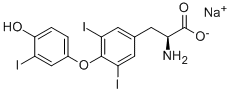
Antigen
| Name | Triiodothyronine T3 |
| 别名 | liothyronine; 55-06-1; 6893-02-3; T3; RT3; r-T3; Reverse T3;(2S)-2-Amino-3-[4-(4-Hydroxy-3,5-Diiodophenoxy)-3-Iodophenyl]propanoic Acid; 3,3′,5′-Triiodo-L-thyronine; O-(4-Hydroxy-3-iodophenyl)-3,5-diiodo-L-tyrosine, Liothyronine; 3,5,3′-triiodothyronine; T3; 3,5,3′-triiodothyronine (T3) |
Description
| Name | Anti-Triiodothyronine (T3) antibody |
| 别名 | liothyronine Antibody; Polyclonal Triiodothyronine antibody, Anti-Triiodothyronine antibody, T3 antibody |
| Host | Mouse; Goat; Rabbit |
| Antibody Product Type | Primary |
| Conjugate | Unconjugated; Biotin; APC; Alkaline Phosphatase (AP); FITC; HRP; PE |
| Specifity | Recognizes Triiodothyronine. Reacts with T3-BSA and free triiodothyronine (T3). |
| Application | ELISA; Immunohistochemistry (IHC); Western Blotting (WB); Immunofluorescence (fixed cells) (IF/ICC); Immunoprecipitation (IP); Cell-ELISA (cELISA); Immunoassay (IA); Immunocytochemistry (ICC) |
Properties
| Form | Liquid/Lyophilized |
| Handling | The antibody solution should be gently mixed before use. |
| Storage Condition | Store at 4°C for frequent use. Stored at -20°C in a manual defrost freezer for a year without detectable loss of activity. Avoid repeated freeze-thaw cycles. |
| Clonality | Monoclonal/Polyclonal |
| Isotype | IgG |
Safety Information
| RIDADR | NONH for all modes of transport |
| WGK Germany | WGK 2 |
| Flash Point(F) | Not applicable |
| Flash Point(C) | Not applicable |
Images
Other Info
| About the antigen | It is a hormone made by the thyroid gland. It has three iodine molecules attached to its molecular structure. It is the most powerful thyroid hormone, and affects almost every process in the body, including body temperature, growth, and heart rate. It affects almost every physiological process in the body, including growth and development, metabolism, body temperature, and heart rate. The thyroid hormones, thyroxine (T4) and triiodothyronine (T3), are tyrosine-based hormones produced by the thyroid gland primarily responsible for regulation of metabolism. An important component in the synthesis of thyroid hormones is iodine. The major form of thyroid hormone in the blood is thyroxine (T4), which has a longer half life than T3. 3,3′,5-Triiodo-L-thyronine also referred to as O-(4-Hydroxy-3-iodophenyl)-3,5-diiodo-L-tyrosine or T3 is the biologically active thyroid hormone. In hypothyroidism pateints, triiodothyronine enhances mood and neuropsychological function. The product also positively regulates the hepatic FGF21 expression and stimulates the metabolic breakdown of glucose, fats, and proteins by enhancing the levels of numerous metabolic enzymes such as hexokinase, liver glucose 6-phosphatase as well as mitochondrial enzymes for oxidative phosphorylation. Additionally, the product facilitates the normal body growth in children and is pivotal for central nervous system maturation in foetus. |