1-(2-NAPHTHYL)METHANAMINE CAS#: 2018-90-8; 凯望编码 (ChemWhat Code): 201624

Identification
| 英文名 | 1-(2-NAPHTHYL)METHANAMINE |
| IUPAC Name | naphthalen-2-ylmethanamine |
| 分子结构 | 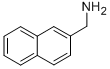 |
| CAS编号 | 2018-90-8 |
| MDL Number | MFCD01529867 |
| 别名 | 1-(2-NAPHTHYL)METHANAMINE 899-666-0 2018-90-8 2-Naphthalenemethanamine naphthalen-2-ylmethanamine 2-(Aminomethyl)naphthalene 2-naphthylmethanamine MFCD01529867 2-Aminomethylnaphthalene (naphthalen-2-yl)methanamine (naphthalene-2-yl)methylamine Naphthalen-2-methylamine C-Naphthalen-2-yl-methylamine 2-naphthylmethylamine 2-Aminomethylnapthalene 2-naphthalenemethylamine SCHEMBL42223 SCHEMBL131652 SCHEMBL2003901 SCHEMBL6643495 SCHEMBL6897074 C-naphethalene-2-yl-methylamine SCHEMBL27678365 (C-naphthalene-2-yl)methylamine DTXSID40174012 XBCAHQUVHHVHHL-UHFFFAOYSA-N AKOS000133202 CS-W002778 FN15510 SB76533 BS-13623 SY023509 EN300-33147 AB01018358-01 1-(2-Naphthyl) methanamine;Naphthalen-2-methylamine |
| 分子式 | C11H11N |
| 分子量 | 157.21 |
| InChI | InChI=1S/C11H11N/c12-8-9-5-6-10-3-1-2-4-11(10)7-9/h1-7H,8,12H2 |
| InChI Key | XBCAHQUVHHVHHL-UHFFFAOYSA-N |
| SMILES | C1=CC=C2C=C(C=CC2=C1)CN |
| Patent Information | ||
| Patent ID | Title | Publication Date |
| CN114805106 | Preparation method of amide compound | 2022 |
| CN114773252 | Chiral amino indoline derivative as well as preparation method and application thereof | 2022 |
| CN106928037 | Preparation method of carvone | 2017 |
| CN107417623 | One-step synthesis method of 5-diarylamino benzimidazole derivatives | 2017 |
| EP2810944 | HETEROCYCLIC COMPOUND HAVING ANTI-HIV ACTIVITY | 2014 |
| US2007/179115 | Purinenucleoside derivative modified in 8-position and medical use thereof | 2007 |
| US6337398 | Succinoylamino hydroxyethylamino sulfonyl urea derivatives useful as retroviral protease inhibitors | 2002 |
Physical Data
| Appearance | White powder |
| Melting Point, °C |
| 55 – 57 |
| 55 – 56 |
| 55 – 56 |
| 269 |
| 58 |
| 59 – 60 |
| 60 |
| Boiling Point, °C | Pressure (Boiling Point), Torr |
| 143 – 147 | 8 |
| 180 | 24 |
| 148 – 149 | 12 |
Spectra
| Description (NMR Spectroscopy) | Nucleus (NMR Spectroscopy) | Solvents (NMR Spectroscopy) | Frequency (NMR Spectroscopy), MHz |
| Chemical shifts, Spectrum | 1H | dimethylsulfoxide-d6 | |
| Chemical shifts, Spectrum | 13C | dimethylsulfoxide-d6 | |
| Chemical shifts, Spectrum | 1H | chloroform-d1 | |
| Chemical shifts | 1H | chloroform-d1 | |
| Chemical shifts, Spectrum | 1H | chloroform-d1 | 400.1 |
| Chemical shifts, Spectrum | 13C | chloroform-d1 | 100.6 |
| Chemical shifts, Spectrum | 1H | chloroform-d1 |
| Description (IR Spectroscopy) | Solvent (IR Spectroscopy) |
| Bands | potassium bromide |
| ATR (attenuated total reflectance), Bands | neat (no solvent, solid phase) |
| ATR (attenuated total reflectance), Bands | |
| FT-IR, in KBr | |
| Bands | KBr |
| Bands | KBr |
Route of Synthesis (ROS)

| Conditions | Yield |
| With piperidin-2-one; sodium tetrahydroborate; N,N-diisopropyl-4H-benzo[d][1,3,2]dioxaborinin-2-amine; ammonia In 1,2-dichloro-ethane at 20℃; | 99% |
| With ammonia; hydrogen In methanol at 120℃; under 15001.5 Torr; for 4h; Autoclave; Experimental Procedure A method to catalyze the reductive amination of aldehydes and ketones to prepare primary amines, except that “benzaldehyde” in step 2) of Example 1 is replaced with “2-naphthaldehyde” and “reaction at 90°C for 4h” is replaced with “120°C” Except for the reaction for 4h”, everything else was exactly the same as in Example 1. The yield of 2-naphthylmethylamine was 99%. | 99% |
| With ammonium hydroxide; hydrogen In ethanol at 130℃; under 7500.75 Torr; for 12h; Autoclave; Experimental Procedure 2.4. General procedure of the reductive amination General procedure: The reductive amination of carbonyl compounds was performed in a 50 mL stainless steel autoclave reactor. In a typical run, benzaldehyde (1 mmol), Co(at)NC-800 (20 mg), ethanol (8 mL) and NH3.H2O (26.5 wt%, 2 mL) were charged into the reactor, and then the autoclave reactor was closed. The reactor was flushed with H2 for several times to remove air, and then charged with 1 MPa H2 at room temperature. The reaction was then carriedout at 130 °C for 12 h with a stirring rate of 1000 RPM. After reaction,the reaction mixture was cooled down to room temperature and then depressurized. Then, the products in the reaction mixture were detected by gas chromatography by the use of ethylbenzene as the internal standard. The products were also identified by GC/MS (Shimadzu GCMS-QP2010) equipped with Agilent capillary column DB-5MS. | 93.6% |
Safety and Hazards
| Pictogram(s) |   |
| Signal | Warning |
| GHS Hazard Statements | H302 (50%): Harmful if swallowed [Warning Acute toxicity, oral] H315 (100%): Causes skin irritation [Warning Skin corrosion/irritation] H319 (100%): Causes serious eye irritation [Warning Serious eye damage/eye irritation] H335 (100%): May cause respiratory irritation [Warning Specific target organ toxicity, single exposure; Respiratory tract irritation] H411 (50%): Toxic to aquatic life with long lasting effects [Hazardous to the aquatic environment, long-term hazard] |
| Precautionary Statement Codes | P261, P264, P264+P265, P270, P271, P273, P280, P301+P317, P302+P352, P304+P340, P305+P351+P338, P319, P321, P330, P332+P317, P337+P317, P362+P364, P391, P403+P233, P405, and P501 (The corresponding statement to each P-code can be found at the GHS Classification page.) |
Other Data
| Transportation | Store at around 0 ℃ |
| HS Code | |
| Storage | Store at around 0 ℃ |
| Shelf Life | 1 year |
| Market Price |
| Druglikeness | |
| Lipinski rules component | |
| 分子量 | 157.215 |
| logP | 2.41 |
| HBA | 1 |
| HBD | 1 |
| Matching Lipinski Rules | 4 |
| Veber rules component | |
| Polar Surface Area (PSA) | 26.02 |
| Rotatable Bond (RotB) | 1 |
| Matching Veber Rules | 2 |
| Use Pattern |
| 2-(Aminomethyl)naphthalene CAS 2018-90-8 is mainly used as an intermediate in pharmaceutical synthesis and organic chemistry for producing functional compounds. |
试剂采购 | |
| 没有试剂厂商? | 向凯望发送快速询价 |
| 想要被列为试剂厂商? (付费服务) | 点击这里联系凯望 |
认证生产商 | |
| Caming Pharmaceutical Limited | http://www.caming.com/ |
| 想要被列为认证生产商 (需要通过认证)? | 请下载并填写 这份表格并发邮件到approved-manufacturers@chemwhat.com |
其他供应商 | |
| Watson International Limited | 访问Watson官网 |
如需其他帮助,请联系我们 | |
| 联系我们获取其它信息或服务 | 点击这里联系凯望 |