1,1′-BIS(DIISOPROPYLPHOSPHINO)FERROCENE CAS#: 97239-80-0; 凯望编码 (ChemWhat Code): 35929

Identification
| 英文名 | 1,1′-BIS(DIISOPROPYLPHOSPHINO)FERROCENE |
| IUPAC Name | DiPPF1 |
| 分子结构 | 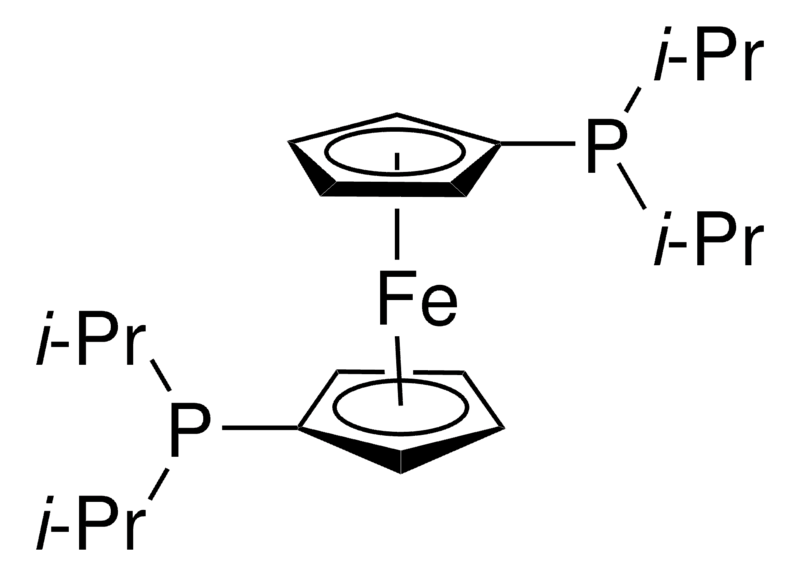 |
| CAS编号 | 97239-80-0 |
| EINECS Number | No data available |
| MDL Number | MFCD02684559 |
| Beilstein Registry Number | No data available |
| 别名 | 1,1′-bis(diisopropylphosphino)ferroceneDiPPF1,1’-bis(diisopropylphosphino)ferrocene1,1′-bis(diisopropylphosphino)ferroceneDiPrPFbis(diisopropylphosphino)ferrocenedipf |
| 分子式 | C22H36FeP2 |
| 分子量 | 418.323 |
| InChI | InChI=1S/2C11H23P.Fe/c21-9(2)12(10(3)4)11-7-5-6-8-11;/h29-11H,5-8H2,1-4H3; |
| InChI Key | XUUUHBFNNJSDAR-UHFFFAOYSA-N |
| Canonical SMILES | CC(C)P([C]1[CH][CH][CH][CH]1)C(C)C.CC(C)P([C]1[CH][CH][CH][CH]1)C(C)C.[Fe] |
| Patent Information | ||
| Patent ID | Title | Publication Date |
| CN104861001 | A ferrocene diphosphine ligand preparation method | 2017 |
Physical Data
| Appearance | Orange yellow powder |
| Solubility | Insoluble in water. |
| Flash Point | 230 °F |
| Refractive index | No data available |
| Sensitivity | Air Sensitive & Hygroscopic |
| Melting Point, °C |
| 48 – 51 |
Spectra
| Description (NMR Spectroscopy) | Nucleus (NMR Spectroscopy) | Solvents (NMR Spectroscopy) | Temperature (NMR Spectroscopy), °C |
| Chemical shifts | 1H | benzene-d6 | 25 |
| Chemical shifts | 13C | benzene-d6 | 25 |
| Chemical shifts | 31P | benzene-d6 | 25 |
| Chemical shifts, Spectrum | 31P | benzene-d6 | 24.84 |
| Description (IR Spectroscopy) | Solvent (IR Spectroscopy) | Comment (IR Spectroscopy) |
| Bands | potassium bromide | 488 cm**-1 – 2968 cm**-1 |
| Description (Mass Spectrometry) | Comment (Mass Spectrometry) |
| high resolution mass spectrometry (HRMS), spectrum | |
| Molecular peak, Fragmentation pattern |
| Description (UV/VIS Spectroscopy) | Absorption Maxima (UV/VIS), nm | Ext./Abs. Coefficient, l·mol-1cm-1 |
| dichloromethane | 445 | 110 |
Route of Synthesis (ROS)

| Conditions | Yield |
| Stage #1: acetylacetonato(1,5-cyclooctadiene)rhodium(I) With tetrafluoroboric acid In butanone-2; water for 0.25h; Stage #2: 1,5-cis,cis-cyclooctadiene In water; butanone at 30℃; Stage #3: 1,1′-bis(diisopropylphosphino)ferrocene In water; butanone at 50℃; | 91% |
Safety and Hazards
| GHS Hazard Statements | Not Classified |
Other Data
| Transportation | Class 6.1; Packaging Group: II; UN Number: 2671 |
| Under the room temperature and away from light | |
| HS Code | 290621 |
| Storage | Under the room temperature and away from light |
| Shelf Life | 1 year |
| Market Price | USD 45/kg |
| Druglikeness | |
| Lipinski rules component | |
| 分子量 | 418.322 |
| HBA | 0 |
| HBD | 0 |
| Matching Lipinski Rules | 3 |
| Veber rules component | |
| Polar Surface Area (PSA) | 27.18 |
| Rotatable Bond (RotB) | 0 |
| Matching Veber Rules | 2 |
| Use Pattern |
| Homogeneous catalyst ligand DiPPF is widely used in homogeneous catalytic reactions, especially in transition metal catalytic reactions, such as palladium-catalyzed cross-coupling reactions (such as Suzuki, Heck, Stille and Sonogashira reactions). Its diphosphine ligand structure can effectively stabilize transition metal centers such as palladium, rhodium and nickel, thereby improving the activity and selectivity of the catalyst. Due to its steric hindrance and electronic effects, DiPPF can significantly improve the yield and efficiency of catalytic reactions and has important applications in the synthesis of complex organic molecules. |
| Drug synthesis In pharmaceutical chemistry, 1,1′-bis(diisopropylphosphino)ferrocene can be used as a catalyst ligand to synthesize biologically active drug molecules. Its catalytic system helps to reduce side reactions and improve the selectivity of target products, which is of great significance in the development of new drugs. |
| Fine chemical synthesis DiPPF is widely used in the synthesis of fine chemicals, fragrances and agricultural chemicals, especially chemical reactions that require high selectivity and high efficiency. Due to its significant promotion of palladium-catalyzed coupling reactions, various complex aromatic and olefin compounds can be synthesized. |
| Materials Science In materials science, DiPPF can be used to synthesize organic electronic materials and functional polymers, such as materials for organic light-emitting diodes (OLEDs) and organic photovoltaic cells (OPVs). Its ligand effect helps to regulate the electronic properties of metal centers, thereby improving the optoelectronic properties of materials. |
| Academic Research In academic research, 1,1′-bis(diisopropylphosphino)ferrocene is widely used as a model ligand to study metal-ligand interactions, catalytic reaction mechanisms, and the development of new catalytic systems. It is used as a tool in coordination chemistry to study different metal complexes and to explore the structure-activity relationship of catalysts. |
试剂采购 | |
| 没有试剂厂商? | 向凯望发送快速询价 |
| 想要被列为试剂厂商? (付费服务) | 点击这里联系凯望 |
认证生产商 | |
| 想要被列为认证生产商 (需要通过认证)? | 请下载并填写 这份表格并发邮件到approved-manufacturers@chemwhat.com |
其他供应商 | |
| Watson International Limited | 访问Watson官网 |
如需其他帮助,请联系我们 | |
| 联系我们获取其它信息或服务 | 点击这里联系凯望 |