1,1,2,2-Tetrakis(4-(4,4,5,5-tetramethyl-1,3,2-dioxaborolan-2-yl)phenyl)ethene CAS#: 1660996-72-4; 凯望编码 (ChemWhat Code): 1491394

Identification
| 英文名 | 1,1,2,2-Tetrakis(4-(4,4,5,5-tetramethyl-1,3,2-dioxaborolan-2-yl)phenyl)ethene |
| IUPAC名称 | 4,4,5,5-tetramethyl-2-[4-[1,2,2-tris[4-(4,4,5,5-tetramethyl-1,3,2-dioxaborolan-2-yl)phenyl]ethenyl]phenyl]-1,3,2-dioxaborolane |
| 分子结构 | 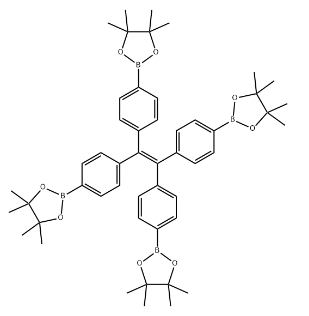 |
| CAS编号 | 1660996-72-4 |
| 别名 | 1,1,2,2-Tetrakis(4-(4,4,5,5-tetramethyl-1,3,2-dioxaborolan-2-yl)phenyl)ethene 1660996-72-4 YSZC726 MFCD31700765 4,4,5,5-tetramethyl-2-[4-[1,2,2-tris[4-(4,4,5,5-tetramethyl-1,3,2-dioxaborolan-2-yl)phenyl]ethenyl]phenyl]-1,3,2-dioxaborolane AS-85909 CS-0110315 E74367 2,2′,2”,2”’-(1,1,2,2-Ethenetetrayltetra-4,1-phenylene)tetrakis(4,4,5,5-tetramethyl-1,3,2-dioxaborolane) |
| 分子式 | C50H64B4O8 |
| 分子量 | 836.3 |
| InChI | InChI=1S/C50H64B4O8/c1-43(2)44(3,4)56-51(55-43)37-25-17-33(18-26-37)41(34-19-27-38(28-20-34)52-57-45(5,6)46(7,8)58-52)42(35-21-29-39(30-22-35)53-59-47(9,10)48(11,12)60-53)36-23-31-40(32-24-36)54-61-49(13,14)50(15,16)62-54/h17-32H,1-16H3 |
| InChI Key | IMKQIUDDYPXPIU-UHFFFAOYSA-N |
| SMILES | B1(OC(C(O1)(C)C)(C)C)C2=CC=C(C=C2)C(=C(C3=CC=C(C=C3)B4OC(C(O4)(C)C)(C)C)C5=CC=C(C=C5)B6OC(C(O6)(C)C)(C)C)C7=CC=C(C=C7)B8OC(C(O8)(C)C)(C)C |
Physical Data
No data available
Spectra
| Description (NMR Spectroscopy) | Nucleus (NMR Spectroscopy) | Solvents (NMR Spectroscopy) | Temperature (NMR Spectroscopy), °C | Frequency (NMR Spectroscopy), MHz |
| Chemical shifts, Spectrum | 1H | chloroform-d1 | 24.84 | |
| Chemical shifts, Spectrum | 1H | chloroform-d1 | ||
| Chemical shifts | 1H | chloroform-d1 | 400 | |
| Chemical shifts | 1H | chloroform-d1 | 300 | |
| Chemical shifts | 1H | chloroform-d1 | 400 | |
| Chemical shifts | 1H | chloroform-d1 | ||
| Chemical shifts | 13C | chloroform-d1 |
| 1,1,2,2-Tetrakis(4-(4,4,5,5-tetramethyl-1,3,2-dioxaborolan-2-yl)phenyl)ethene CAS#: 1660996-72-4 NMR | 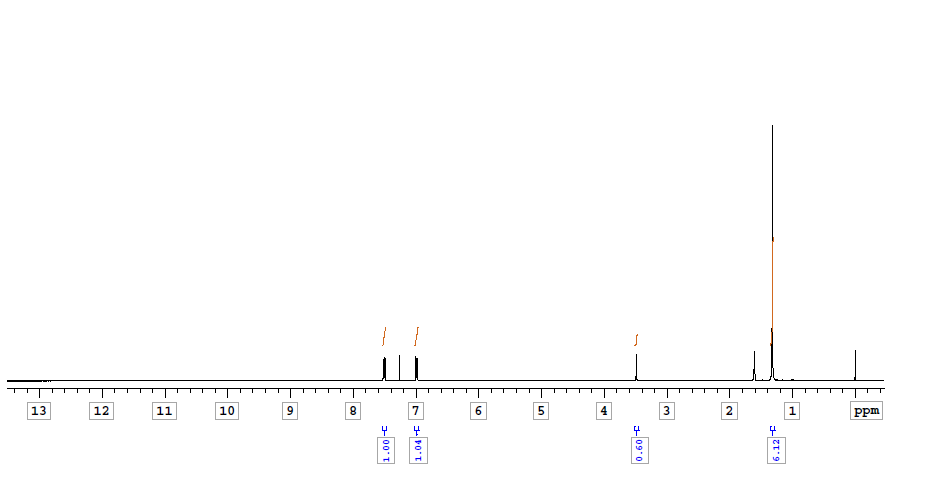 |
| Description (IR Spectroscopy) | Solvent (IR Spectroscopy) |
| Bands | potassium bromide |
| Bands, Spectrum |
Route of Synthesis (ROS)

| Conditions | Yield |
| Stage #1: 1,1,2,2-tetrakis(4-bromophenyl)ethene; bis(pinacol)diborane With potassium acetate In 1,4-dioxane for 1h; Inert atmosphere; Stage #2: With (1,1′-bis(diphenylphosphino)ferrocene)palladium(II) dichloride In 1,4-dioxane Inert atmosphere; Experimental Procedure 5.1 (1) Preparation of tetrakis (pinacol borate) tetraphenylene Put tetrabromotetraphenylethylene (0.1mmol), bipinacol borate (1.0mmol), potassium acetate (1mmol) into the 1,4-dioxane solvent single-neck bottle equipped with 30mL, pass nitrogen 60 minute. Weigh 1,1′-bisdiphenylphosphinoferrocene palladium dichloride, put it into the above-mentioned single-necked flask, and let it pass nitrogen for half an hour. Continue heating to reflux in a nitrogen atmosphere overnight, cool the reaction system, pour the reaction solution into a beaker containing 500 mL of water, and extract with dichloromethane. The organic phase was collected and dried, mixed with silica gel, and sampled by dry method, and purified by column using dichloromethane/methanol (volume ratio of 10:1) as a developing solvent to obtain the intermediate tetrakis (pinacol borate) tetraphenyl Ethylene, 85% yield. | 85% |
| With (1,1′-bis(diphenylphosphino)ferrocene)palladium(II) dichloride; potassium acetate In 1,4-dioxane Inert atmosphere; Reflux; Experimental Procedure 5.1 (1) Preparation of tetrakis (pinacol borate) tetraphenylene Put tetrabromotetraphenylethylene (0.1mmol), bipinacol borate (1.0mmol), potassium acetate (1mmol) into the 1,4-dioxane solvent single-neck bottle equipped with 30mL, pass nitrogen 60 minute. Weigh 1,1′-bisdiphenylphosphinoferrocene palladium dichloride, put it into the above-mentioned single-necked flask, and let it pass nitrogen for half an hour. Continue heating to reflux in a nitrogen atmosphere overnight, cool the reaction system, pour the reaction solution into a beaker containing 500 mL of water, and extract with dichloromethane. The organic phase was collected and dried, mixed with silica gel, and sampled by dry method, and purified by column using dichloromethane/methanol (volume ratio of 10:1) as a developing solvent to obtain the intermediate tetrakis (pinacol borate) tetraphenyl Ethylene, 85% yield. | 85% |
| With dichloro(1,1′-bis(diphenylphosphanyl)ferrocene)palladium(II)*CH2Cl2; potassium acetate In 1,4-dioxane at 110℃; for 72h; Inert atmosphere; | 83% |
Safety and Hazards
| GHS Hazard Statements | Not Classified |
Other Data
| Transportation | Under the room temperature and away from light |
| HS Code | |
| Storage | Under the room temperature and away from light |
| Shelf Life | 1 year |
| Market Price |
| Druglikeness | |
| Lipinski rules component | |
| 分子量 | 836.297 |
| logP | -14.8 |
| HBA | 8 |
| HBD | 0 |
| Matching Lipinski Rules | 2 |
| Veber rules component | |
| Polar Surface Area (PSA) | 73.84 |
| Rotatable Bond (RotB) | 8 |
| Matching Veber Rules | 2 |
| Use Pattern |
| 1,1,2,2-Tetrakis(4-(4,4,5,5-tetramethyl-1,3,2-dioxaborolan-2-yl)phenyl)ethene has important applications in the field of materials science. It serves as a starting material for the synthesis of organic semiconductor materials, fluorescent materials, and light-emitting diode materials. By modifying and functionalizing its structure, the optical, electronic, and conductivity properties of materials can be controlled, enabling their use in optoelectronic devices, light sensors, organic solar cells, and other fields. |
试剂采购 | |
| 没有试剂厂商? | 向凯望发送快速询价 |
| 想要被列为试剂厂商? (付费服务) | 点击这里联系凯望 |
认证生产商 | |
| Warshel Chemical Ltd | https://www.warshel.com/ |
| 想要被列为认证生产商 (需要通过认证)? | 请下载并填写 这份表格并发邮件到approved-manufacturers@chemwhat.com |
其他供应商 | |
| Watson International Limited | 访问Watson官网 |
如需其他帮助,请联系我们 | |
| 联系我们获取其它信息或服务 | 点击这里联系凯望 |