12-Bromododecanoic acid CAS#: 73367-80-3; 凯望编码 (ChemWhat Code): 1119834

Identification
| 英文名 | 12-Bromododecanoic acid |
| IUPAC Name | 12-bromododecanoic acid |
| 分子结构 |  |
| CAS编号 | 73367-80-3 |
| EINECS Number | 277-401-4 |
| MDL Number | MFCD00002738 |
| Beilstein Registry Number | 1771588 |
| 别名 | 12-Bromdodecansäure 12-Bromododecanoic acid 12-Bromolauric acid Acide 12-bromododécanoïque Dodecanoic acid, 12-bromo- 12-Brom-dodecansaeure 12-bromo dodecanoic acid 12-bromo-1-dodecanoic acid 12-bromo-dodecanoic acid 12-Bromododecanoicacid |
| 分子式 | C12H23BrO2 |
| 分子量 | 279.218 |
| InChI | InChI=1S/C12H23BrO2/c13-11-9-7-5-3-1-2-4-6-8-10-12(14)15/h1-11H2,(H,14,15) |
| InChI Key | YYKBWYBUCFHYPR-UHFFFAOYSA-N |
| Canonical SMILES | O=C(O)CCCCCCCCCCCBr |
| Patent Information | ||
| Patent ID | Title | Publication Date |
| CN117624240 | Arctigenin mitochondrial targeting triphenylphosphine derivative, preparation method and application thereof, and drug delivery system | 2024 |
| US2013/131354 | Naphthocyanines for Use as Contrast Agents | 2013 |
| US2015/18515 | METHOD FOR PRODUCING EPOXY COMPOUND AND CATALYST COMPOSITION FOR EPOXIDATION REACTION | 2015 |
Physical Data
| Appearance | Off-white powder |
| Solubility | No data available |
| Flash Point | No data available |
| Refractive index | No data available |
| Sensitivity | No data available |
| Melting Point, °C | Solvent (Melting Point) |
| 54.9 – 55.3 | |
| 53 – 55 | |
| 49 – 50 | |
| 52 | hexane |
| Description (Adsorption (MCS)) | Partner (Adsorption (MCS)) |
| Adsorption | graphite |
| Further physical properties of the adsorbed molecule | MoS2 |
| Further physical properties of the adsorbed molecule | graphite |
Spectra
| Description (NMR Spectroscopy) | Nucleus (NMR Spectroscopy) | Solvents (NMR Spectroscopy) | Frequency (NMR Spectroscopy), MHz |
| Chemical shifts, Spectrum | 1H | chloroform-d1 | 300 |
| Chemical shifts, Spectrum | 13C | chloroform-d1 | |
| Chemical shifts, Spectrum | 1H | dimethylsulfoxide-d6 |
| 12-Bromododecanoic acid CAS#: 73367-80-3 NMR | 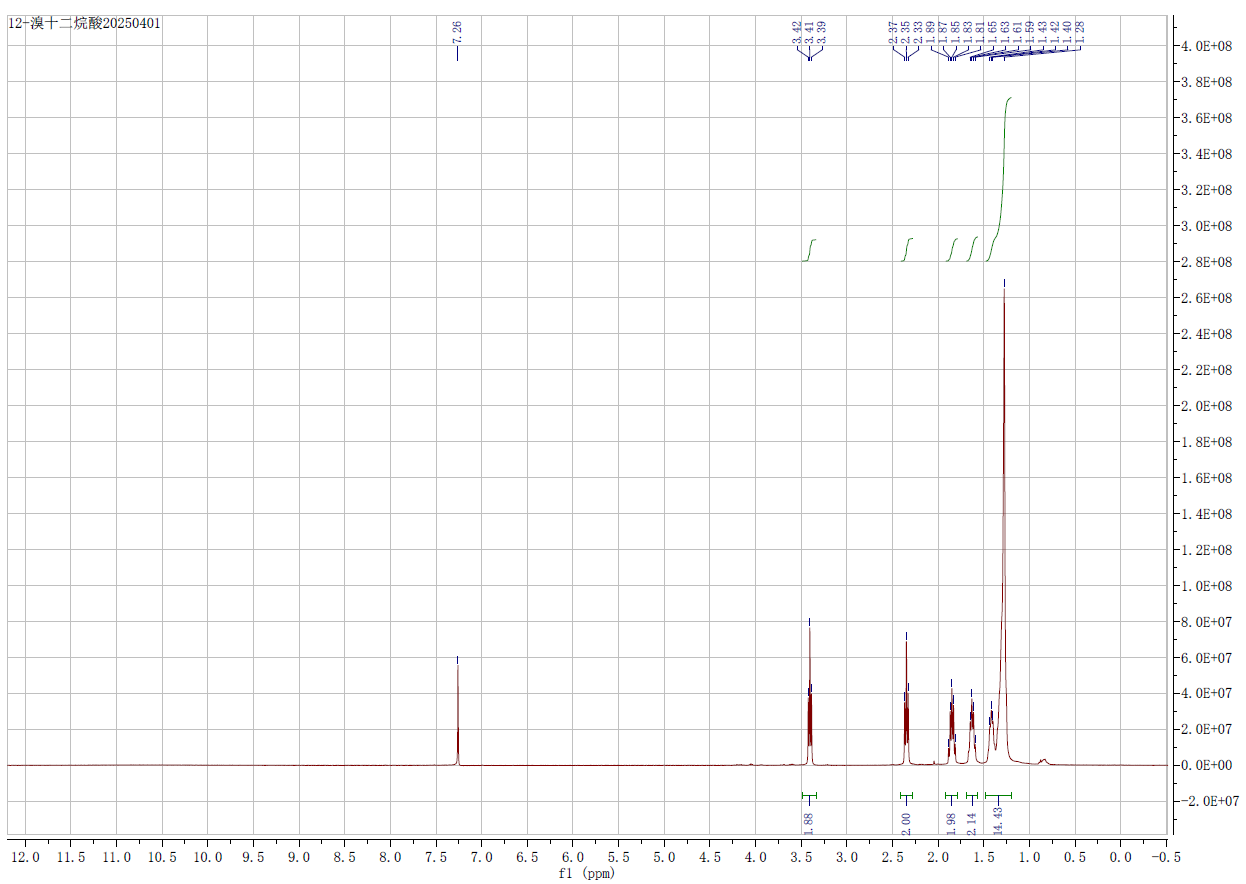 |
| Description (IR Spectroscopy) | Solvent (IR Spectroscopy) |
| Bands | neat (no solvent, solid phase) |
| Description (Mass Spectrometry) |
| electron impact (EI), spectrum |
| high resolution mass spectrometry (HRMS), electrospray ionisation (ESI), liquid chromatography mass spectrometry (LCMS), time-of-flight mass spectra (TOFMS), spectrum |
Route of Synthesis (ROS)
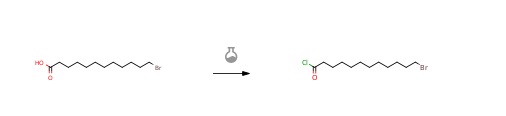
| Conditions | Yield |
| With oxalyl dichloride; N,N-dimethyl-formamide In dichloromethane at 20℃; for 16h; | 100% |
| With oxalyl dichloride; N,N-dimethyl-formamide In chloroform at 45℃; for 2h; Cooling with ice; | 98% |
| With thionyl chloride In N,N-dimethyl-formamide at 80℃; for 1h; |
Safety and Hazards
| Pictogram(s) |  |
| Signal | Warning |
| GHS Hazard Statements | H315 (66.7%): Causes skin irritation [Warning Skin corrosion/irritation] H319 (66.7%): Causes serious eye irritation [Warning Serious eye damage/eye irritation] H335 (66.7%): May cause respiratory irritation [Warning Specific target organ toxicity, single exposure; Respiratory tract irritation] Information may vary between notifications depending on impurities, additives, and other factors. |
| Precautionary Statement Codes | P261, P264, P264+P265, P271, P280, P302+P352, P304+P340, P305+P351+P338, P319, P321, P332+P317, P337+P317, P362+P364, P403+P233, P405, and P501 (The corresponding statement to each P-code can be found at the GHS Classification page.) |
Other Data
| Transportation | NONH for all modes of transport |
| Under the room temperature and away from light | |
| HS Code | No data available |
| Storage | Under the room temperature and away from light |
| Shelf Life | 2 years |
| Market Price | USD |
| Druglikeness | |
| Lipinski rules component | |
| 分子量 | 279.217 |
| logP | 5.341 |
| HBA | 2 |
| HBD | 1 |
| Matching Lipinski Rules | 3 |
| Veber rules component | |
| Polar Surface Area (PSA) | 37.3 |
| Rotatable Bond (RotB) | 11 |
| Matching Veber Rules | 1 |
| Use Pattern |
| Organic synthesis intermediates |
| It is a very useful building block that can introduce esters and amides at the carboxylic acid position and perform nucleophilic substitution (SN2) reactions at the bromine position to construct more complex molecular structures. It is widely used in the development of surfactants, functional materials, pharmaceutical intermediates, etc. |
| Polymer modifiers / grafting initiators |
| It can be used to synthesize polymers with specific terminal functional groups, such as controlling polymerization reactions by bromine-initiated atom transfer radical polymerization (ATRP)**. The carboxylic acid part can be used to graft to the polymer backbone or further react to form ester and amide bonds. |
| Drug and bioactive molecule precursors |
| Although it is not often used as an active drug, it is also used in the construction of precursors in pharmaceutical chemistry or as part of a carrier because it has a long-chain alkyl structure and functional groups. |
| Functionalized material synthesis |
| In the synthesis of self-assembling materials containing bromine functional groups (such as amphiphilic molecules, surfactants, liquid crystal monomers), it is used as one of the building blocks. |
试剂采购 | |
| 没有试剂厂商? | 向凯望发送快速询价 |
| 想要被列为试剂厂商? (付费服务) | 点击这里联系凯望 |
认证生产商 | |
| 想要被列为认证生产商 (需要通过认证)? | 请下载并填写 这份表格并发邮件到approved-manufacturers@chemwhat.com |
其他供应商 | |
| Watson International Limited | 访问Watson官网 |
如需其他帮助,请联系我们 | |
| 联系我们获取其它信息或服务 | 点击这里联系凯望 |