1,3,6-HEXANETRICARBONITRILE CAS#: 1772-25-4; 凯望编码 (ChemWhat Code): 112490

Identification
| 英文名 | 1,3,6-HEXANETRICARBONITRILE |
| IUPAC Name | pyridihexane-1,3,6-tricarbonitrile |
| 分子结构 | 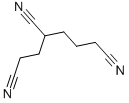 |
| CAS编号 | 1772-25-4 |
| MDL Number | MMFCD00131222 |
| 别名 | 1,3,6-Hexanetricarbonitrile 1772-25-4 hexane-1,3,6-tricarbonitrile 1,3,6-TRICYANOHEXANE 4-Cyanosuberonitrile SJY3YNQ3SI DTXSID4041234 HSDB 5855 UNII-SJY3YNQ3SI EINECS 217-199-7 (+/-)-1,3,6-HEXANETRICARBONITRILE, TECH. , 80+% SCHEMBL1323168 CHEMBL3183751 DTXCID2021234 BAA77225 Tox21_300976 MFCD00129792 AKOS022182701 1,3,6-TRICYANOHEXANE [HSDB] s12371 NCGC00248239-01 NCGC00254878-01 BS-21827 CAS-1772-25-4 CS-0198995 H1504 NS00025841 Q27289244 |
| 分子式 | C9H11N3 |
| 分子量 | 161.2 |
| InChI | InChI=1S/C9H11N3/c10-6-2-1-4-9(8-12)5-3-7-11/h9H,1-5H2 |
| InChI Key | LNLFLMCWDHZINJ-UHFFFAOYSA-N |
| Isomeric SMILES | C(CC#N)CC(CCC#N)C#N |
| Patent Information | ||
| Patent ID | Title | Publication Date |
| CN115784927 | Preparation method of alkane trinitrile | 2023 |
| US2021/408602 | ELECTROLYTE AND ELECTROCHEMICAL DEVICE | 2021 |
| US4128571 | Thermal conversion of 4-cyano-suberonitrile to acrylonitrile | 1978 |
| US5132427 | Process for the preparation of amines | 1992 |
Physical Data
| Appearance | Light yellow to yellow oily liquid |
| Boiling Point, °C | Pressure (Boiling Point), Torr |
| 186 – 200 | 0.2 |
Spectra
| Description (NMR Spectroscopy) | Nucleus (NMR Spectroscopy) | Solvents (NMR Spectroscopy) | Frequency (NMR Spectroscopy), MHz |
| Chemical shifts | 1H | chloroform-d1 | |
| Chemical shifts | 13C | chloroform-d1 | |
| Chemical shifts | 1H | chloroform-d1 | 400 |
Route of Synthesis (ROS)
| Conditions | Yield |
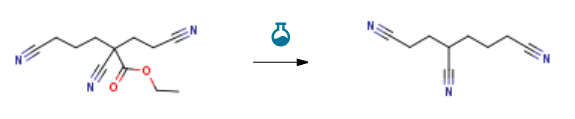
| With water; sodium chloride In dimethyl sulfoxide at 160℃; Reagent/catalyst; Temperature; Solvent; Experimental Procedure 4-8 Preparation of 1,3,6-hexane trinitrile Take 50 grams of 2,5-dicyano-2-cyanoethyl-pentanoic acid ethyl ester prepared in Example 1, add 100 grams of DMSO, add 8 grams of water, 2.5 grams of NaCl, and raise the temperature to 160°C.After the gas no longer overflowed, the DMSO and water were removed by concentration under reduced pressure, and then the distillation was continued to obtain a product of 1 mmHg, a fraction at 195-196°C of 32.0 g, a yield of 92.8%, and a GC purity of 99.5%. | 92.8% |
Safety and Hazards
| Pictogram(s) |  |
| Signal | Warning |
| GHS Hazard Statements | H302 (97.62%): Harmful if swallowed [Warning Acute toxicity, oral] H332 (92.86%): Harmful if inhaled [Warning Acute toxicity, inhalation] |
| Precautionary Statement Codes | P261, P264, P270, P271, P301+P317, P304+P340, P317, P330, and P501 (The corresponding statement to each P-code can be found at the GHS Classification page.) |
Other Data
| Transportation | Under the room temperature and away from light |
| HS Code | |
| Storage | Under the room temperature and away from light |
| Shelf Life | 1 year |
| Market Price |
| Druglikeness | |
| Lipinski rules component | |
| 分子量 | 161.206 |
| logP | 0.107 |
| HBA | 3 |
| HBD | 0 |
| Matching Lipinski Rules | 4 |
| Veber rules component | |
| Polar Surface Area (PSA) | 71.37 |
| Rotatable Bond (RotB) | 5 |
| Matching Veber Rules | 2 |
| Use Pattern |
| 1,3,6-HEXANETRICARBONITRILE CAS#: 1772-25-4 is an important electrolyte additive, and the composition of the electrolyte restricts the application of positive and negative electrode materials at high voltages. Traditional organic carbonates, such as linear carbonates like DEC, DMC, EMC, and cyclic carbonates like PC, EC, tend to undergo decomposition at high voltages [2,3]. Therefore, the development of novel organic solvents with a wide electrochemical window, high lithium salt solubility, and low toxicity has become a key focus in the development of high-voltage electrolytes. Nitrile-based organic solvents typically possess a wide electrochemical window, high anodic stability, low viscosity, and high boiling points, among other excellent characteristics [4]. Additionally, the decomposition products of solvents containing nitrile groups are generally carboxylates, aldehydes, or corresponding organic amines, eliminating the generation of toxic CN- ions during usage [5-7]. Nitrile solvents demonstrate a broad electrochemical window and are considered promising new organic solvents. However, in terms of the electrochemical performance of lithium-ion batteries, nitrile solvents still face compatibility issues with the negative electrode. The formation of a mixed system with carbonate solvents or the addition of mixed salts like LiBOB can partially alleviate this issue. |
试剂采购 | |
| 没有试剂厂商? | 向凯望发送快速询价 |
| 想要被列为试剂厂商? (付费服务) | 点击这里联系凯望 |
认证生产商 | |
| 想要被列为认证生产商 (需要通过认证)? | 请下载并填写 这份表格并发邮件到approved-manufacturers@chemwhat.com |
其他供应商 | |
| Watson International Limited | 访问Watson官网 |
如需其他帮助,请联系我们 | |
| 联系我们获取其它信息或服务 | 点击这里联系凯望 |