1H-Benzotriazole CAS#: 95-14-7; 凯望编码 (ChemWhat Code): 50450

Identification
| 英文名 | 1H-Benzotriazole |
| IUPAC名称 | 2H-benzotriazole |
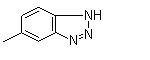
| 分子结构 |  |
| CAS编号 | 95-14-7 |
| EINECS Number | 202-394-1 |
| MDL Number | MFCD00005699 |
| Beilstein Registry Number | 112133 |
| 别名 | 1,2,3-Benzotriazole, benzotriazoel, benzotriazole;CAS#: 95-14-7 |
| 分子式 | C6H5N3 |
| 分子量 | 119.124 |
| InChI | InChI=1S/C6H5N3/c1-2-4-6-5(3-1)7-9-8-6/h1-4H,(H,7,8,9) |
| InChI Key | QRUDEWIWKLJBPS-UHFFFAOYSA-N |
| Canonical SMILES | c1ccc2c(c1)[nH]nn2 |
| Patent Information | ||
| Patent ID | Title | Publication Date |
| KR2020/43648 | METHOD FOR PRODUCING 2,5-FURANDICARBOXYLIC ACID USING IONIC LIQUID AND CARBON DIOXIDE | 2020 |
| CN111217766 | Synthetic method of visible light-promoted β – amine-based selenium ether (by machine translation) | 2020 |
| CN109134392 | N2?- Alkene base benzene and triazole derivatives and its synthesis method (by machine translation) | 2019 |
| CN110204499 | Method for regioselectively synthesizing N – 2-allyl -1, 2, 3 – triazole derivative (by machine translation) | 2019 |
| CN110003187 | Polyfluoroalkyl-substituted benzofuran compound and preparation method thereof (by machine translation) | 2019 |
Physical Data
| Appearance | White Needle, White granular,White powder,White flake |
| Solubility | 25 g/l in water (20 oC) |
| Refractive index | 1.5589 (estimate) |
| Stability | Stable, but may be light sensitive. Incompatible with strong oxidizing agents, heavy metals. |
| Melting Point, °C | Solvent (Melting Point) |
| 98~99 | |
| 96 – 97 | benzene |
| 98~100 | dichloromethane, methanol |
| 98 | CHCl3 |
| 98.5 | benzene, toluene |
| Boiling Point, °C | Pressure (Boiling Point), Torr |
| 180 | 7.50075 |
| Density, g·cm-3 | Type (Density) |
| 1.34 | |
| 1.31 | crystallographic |
| Description (Adsorption (MCS)) | Solvent (Adsorption (MCS)) | Temperature (Adsorption (MCS)), °C | Comment (Adsorption (MCS)) | Partner (Adsorption (MCS)) |
| Adsorption | aq. buffer | copper | ||
| Adsorption | acetonitrile, water | octadecyl silica gel | ||
| Further physical properties of the adsorbed molecule | acetonitrile, water | 20 | diaspher-100-C18 | |
| Adsorption isotherm | H2O | 25 | mercury | |
| Further physical properties of the adsorbed molecule | aq. H2SO4 | copper | ||
| Further physical properties of the adsorbed molecule | influence of an electric field. Object(s) of Study: in the presence of catalysts. Object(s) of Study: decomposition | copper |
| Description (Association (MCS)) | Solvent (Association (MCS)) | Temperature (Association (MCS)), °C | Partner (Association (MCS)) |
| Further physical properties of the complex | CCl4 | 25 | zinc 5,10,15,20-tetraphenylporphyrin |
| Further physical properties of the complex | benzene | 25 | zinc 5,10,15,20-tetraphenylporphyrin |
| IR spectrum of the complex | CCl4 | acetonitrile | |
| Stability constant of the complex with … | CH2Cl2 | 24.9 | diiodine |
| UV/VIS spectrum of the complex | dioxane | 4-nitro-phenol |
Spectra
| Description (NMR Spectroscopy) | Nucleus (NMR Spectroscopy) | Solvents (NMR Spectroscopy) | Frequency (NMR Spectroscopy), MHz |
| Chemical shifts, Spectrum | 1H | chloroform-d1 | 500 |
| Chemical shifts, Spectrum | 13C | chloroform-d1 | 125 |
| Chemical shifts | 1H | dimethylsulfoxide-d6 | 400 |
| Chemical shifts, Spectrum | 1H | dimethylsulfoxide-d6, trifluoroacetic acid-d1 | 300 |
| Spectrum | 14N | liquid carbon dioxide, acetone | 50.7 |
| Linewidth of NMR absorption | 14N |
| Description (IR Spectroscopy) | Solvent (IR Spectroscopy) | Temperature (IR Spectroscopy), °C | Comment (IR Spectroscopy) |
| Bands | neat (no solvent, solid phase) | ||
| Bands, Spectrum | potassium bromide | ||
| Bands | gaseous matrix | -261.16 – -259.16 | |
| Spectrum | KBr | 900 – 600 1/cm | |
| Spectrum | gas | 1700 – 650 cm**(-1) | |
| Bands | D2O | 3077 – 213 cm**(-1) |
| Description (Mass Spectrometry) |
| liquid chromatography mass spectrometry (LCMS), spectrum |
| electrospray ionisation (ESI), spectrum |
| high resolution mass spectrometry (HRMS), spectrum |
| time-of-flight mass spectra (TOFMS), spectrum |
| high resolution mass spectrometry (HRMS), electrospray ionisation (ESI), liquid chromatography mass spectrometry (LCMS), fragmentation pattern, spectrum |
| HRMS (High resolution mass spectrometry), Spectrum |
| spectrum, electron impact (EI) |
| Description (UV/VIS Spectroscopy) | Solvent (UV/VIS Spectroscopy) | Comment (UV/VIS Spectroscopy) | Absorption Maxima (UV/VIS), nm |
| Spectrum | N,N-dimethyl-formamide | ||
| Spectrum | water | 256 | |
| in the presence of additive(s), Spectrum | water | ||
| Spectrum | neat (no solvent, solid phase) | 180, 255, 270 | |
| Spectrum | alkaline aq. solution | ||
| Spectrum | gaseous matrix | low temperature | |
| Absorption maxima | gaseous matrix | 268, 273, 279 | |
| UV/VIS | |||
| Spectrum | aq. HCl / methanol, NaOH / methanol | 210 – 300 nm | |
| Spectrum | sodium methanolate / methanol | 200 – 300 nm |
Route of Synthesis (ROS)

| Conditions | Yield |
| With thionyl chloride In dichloromethane at 25℃; for 2h; | 97% |
| With thionyl chloride In dichloromethane at 20℃; | 93% |
| Stage #1: 1,2,3-Benzotriazole With thionyl chloride In tetrahydrofuran at 20℃; for 0.5h; Stage #2: 2-thiophenylcarboxylic acid In tetrahydrofuran at 20℃; for 2h; | 90% |
| With thionyl chloride | |
| Stage #1: 1,2,3-Benzotriazole With thionyl chloride In dichloromethane at 20℃; for 0.5h; Inert atmosphere; Stage #2: 2-thiophenylcarboxylic acid In dichloromethane at 20℃; for 2h; Inert atmosphere; |
Safety and Hazards
| Pictogram(s) |   |
| Signal | Warning |
| GHS Hazard Statements | H302 (98.63%): Harmful if swallowed [Warning Acute toxicity, oral] H319 (83.65%): Causes serious eye irritation [Warning Serious eye damage/eye irritation] H332 (42%): Harmful if inhaled [Warning Acute toxicity, inhalation] H411 (12.11%): Toxic to aquatic life with long lasting effects [Hazardous to the aquatic environment, long-term hazard] H412 (43.26%): Harmful to aquatic life with long lasting effects [Hazardous to the aquatic environment, long-term hazard] Information may vary between notifications depending on impurities, additives, and other factors. |
| Precautionary Statement Codes | P261, P264, P270, P271, P273, P280, P301+P312, P304+P312, P304+P340, P305+P351+P338, P312, P330, P337+P313, P391, and P501 (The corresponding statement to each P-code can be found at the?GHS Classification?page.) |
Other Data
| Transportation | NONH for all modes of transport |
| Under the room temperature and away from light | |
| HS Code | 293399 |
| Storage | Under the room temperature and away from light |
| Shelf Life | 2 yearS |
| Market Price | USD 6/kg |
| Druglikeness | |
| Lipinski rules component | |
| 分子量 | 119.126 |
| logP | 1.199 |
| HBA | 3 |
| HBD | 1 |
| Matching Lipinski Rules | 4 |
| Veber rules component | |
| Polar Surface Area (PSA) | 41.57 |
| Rotatable Bond (RotB) | 0 |
| Matching Veber Rules | 2 |
| Bioactivity |
| In vitro: Efficacy |
| Quantitative Results |
| pX | Parameter | Value (qual) | Value (quant) | Unit | Target | Effect |
| 4 | inhibition rate | < | 50 | % | Teleost-specific glutathione S-transferase Gstr1 [zebra fish]:Wild | |
| 3.7 | IC50 | = | 200 | μM | Ntpase/Helicase NS3 [Hepatitis C virus]:Wild | |
| 3.41 | NOAEC | 46 | mg/L | Toxic | ||
| 3.26 | LC50 | 3.3 | mg/L | Toxic | ||
| 3.11 | LOAEC | 92 | mg/L | Toxic | ||
| 3.07 | EC50 | 102 | mg/L | Toxic | ||
| 2.28 | Ki (inhibition constant) | 5200 | μm | enzyme:Wild | antifungal agent | |
| 1.76 | MIC | = | 17.6 | mM | High voltage-activated calcium channel [rat]:Wild | |
| ZI (zone of inhibition) | 8 | mm | antibiotic agent | |||
| Activity(Gross effect) | Active | |||||
| percentage(Ionized) | = | 0.0002 | % | |||
| tested(relative to control (100%)) | Not Published | antibiotic agent |
| Use Pattern |
| 1H-Benzotriazole CAS#: 95-14-7 Coating/paints/lacquers |
| 1H-Benzotriazole CAS#: 95-14-7 photocatalyst in an acidic anti-mould and anti-fungal photocatalytic coating film composition |
| 1H-Benzotriazole CAS#: 95-14-7 photocatlyst to generate strong oxidizing compounds which decompose harmful organic compounds and provide protection for the acidic environment by decomposing neutralizing chemicals from outside |
| ultraviolet absorbing agent |
| Anticorrosive agent for a liquid sterilant composition used for sterilizing medical instruments |
| as sequestering agent for the coloring composition for dyeing a fibrous structure |
| Remove mildew from trains |
Related Chemicals
试剂采购 | |
| 没有试剂厂商? | 向凯望发送快速询价 |
| 想要被列为试剂厂商? (付费服务) | 点击这里联系凯望 |
认证生产商 | |
| Watsonnoke Scientific Ltd | https://www.watsonnoke.com/ |
| 想要被列为认证生产商 (需要通过认证)? | 请下载并填写 这份表格并发邮件到approved-manufacturers@chemwhat.com |
其他供应商 | |
| Watson International Limited | 访问Watson官网 |
如需其他帮助,请联系我们 | |
| 联系我们获取其它信息或服务 | 点击这里联系凯望 |