(1S,2S)-2-Fluorocyclopropanecarboxylic acid CAS#: 127199-14-8; 凯望编码 (ChemWhat Code): 1411675

Identification
| 英文名 | (1S,2S)-2-Fluorocyclopropanecarboxylic acid |
| IUPAC Name | (1S,2S)-2-fluorocyclopropane-1-carboxylic acid |
| 分子结构 | 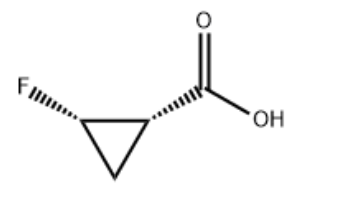 |
| CAS编号 | 127199-14-8 |
| 别名 | (1S,2S)-2-fluorocyclopropanecarboxylic acid 127199-14-8 105919-34-4 cis-2-fluorocyclopropanecarboxylic acid (1s,2s)-2-fluorocyclopropane-1-carboxylic acid cis-2-Fluorocyclopropane-1-carboxylic acid cis-2-Fluoro-cyclopropanecarboxylic acid (1S,2S)-rel-2-Fluorocyclopropanecarboxylic acid Cyclopropanecarboxylic acid, 2-fluoro-, (1S-cis)- MFCD19237459 (cis)-2-fluorocyclopropanecarboxylic acid Cyclopropanecarboxylic acid, 2-fluoro-, (1S,2S)- (1S,2S)-2-fluorocyclopropanecarboxylicacid MFCD04972869 SCHEMBL1463730 AMY5475 DTXSID901262266 CFA19914 CS1221 AKOS006294678 |
| 分子式 | C4H5FO2 |
| 分子量 | 104.08 |
| InChI | InChI=1S/C4H5FO2/c5-3-1-2(3)4(6)7/h2-3H,1H2,(H,6,7)/t2-,3+/m1/s1 |
| InChI Key | HZQKMZGKYVDMCT-GBXIJSLDSA-N |
| Canonical SMILES | C1[C@H]([C@H]1F)C(=O)O |
Physical Data
| Appearance | White solid |
| Melting Point, °C | Solvent (Melting Point) |
| 55 – 56 | |
| 62 – 63 | toluene |
Spectra
| Description (NMR Spectroscopy) | Nucleus (NMR Spectroscopy) | Solvents (NMR Spectroscopy) | Frequency (NMR Spectroscopy), MHz |
| Chemical shifts | 1H | chloroform-d6 | 400 |
| Chemical shifts, Spectrum | 1H | chloroform-d1 | 400 |
| Chemical shifts, Spectrum | 1H | chloroform-d1 | 100 |
| Chemical shifts | 1H | CDCl3 | |
| Chemical shifts | 19F | CDCl3 |
| Description (IR Spectroscopy) | Solvent (IR Spectroscopy) | Temperature (IR Spectroscopy), °C |
| ATR (attenuated total reflectance), Bands | ||
| Bands | KBr | 3210 – 1190 cm**(-1) |
Route of Synthesis (ROS)

Route of Synthesis (ROS) of (1S,2S)-2-Fluorocyclopropanecarboxylic acid
| Conditions | Yield |
| With N-ethyl-N,N-diisopropylamine; N-[(dimethylamino)-3-oxo-1H-1,2,3-triazolo[4,5-b]pyridin-1-yl-methylene]-N-methylmethanaminium hexafluorophosphate In N,N-dimethyl-formamide at 10 – 30℃; for 5h; | 83.4% |
| With N-ethyl-N,N-diisopropylamine; N-[(dimethylamino)-3-oxo-1H-1,2,3-triazolo[4,5-b]pyridin-1-yl-methylene]-N-methylmethanaminium hexafluorophosphate In N,N-dimethyl-formamide at 20℃; | 1.1 g |
| Experimental Procedure DMF (50 mL), (1S,2S)-2-fluorocyclopropanecarboxylic acid (425 mg, 4.1 mmol), HATU (2.1 g, 5.58 mmol) and DIEA (1.44 g, 11.16 mmol) were successively added to compound 4a (1.0 g, 3.71 mmol), and the mixture was stirred at room temperature for 5 h. The reaction was quenched by adding water, extracted 3 times with ethyl acetate and washed twice with saturated brine. The organic phase was dried and concentrated, and the residue was separated and purified by silica gel column chromatography (eluent: EA/PE=1/2) to obtain 117E (1.1 g, 83.4%). LC-MS (ESI): m/z=356.3 [M+H]+. |
Safety and Hazards
| Pictogram(s) |   |
| Signal | Danger |
| GHS Hazard Statements | H314 (100%): Causes severe skin burns and eye damage [Danger Skin corrosion/irritation] H335 (100%): May cause respiratory irritation [Warning Specific target organ toxicity, single exposure; Respiratory tract irritation] |
| Precautionary Statement Codes | P260, P261, P264, P271, P280, P301+P330+P331, P302+P361+P354, P304+P340, P305+P354+P338, P316, P319, P321, P363, P403+P233, P405, and P501 (The corresponding statement to each P-code can be found at the GHS Classification page.) |
Other Data
| Transportation | Store in room temperature for long time and dry place; in container tightly sealed; Protect from light. |
| HS Code | |
| Storage | Store in room temperature for long time and dry place; in container tightly sealed; Protect from light. |
| Shelf Life | 2 years |
| Market Price |
| Druglikeness | |
| Lipinski rules component | |
| 分子量 | 104.081 |
| logP | 0.27 |
| HBA | 2 |
| HBD | 1 |
| Matching Lipinski Rules | 4 |
| Veber rules component | |
| Polar Surface Area (PSA) | 37.3 |
| Rotatable Bond (RotB) | 1 |
| Matching Veber Rules | 2 |
| Use Pattern |
| (1S,2S)-2-Fluorocyclopropanecarboxylic acid CAS#: 127199-14-8 and its derivatives can act as chiral catalysts in asymmetric synthesis reactions. They can guide the reaction selectively to produce chiral products, thereby enhancing the stereo-selectivity and efficiency of the reaction. |
试剂采购 | |
| 没有试剂厂商? | 向凯望发送快速询价 |
| 想要被列为试剂厂商? (付费服务) | 点击这里联系凯望 |
认证生产商 | |
| Caming Pharmaceutical Ltd | http://www.caming.com/ |
| 想要被列为认证生产商 (需要通过认证)? | 请下载并填写 这份表格并发邮件到approved-manufacturers@chemwhat.com |
其他供应商 | |
| Watson International Limited | 访问Watson官网 |
如需其他帮助,请联系我们 | |
| 联系我们获取其它信息或服务 | 点击这里联系凯望 |