2-(1,3-Dioxolan-2-yl)ethyltriphenylphosphonium bromide CAS#: 86608-70-0; 凯望编码 (ChemWhat Code): 69059

Identification
| 英文名 | 2-(1,3-Dioxolan-2-yl)ethyltriphenylphosphonium bromide |
| IUPAC Name | 2-(1,3-dioxolan-2-yl)ethyl-triphenylphosphanium;bromide |
| 分子结构 | 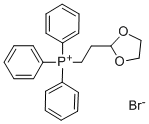 |
| CAS编号 | 86608-70-0 |
| MDL Number | MMFCD00075119 |
| 别名 | 86608-70-0 2-(1,3-Dioxolan-2-yl)ethyltriphenylphosphonium bromide (2-(1,3-Dioxolan-2-yl)ethyl)triphenylphosphonium bromide Phosphonium, [2-(1,3-dioxolan-2-yl)ethyl]triphenyl-, bromide 2-(1,3-dioxolan-2-yl)ethyl-triphenylphosphanium;bromide (2-(1,3-Dioxolan-2-yl)ethyl)triphenyl-phosphonium bromide [2-(1,3-dioxolan-2-yl)ethyl]triphenylphosphanium bromide Phosphonium, (2-(1,3-dioxolan-2-yl)ethyl)triphenyl-, bromide (1:1) Phosphonium, [2-(1,3-dioxolan-2-yl)ethyl]triphenyl-, bromide (1:1) [2-(1,3-dioxolan-2-yl)ethyl]triphenylphosphonium bromide EC 404-940-6 SCHEMBL1454426 DTXSID70888675 BCP21878 MFCD00075119 AKOS015833065 CS-W011599 WS-03265 DB-019355 D2056 F17212 (2-(1,3-Dioxolan-2-yl)ethyl)triphenylphosphoniumbromide 2-(1,3-dioxolan-2-yl)ethyl-triphenylphosphonium bromide [2-(1,3-dioxolan-2-yl)ethyl] triphenylphosphonium bromide [2-(1,3-dioxolan-2-yl)ethyl]-triphenylphosphonium bromide [2-(1,3-dioxolan-2-yl)-ethyl]-triphenylphosphonium bromide 2-(1,3-Dioxolan-2-yl)ethyltriphenylphosphonium bromide, 97% |
| 分子式 | C23H24BrO2P |
| 分子量 | 443.3 |
| InChI | InChI=1S/C23H24O2P.BrH/c1-4-10-20(11-5-1)26(21-12-6-2-7-13-21,22-14-8-3-9-15-22)19-16-23-24-17-18-25-23;/h1-15,23H,16-19H2;1H/q+1;/p-1 |
| InChI Key | ZCJKBPSRKLHANV-UHFFFAOYSA-M |
| Isomeric SMILES | C1=CCC1COC(O1)CC[P+](C2=CC=CC=C2)(C3=CC=CC=C3)C4=CC=CC=C4.[Br-] |
Physical Data
| Appearance | White to Light yellow to Light orange solid |
Spectra
| Description (NMR Spectroscopy) | Nucleus (NMR Spectroscopy) | Solvents (NMR Spectroscopy) | Frequency (NMR Spectroscopy), MHz |
| Chemical shifts | 1H | tetradeuteriomethanol | 400 |
| Spectrum | 1H | tetradeuteriomethanol | 400 |
| Spectrum | 13C | tetradeuteriomethanol | 100 |
| Chemical shifts | 13C | tetradeuteriomethanol | 100 |
| Chemical shifts | 1H | dimethylsulfoxide-d6 | |
| Spin-spin coupling constants | dimethylsulfoxide-d6 |
| Description (IR Spectroscopy) | Solvent (IR Spectroscopy) |
| Bands | KBr |
Route of Synthesis (ROS)

| Conditions | Yield |
| Stage #1: 3-(1-methylethyl)-1-[5-(trifluoromethyl)pyridin-2-yl]-1H-pyrazole-4-carbaldehyde; 2-(1,3-dioxolan-2-yl)ethyl(triphenyl)phosphonium bromide With sodium hydride In DMF (N,N-dimethyl-formamide) at 0 – 70℃; Stage #2: With hydrogen; 5%-palladium/activated carbon In ethanol at 20℃; for 3.5h; Experimental Procedure Reference Example 52 Reference Example 52 To a mixture of2- (1, 3-dioxolan-2- yl) ethyltetraphenylphosphonium bromide (18.95 g) and N, N- dimethylformamide (178 ml) was added sodium hydride (60%, in oil, 1.71 g) at0 C and the mixture was stirred at room temperature for 30 minutes. Then,3-isopropyl-l- [5-(trifluoromethyl)-2-pyridinyl]-lH-pyrazole-4-carbaldehyde (10.09 g) was added and the mixture was stirred at room temperature overnight, and at70 C for 4 hours. The reaction mixture was poured into dilute hydrochloric acid, and extracted with ethyl acetate. The ethyl acetate layer was washed with saturated aqueous sodium chloride solution, dried(MgS04) and concentrated. The residue was subjected to silica gel column chromatography, and a colorless oil was obtained from a fraction eluted with ethyl acetate-hexane (1: 15, volume ratio). A mixture of the obtained oily substance,5% palladium-carbon (1.28 g) and ethanol (174 ml) was stirred at room temperature for 3.5 hours under a hydrogen atmosphere. Palladium-carbon was removed by filtration and the filtrate was concentrated to give2- {4- [3- (1, 3-dioxolan-2-yl)propyl-3-isopropyl-lH-pyrazol-1-yl}-5-(trifluoromethyl) pyridine (12.84 g, yield98%) as a colorless oil. 1H-NMR (CDC13) g : 1.32 (6H, d, J = 7.0 Hz), 1.72-1. 82 (4H, m), 2.46-2. 58 (2H, m), 2.92-3. 10 (1H, m), 3.82-4. 00 (4H, m), 4.88-4. 96 (1H, m), 7.88-7. 98 (1H, m), 8.02 (1H, d, J = 8.4 Hz), 8.27 (1H, s), 8.56-8. 61 (1H, m). | 98% |
Safety and Hazards
| Pictogram(s) |    |
| Signal | Danger |
| GHS Hazard Statements | H302 (100%): Harmful if swallowed [Warning Acute toxicity, oral] H318 (100%): Causes serious eye damage [Danger Serious eye damage/eye irritation] H373 (100%): May causes damage to organs through prolonged or repeated exposure [Warning Specific target organ toxicity, repeated exposure] H412 (100%): Harmful to aquatic life with long lasting effects [Hazardous to the aquatic environment, long-term hazard] |
| Precautionary Statement Codes | P260, P264, P264+P265, P270, P273, P280, P301+P317, P305+P354+P338, P317, P319, P330, and P501 (The corresponding statement to each P-code can be found at the GHS Classification page.) |
Other Data
| Transportation | Under room temperature away from light |
| Storage | Under room temperature away from light |
| Shelf Life | 1 year |
| Market Price |
| Druglikeness | |
| Lipinski rules component | |
| 分子量 | 443.32 |
| logP | 7.198 |
| HBA | 2 |
| HBD | 0 |
| Matching Lipinski Rules | 3 |
| Veber rules component | |
| Polar Surface Area (PSA) | 18.46 |
| Rotatable Bond (RotB) | 6 |
| Matching Veber Rules | 2 |
试剂采购 | |
| 没有试剂厂商? | 向凯望发送快速询价 |
| 想要被列为试剂厂商? (付费服务) | 点击这里联系凯望 |
认证生产商 | |
| Caming Pharmaceutical Limited | http://www.caming.com/ |
| 想要被列为认证生产商 (需要通过认证)? | 请下载并填写 这份表格并发邮件到approved-manufacturers@chemwhat.com |
其他供应商 | |
| Watson International Limited | 访问Watson官网 |
如需其他帮助,请联系我们 | |
| 联系我们获取其它信息或服务 | 点击这里联系凯望 |