2-(2-Chlorobenzylidene)malononitrile CAS#: 2698-41-1; 凯望编码 (ChemWhat Code): 61728

Identification
| 英文名 | [(2-Chlorophenyl)methylene]malononitrile |
| IUPAC Name | 2-[(2-chlorophenyl)methylidene]propanedinitrile |
| 分子结构 | 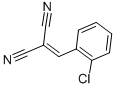 |
| CAS编号 | 2698-41-1 |
| 别名 | 2698-41-1 2-Chlorobenzylidenemalononitrile [(2-Chlorophenyl)methylene]malononitrile 2-(2-Chlorobenzylidene)malononitrile Alonitrile o-Chlorobenzylidenemalononitrile 2-CHLOROBENZALMALONONITRILE o-Chlorobenzalmalononitrile 2-Chlorobmn CS (lacrimator) o-Chlorobenzylidene malononitrile 2-[(2-chlorophenyl)methylidene]propanedinitrile o-Chlorobenzylidenemalonic nitrile (o-Chlorobenzylidene)malononitrile USAF KF-11 (o-Chlorobenzal)malononitrile NCI-C55118 chlorobenzylidene malononitrile 2-Chlorobenzylidene malononitrile NSC 542 o-Chlorobenzylidenemalonitrile Malononitrile, (o-chlorobenzylidene)- (2-Chlorobenzylidene)malononitrile (2-chlorobenzylidene)propanedinitrile Propanedinitrile, ((2-chlorophenyl)methylene)- .beta.,.beta.-Dicyano-o-chlorostyrene D8317IAV7Q (o-Chlorobenzylidene)malonitrile CHEMBL1256101 2-[(2-Chlorophenyl)methylene]propanedinitrile Propanedinitrile, ((2-chlorophenyl)methylene) Propanedinitrile, [(2-chlorophenyl)methylene]- NSC-542 NSC637336 ((2-Chlorophenyl)methylene)malononitrile 2-Chlorobenzylidene malonitrile CS GAS o-Chlorobenzalmalonitrile chlorobenzylidenemalononitrile CCRIS 2377 CS gas (lacrimator) Propanedinitrile, [(2-chlorophenyl)methylene] beta,beta-Dicyano-o-chlorostyrene HSDB 4346 Propanedinitrile, 2-((2-chlorophenyl)methylene)- Propanedinitrile, 2-[(2-chlorophenyl)methylene]- ortho-Chlorobenzylidene malononitrile EINECS 220-278-9 TL 238 2-((2-CHLOROPHENYL)METHYLENE)PROPANEDINITRILE BRN 1866635 UNII-D8317IAV7Q ((2-Chloro-phenyl)methylene)propanenitrile Propanedinitrile, [(chlorophenyl)methylene]- Malononitrile, o-chlorobenzylidene- 2-Chloro BMN WLN: NCYCN&U1R BG SCHEMBL436060 2-Chlorobenzylidenemaloninitrile GTPL4158 NSC542 DTXSID9020297 CHEBI:188626 beta,bbeta-Dicyano-o-chlorostyrene CHLOROBENZALMALONITRILE, O- BDBM50327657 MFCD00019784 STL196772 AKOS000504237 AM84860 MCULE-8865036332 NSC-637336 2-(2-Chlorobenzylidene)malononitrile # 2-CHLOROBENZALMALONONITRILE [HSDB] AS-11303 SY106828 2-((2-chlorophenyl)methylene)malononitrile CS-0095253 NS00020621 O-CHLOROBENZYLIDENEMALONONITRILE [MI] A18547 H11803 Q209357 W-107137 [(2-chlorophenyl)methylene]malononitrile; ((2-chlorophenyl)methylene)propanedinitrile |
| 分子式 | C10H5ClN2 |
| 分子量 | 188.61 |
| InChI | InChI=1S/C10H5ClN2/c11-10-4-2-1-3-9(10)5-8(6-12)7-13/h1-5H |
| InChI Key | JJNZXLAFIPKXIG-UHFFFAOYSA-N |
| Isomeric SMILES | CC1=CC=C(C(=C1)C=C(C#N)C#N)Cl |
| Patent Information | ||
| Patent ID | Title | Publication Date |
| CN108383755 | Synthesis method of alkenyl dinitrile compounds | 2018 |
| CN104497007 | A chiral indole and ABS synthetic method of the compound | 2017 |
| US4140710 | Recovery of o-chlorobenzilidene malononitrile from finely divided mixtures thereof with colloidal silica | 1979 |
| US4418210 | Process for producing asymmetrical thioureas | 1983 |
Physical Data
| Melting Point, °C |
| 93 – 95 |
| 94 – 96 |
| 96 – 98 |
| 90 – 92 |
| 85 – 87 |
| Density, g·cm-3 | Measurement Temperature, °C |
| 1.389 | 24.85 |
| Description (Association (MCS)) | Partner (Association (MCS)) |
| Adsorption | pyrographite |
| Rate of adsorption | pyrographite |
Spectra
| Description (NMR Spectroscopy) | Nucleus (NMR Spectroscopy) | Solvents (NMR Spectroscopy) | Frequency (NMR Spectroscopy), MHz |
| Chemical shifts | 1H | chloroform-d1 | |
| Chemical shifts | 13C | chloroform-d1 | |
| Chemical shifts, Spectrum | 1H | dimethylsulfoxide-d6 | |
| Chemical shifts, Spectrum | 13C | dimethylsulfoxide-d6 | |
| Chemical shifts | 1H | chloroform-d1 | 400 |
| Description (IR Spectroscopy) | Solvent (IR Spectroscopy) |
| Bands | potassium bromide |
| Bands, Spectrum | |
| Bands | |
| Bands | KBr |
| Description (UV/VIS Spectroscopy) | Solvent (UV/VIS Spectroscopy) | Comment (UV/VIS Spectroscopy) | Absorption Maxima (UV/VIS), nm |
| methanol | 287 | ||
| Absorption maxima |
Route of Synthesis (ROS)

| Conditions | Yield |
| With mercapto-functionalized silica-coated nano γ-Fe2O3-pyridine In neat (no solvent) at 70℃; for 1.5h; Michael Addition; Green chemistry; Experimental Procedure 2.3. General procedure for Michael addition of diethyl phosphiteto ,α,β-unsaturated malonates catalyzed by nano-Fe2O3-pyridine based catalyst 1 General procedure: Catalyst 1 (5 mol%) was added to a mixture of ,-unsaturatedmalonate (5 mmol) and diethyl phosphite (10 mmol). The mixturewas stirred at 70 C for the appropriate time (Table 2). The catalystwas separated by a magnetic bar from the cooled mixture,washed with EtOH, dried 30 min at 110 C and reused for a consecutiverun under the same reaction conditions. Evaporation of thesolvent of the remaining solution under reduced pressure gave thecrude products. The pure products (2-18, Table 2) were isolated bychromatography on silica gel eluted with n-hexane:EtOAc (1:2). | 95% |
| With 3-aminopropylated silica gel at 50℃; for 0.25h; phospha-Michael addition; Neat (no solvent); | 91% |
| With iron-doped single walled carbon nanotubes In neat (no solvent) at 50℃; for 3h; Green chemistry; chemoselective reaction; Experimental Procedure 4.3.2 Solvent-free synthesis of β-phosphonomalonates catalyzed by Fe/SWCNTs General procedure: The required malonates (1 mmol) and phosphorus compound (1.2 mmol) were added to Fe/SWCNTs (0.05 g) and the mixture was heated in an oil bath at 50 °C. After the reaction was complete, EtOAc (4×10 mL) was added to the reaction mixture and centrifuged to separate the catalyst. The organic solvent was removed under reduced pressure. After purification by plate chromatography (solvent: n-hexane/ethyl acetate, 50:50) the product was obtained. | 90% |
Safety and Hazards
| Pictogram(s) |     |
| Signal | Danger |
| GHS Hazard Statements | H301 (98.44%): Toxic if swallowed [Danger Acute toxicity, oral] H315 (31.25%): Causes skin irritation [Warning Skin corrosion/irritation] H317 (92.19%): May cause an allergic skin reaction [Warning Sensitization, Skin] H319 (31.25%): Causes serious eye irritation [Warning Serious eye damage/eye irritation] H330 (29.69%): Fatal if inhaled [Danger Acute toxicity, inhalation] H334 (62.5%): May cause allergy or asthma symptoms or breathing difficulties if inhaled [Danger Sensitization, respiratory] H335 (32.81%): May cause respiratory irritation [Warning Specific target organ toxicity, single exposure; Respiratory tract irritation] H400 (90.62%): Very toxic to aquatic life [Warning Hazardous to the aquatic environment, acute hazard] H411 (29.69%): Toxic to aquatic life with long lasting effects [Hazardous to the aquatic environment, long-term hazard] |
| Precautionary Statement Codes | P233, P260, P261, P264, P264+P265, P270, P271, P272, P273, P280, P284, P301+P316, P302+P352, P304+P340, P305+P351+P338, P316, P319, P320, P321, P330, P332+P317, P333+P317, P337+P317, P342+P316, P362+P364, P391, P403, P403+P233, P405, and P501 (The corresponding statement to each P-code can be found at the GHS Classification page.) |
Other Data
| Under the room temperature and away from light | |
| HS Code | |
| Storage | Under the room temperature and away from light |
| Shelf Life | |
| Market Price |
| Druglikeness | |
| Lipinski rules component | |
| 分子量 | 188.616 |
| logP | 2.28 |
| HBA | 2 |
| HBD | 0 |
| Matching Lipinski Rules | 4 |
| Veber rules component | |
| Polar Surface Area (PSA) | 47.58 |
| Rotatable Bond (RotB) | 1 |
| Matching Veber Rules | 2 |
| Use Pattern |
| 2-(2-Chlorobenzylidene)malononitrile CAS#: 2698-41-1 has extensive applications in exploring the effects of irritants on the human body, and is used as tear gas and riot control agents. |
试剂采购 | |
| 没有试剂厂商? | 向凯望发送快速询价 |
| 想要被列为试剂厂商? (付费服务) | 点击这里联系凯望 |
认证生产商 | |
| Caming Pharmaceutical Limited | http://www.caming.com/ |
| 想要被列为认证生产商 (需要通过认证)? | 请下载并填写 这份表格并发邮件到approved-manufacturers@chemwhat.com |
其他供应商 | |
| Watson International Limited | 访问Watson官网 |
如需其他帮助,请联系我们 | |
| 联系我们获取其它信息或服务 | 点击这里联系凯望 |