2-CARBOXYETHYL ACRYLATE CAS#: 24615-84-7; 凯望编码 (ChemWhat Code): 55257

Identification
| 英文名 | 2-CARBOXYETHYL ACRYLATE |
| IUPAC Name | 3-prop-2-enoyloxypropanoic acid |
| 分子结构 | 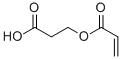 |
| CAS编号 | 24615-84-7 |
| MDL Number | MFCD00040709 |
| 别名 | 2-Carboxyethyl acrylate 24615-84-7 2-Propenoic acid, 2-carboxyethyl ester Hydracrylic acid, acrylate carboxyethyl acrylate 3-(Acryloyloxy)propionic acid KM1E1216WR DTXSID2027834 ACRYLIC ACID DIMER EBECRYL .BETA.-CEA ARONIX M 566 C 800 (ACRYLATE) DTXCID807834 ACRYLIC ACID 2-CARBOXYETHYL ESTER .BETA.-HYDROXYPROPIONIC ACID ACRYLIC ESTER EBECRYL BETA-CEA CARBOXYETHYL ACRYLATE [INCI] BETA-HYDROXYPROPIONIC ACID ACRYLIC ESTER 246-359-9 3-prop-2-enoyloxypropanoic acid 3-(acryloyloxy)propanoic acid beta-Carboxyethyl acrylate 2-Carboxyethyl 2-propenoate 2-carboxyethylacrylate Hydracrylic acid acrylate Sipomer B-CEA 3-Acryloyloxypropionic acid CAS-24615-84-7 beta-(Acryloyloxy)propionic acid EINECS 246-359-9 UNII-KM1E1216WR beta-carboxyethylacrylate beta carboxyethyl acrylate beta-acryloxypropionic acid SCHEMBL27385 CHEMBL3185107 3-(prop-2-enoyloxy)propanoic acid Tox21_202236 Tox21_303489 AKOS006377408 Beta-carboxyethyl acrylate,distribution NCGC00249195-01 NCGC00257334-01 NCGC00259785-01 AS-77136 .BETA.-(ACRYLOYLOXY)PROPIONIC ACID CS-0346107 NS00019712 EN300-202121 F71247 Q27282330 2-Carboxyethyl acrylate, contains 900-1100 ppm MEHQ as inhibitor 7BC |
| 分子式 | C6H8O4 |
| 分子量 | 144.12 |
| InChI | InChI=1S/C6H8O4/c1-2-6(9)10-4-3-5(7)8/h2H,1,3-4H2,(H,7,8) |
| InChI Key | CYUZOYPRAQASLN-UHFFFAOYSA-N |
| SMILES | C=CC(=O)OCCC(=O)O |
| Patent Information | ||
| Patent ID | Title | Publication Date |
| US2011/65827 | NOVEL HOLOGRAPHIC MEDIA AND PHOTOPOLYMERS | 2011 |
| US2007/225522 | Method for Producing Carboxyl Group-Containing Water-Soluble Polymer | 2007 |
| WO2005/80308 | CLEAVING OLIGOMERIC (METH)ACRYLIC ACID IN THE LIQUID PHASE AND UNDER PRESSURE | 2005 |
Physical Data
| Appearance | Transparent liquid |
| Boiling Point, °C | Pressure (Boiling Point), Torr |
| 146 – 148 | 16 |
| 136 | 10 |
| 132 | 7 |
| Density, g·cm-3 | Reference Temperature, °C | Measurement Temperature, °C |
| 1.2 | 4 | 20 |
| 1.2019 | 20 | 20 |
Spectra
| Description (NMR Spectroscopy) | Nucleus (NMR Spectroscopy) | Solvents (NMR Spectroscopy) | Frequency (NMR Spectroscopy), MHz |
| Chemical shifts, Spectrum | 1H | dimethylsulfoxide-d6 | |
| Spectrum | 1H | water-d2 | 400 |
| Chemical shifts | 1H | CDCl3 |
| Description (IR Spectroscopy) |
| Bands |
Route of Synthesis (ROS)

| Conditions | Yield |
| With oxalyl dichloride; 10H-phenothiazine; 9,10-phenanthrenequinone; N,N-dimethyl-formamide In dichloromethane at 0 – 20℃; under 200 Torr; Experimental Procedure CEA from Example 7 (51 g; ~ 0.35 mole) and dimethyl formamide (DMF; 0.2 mL; 0.26 mmole) were dissolved in CH2Cl3 (100 mL). The CEA solution was added slowly (over 2 hours) to a stirred solution of oxalyl chloride (53 mL; 0.61 mole), DMF (0.2 mL; 2.6 mmole), anthraquinone (0.5 g; 2.4 mmole), phenothiazine (0.1 g, 0.5 mmole), and CH2Cl3 (75 mL) in a 500 mL round bottom flask in an ice bath at 200 mm pressure. A dry ice condenser was used to retain the CH2Cl3 in the reaction flask. After the addition was complete the reaction was stirred at room temperature overnight. The weight of reaction solution was 369 g. A sample of the CEA-Cl (Compound 7) reaction solution (124 mg) was treated with 1,4- dibromobenzene (DBB, 6.85 mg) evaporated and dissolved in CDCl3: 1H NMR (CDCl3, 400 MHz) δ 7.38 (s, 4H; DBB internal std.), 6.45 (d, IH, J = 17.4 Hz), 6.13 (dd, IH, J = 17.4, 10.4 Hz), 5.90 (d, IH, J = 10.4 Hz), 4.47 (t, 2H, J = 5.9 Hz), 3.28 (t, 2H, J = 5.9). The spectra was consistent with the desired product. There was 0.394 mole DBB for 1.0 mole CEA-Cl by integration, which gave a calculated yield of 61%. Commercially available CEA (426 g; Aldrich) was reacted with oxalyl chloride (532 mL) in a procedure similar to the one listed above. The residue CEA- Cl (490 g) was distilled using an oil bath at 1400C at a pressure of 18 mm Hg. The distillate temperature reached 980C and 150 g of distillate was collected. The distillate was redistilled at 18 mm Hg at a maximum bath temperature of 1200C. The temperature range for the distillate was 300C to 700C which gave 1 1 g of material. The distillate appeared to be 3-chloro-3-oxopropyl 3-chloropropanoate. The residue of the second distillation (125 g; 26 % of theory) was used in Example 9. | A 61% B 26% |
Safety and Hazards
| Pictogram(s) |   |
| Signal | Danger |
| GHS Hazard Statements | H302 (71.2%): Harmful if swallowed [Warning Acute toxicity, oral] H312 (57.7%): Harmful in contact with skin [Warning Acute toxicity, dermal] H314 (77.8%): Causes severe skin burns and eye damage [Danger Skin corrosion/irritation] H315 (14.8%): Causes skin irritation [Warning Skin corrosion/irritation] H318 (73%): Causes serious eye damage [Danger Serious eye damage/eye irritation] H319 (14.8%): Causes serious eye irritation [Warning Serious eye damage/eye irritation] |
| Precautionary Statement Codes | P260, P264, P264+P265, P270, P280, P301+P317, P301+P330+P331, P302+P352, P302+P361+P354, P304+P340, P305+P351+P338, P305+P354+P338, P316, P317, P321, P330, P332+P317, P337+P317, P362+P364, P363, P405, and P501 (The corresponding statement to each P-code can be found at the GHS Classification page.) |
Other Data
| Transportation | Under the room temperature and away from light |
| HS Code | |
| Storage | Under the room temperature and away from light |
| Shelf Life | 2 years |
| Market Price |
| Druglikeness | |
| Lipinski rules component | |
| 分子量 | 144.127 |
| logP | 0.073 |
| HBA | 4 |
| HBD | 1 |
| Matching Lipinski Rules | 4 |
| Veber rules component | |
| Polar Surface Area (PSA) | 63.6 |
| Rotatable Bond (RotB) | 5 |
| Matching Veber Rules | 2 |
| Use Pattern |
| Used as an excellent active diluent in UV curing coatings, adhesives, and ink systems to improve adhesion. Used as a special monomer for emulsion polymerization, adhesives, and coating resin production. |
试剂采购 | |
| 没有试剂厂商? | 向凯望发送快速询价 |
| 想要被列为试剂厂商? (付费服务) | 点击这里联系凯望 |
认证生产商 | |
| Warshel Chemical Ltd | https://www.warshel.com/ |
| 想要被列为认证生产商 (需要通过认证)? | 请下载并填写 这份表格并发邮件到approved-manufacturers@chemwhat.com |
其他供应商 | |
| Watson International Limited | 访问Watson官网 |
如需其他帮助,请联系我们 | |
| 联系我们获取其它信息或服务 | 点击这里联系凯望 |