2-Cyclopropyl-4-(4-fluorophenyl)-quinolyl-3-methanol CAS#: 121660-11-5; 凯望编码 (ChemWhat Code): 340139

Identification
| 英文名 | 2-Cyclopropyl-4-(4-fluorophenyl)-quinolyl-3-methanol |
| IUPAC Name | p[2-cyclopropyl-4-(4-fluorophenyl)quinolin-3-yl]methanol |
| 分子结构 |  |
| CAS编号 | 121660-11-5 |
| MDL Number | MFCD09032924 |
| 别名 | 121660-11-5 (2-Cyclopropyl-4-(4-fluorophenyl)quinolin-3-yl)methanol 2-Cyclopropyl-4-(4-fluorophenyl)-quinolyl-3-methanol 2-Cyclopropyl-4-(4-fluorophenyl)-3-quinolinemethanol 3-Quinolinemethanol, 2-cyclopropyl-4-(4-fluorophenyl)- [2-cyclopropyl-4-(4-fluorophenyl)quinolin-3-yl]methanol MFCD09032924 2-Cyclopropyl-4-(4′-fluorophenyl) Quinolyl-3-methanol C19H16FNO FIZDBNPUFMDGFZ-UHFFFAOYSA-N 2-Cyclopropyl-4-(4-fluorophenyl)-3-quinolinemethanol; 2-Cyclopropyl-3-(hydroxymethyl)-4-(4-fluorophenyl)quinoline; 2-Cyclopropyl-4-(4-fluorophenyl)-3-quinolinemethanol; 2-Cyclopropyl-4-(4′-fluorophenyl) quinolyl-3-methanol; [2-Cyclopropyl-4-(4-fluorophenyl)quinolin-3-yl]methanol SCHEMBL31546 2-Cyclopropyl-4-(4-fluorophenyl)quinoline-3-methanol AMY4153 DTXSID60431270 BCP07795 AKOS015900378 AC-2056 SB71698 DS-12057 SY042631 CS-0156033 A24866 D84156 J-509251 [2-Cyclopropyl-4-(4-fluorophenyl)-3-quinolinyl]methanol (2-cyclopropyl-4-(4-fluorophenyl)quinoline-3-yl)methanol 2-Cyclopropyl-4-(4-fluorophenyl)-3-(hydroxymethyl)quinoline |
| 分子式 | C19H16FNO |
| 分子量 | 293.3 |
| InChI | InChI=1S/C19H16FNO/c20-14-9-7-12(8-10-14)18-15-3-1-2-4-17(15)21-19(13-5-6-13)16(18)11-22/h1-4,7-10,13,22H,5-6,11H2 |
| InChI Key | FIZDBNPUFMDGFZ-UHFFFAOYSA-N |
| Isomeric SMILES | C1CC1C2=NC3=CC=CC=C3C(=C2CO)C4=CC=C(C=C4)F |
| Patent Information | ||
| Patent ID | Title | Publication Date |
| WO2012/13325 | PROCESS FOR THE PREPARATION OF KEY INTERMEDIATES FOR THE SYNTHESIS OF STATINS OR PHARMACEUTICALLY ACCEPTABLE SALTS THEREOF | 2012 |
| US6437135 | Process for producing quinolinecarbaldehyde | 2002 |
Physical Data
| Appearance | White to light yellow powder or crystal |
| Melting Point, °C | Solvent (Melting Point) |
| 129 – 130 | |
| 131 – 133 | |
| 129 – 130 | toluene |
| 125 – 135 | |
| 133.3 – 134.7 | |
| 132 – 133 |
Spectra
| Description (NMR Spectroscopy) | Nucleus (NMR Spectroscopy) | Solvents (NMR Spectroscopy) | Frequency (NMR Spectroscopy), MHz |
| Chemical shifts, Spectrum | 1H | benzene-d6 | 500.2 |
| hemical shifts, Spectrum | 13C | benzene-d6 | 125.8 |
| Chemical shifts, Spectrum | 19F | benzene-d6 | 470.6 |
| Chemical shifts, Spectrum | 1H | chloroform-d1 | 400 |
| Chemical shifts, Spectrum | 13C | chloroform-d1 | 100 |
| Description (IR Spectroscopy) | Solvent (IR Spectroscopy) |
| ATR (attenuated total reflectance), Bands | |
| Bands | potassium bromide |
| Bands | film |
Route of Synthesis (ROS)
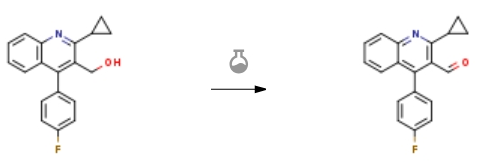
| Conditions | Yield |
| With oxalyl dichloride; triethylamine In dichloromethane; dimethyl sulfoxide at -78℃; for 1h; | 91% |
| Stage #1: 2-cyclopropyl-4-(4-fluorophenyl)-3-(hydroxymethyl)quinoline With oxalyl dichloride; dimethyl sulfoxide In toluene at -60 – -15℃; for 3.5h; Inert atmosphere; Stage #2: With triethylamine In toluene at 5 – 10℃; for 0.5h; Temperature; Solvent; Inert atmosphere; Experimental Procedure Under the protection of nitrogen, in a 500ml round-bottom flask, add 200ml toluene, 10.4g (0.082mol) oxalyl chloride, start stirring, and lower the temperature to about -60°C ,Add 18.6g (0.238mol) DMSO dropwise, the control temperature should not exceed -15°C ,after dripping, keep warm at -15°C for 30 minutes,20g (0.068mol) of compound IV in toluene (50ml) was added dropwise,Control the temperature not to exceed -15°C , keep warm at -15°C for 3 hours after dropping,Slowly add 20.7g (0.205mol) of triethylamine, control the temperature not to exceed 10°C ,After dripping, keep warm at 5°C for 30 minutes, add 100ml of water, stir and separate,The lower water layer was extracted with 100ml toluene, and the upper toluene layer was combined.Wash it once with 50ml of water, the toluene layer is desolvated to dryness, add 40ml of n-heptane,Heat to complete dissolution, lower the temperature and crystallize, suction filtration, filter solid drying17.9 g (0.061 mol) of compound V was obtained with a product purity of 99.2% and a pure yield of 89.0%. | 89% |
| With sodium hydrogencarbonate; dimethyl sulfoxide; sodium iodide at 25℃; for 56h; Kornblum Oxydation; Experimental Procedure Example 19: Preparation of 2-cyclopropyl-4-(4-fluorophenyl)quinoline-3-carbaldehyde (PTVCHO) by Kornblum oxidation:; PTVBR PTVCHO; A mixture of 3-(bromomethyl)-2-cyclopropyl-4-(4-fluorophenyl)quinolone (PTVBR) (0.86 g), sodium iodide (0.04 g), NaHC03 (0.22 g) and dimethylsulfoxide (10 mL) was stirred at 25 °C for 56 hours. Water (20 mL) and terf-butyl methyl ether (10 mL) were added. Phases were separated and water phase was re- extracted with ierf-butyl methyl ether (10 mL). Combined feri-butyl methyl ether phases were washed with water (10 mL) followed by brine (10 mL) and concentrated. The residual material was purified by chromatography (silica gel; hexane : toluene 25 : 75 – 0 : 100) to yield 0.42 g (60 % yield) of 2- cyclopropyl-4-(4-fluorophenyl)quinoline-3-carbaldehyde (PTVCHO). 1H NMR (CDCI3): δ 1.01 (2H, m), 1.30 (2H, m), 3.13 (1 H, m), 7.10 – 7.39 (6H, m), 7.64 (1 H, m), 7.88 (1 H, m), 9.97 (1 H, s) ppm. 3C NMR (CDCI3): δ 11.3, 14.5, 115.6, 115.8, 125.2, 126.0, 126.1 , 126.5, 129.9, 130.0, 131.3, 131.4, 131.8, 131.9, 132.0, 148.9, 152.8, 161.6, 162.0, 164.0, 193.6 ppm. | 60% |
| With sodium acetate; pyridinium chlorochromate In dichloromethane at 20℃; for 1h; | 56.5% |
| With phosphorus pentoxide; dimethyl sulfoxide; triethylamine Oxidation; |
Safety and Hazards
| Pictogram(s) |  |
| Signal | Warning |
| GHS Hazard Statements | H315 (100%): Causes skin irritation [Warning Skin corrosion/irritation] H319 (100%): Causes serious eye irritation [Warning Serious eye damage/eye irritation] |
| Precautionary Statement Codes | P264, P264+P265, P280, P302+P352, P305+P351+P338, P321, P332+P317, P337+P317, and P362+P364 (The corresponding statement to each P-code can be found at the GHS Classification page.) |
Other Data
| Druglikeness | |
| Lipinski rules component | |
| 分子量 | 293.341 |
| logP | 3.936 |
| HBA | 2 |
| HBD | 1 |
| Matching Lipinski Rules | 4 |
| Veber rules component | |
| Polar Surface Area (PSA) | 33.12 |
| Rotatable Bond (RotB) | 3 |
| Matching Veber Rules | 2 |
| Use Pattern |
| 2-Cyclopropyl-4-(4-fluorophenyl)-quinolyl-3-methanol is an intermediate in the synthesis of Pitavastatin calcium, a statin medication primarily used to lower cholesterol and prevent cardiovascular diseases. As an intermediate, it plays several crucial roles in the drug synthesis process: As an intermediate, 2-Cyclopropyl-4-(4-fluorophenyl)-quinolyl-3-methanol helps to enhance the synthesis efficiency of Pitavastatin calcium, making the production process more efficient and controllable. The quality and purity of the intermediate directly affect the final drug’s quality. High-quality intermediates contribute to producing Pitavastatin calcium with higher purity and fewer side effects. Choosing the appropriate intermediate in the drug synthesis process can minimize unnecessary by-products, thereby reducing the final drug’s side effects. The structure of 2-Cyclopropyl-4-(4-fluorophenyl)-quinolyl-3-methanol contributes to the pharmacological activity of Pitavastatin calcium, making it more effective in lowering cholesterol and preventing cardiovascular diseases. |
试剂采购 | |
| 没有试剂厂商? | 向凯望发送快速询价 |
| 想要被列为试剂厂商? (付费服务) | 点击这里联系凯望 |
认证生产商 | |
| Caming Pharmaceutical Limited | http://www.caming.com/ |
| 想要被列为认证生产商 (需要通过认证)? | 请下载并填写 这份表格并发邮件到approved-manufacturers@chemwhat.com |
其他供应商 | |
| Watson International Limited | 访问Watson官网 |
如需其他帮助,请联系我们 | |
| 联系我们获取其它信息或服务 | 点击这里联系凯望 |