2-Phenylethylamine Hydroiodide CAS#: 151059-43-7; 凯望编码 (ChemWhat Code): 544893

Identification
| 英文名 | 2-Phenylethylamine Hydroiodide |
| IUPAC Name | 2-phenylethanamine;hydroiodide |
| 分子结构 | 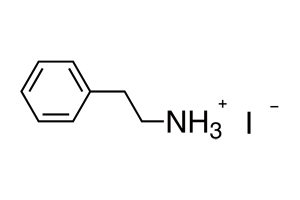 |
| CAS编号 | 151059-43-7 |
| EINECS Number | 207-322-2 |
| MDL Number | MFCD28384152 |
| Beilstein Registry Number | 105692 |
| 别名 | PEAIphenethylammonium iodidephenylethylammonium iodide |
| 分子式 | C8H12IN |
| 分子量 | 249.09 |
| InChI | InChI=1S/C8H11N.HI/c9-7-6-8-4-2-1-3-5-8;/h1-5H,6-7,9H2;1H |
| InChI Key | UPHCENSIMPJEIS-UHFFFAOYSA-N |
| Canonical SMILES | [I-].[NH3+]CCc1ccccc1 |
| Patent Information |
| No data available |
Physical Data
| Appearance | White to pale yellow solid |
| Solubility | No data available |
| Flash Point | No data available |
| Refractive index | No data available |
| Sensitivity | No data available |
| Melting Point, °C | Solvent (Melting Point) | Comment (Melting Point) |
| 262 – 265 | ||
| 267 | ||
| 62 – 63 | ethanol, diethyl ether | Decomposition.at:235 degreeC. – :236 degreeC. |
Spectra
| Description (NMR Spectroscopy) | Nucleus (NMR Spectroscopy) | Solvents (NMR Spectroscopy) | Frequency (NMR Spectroscopy), MHz |
| Chemical shifts, Spectrum | 1H | dimethylsulfoxide-d6 | 400 |
| Chemical shifts, Spectrum | 13C | dimethylsulfoxide-d6 | 75 |
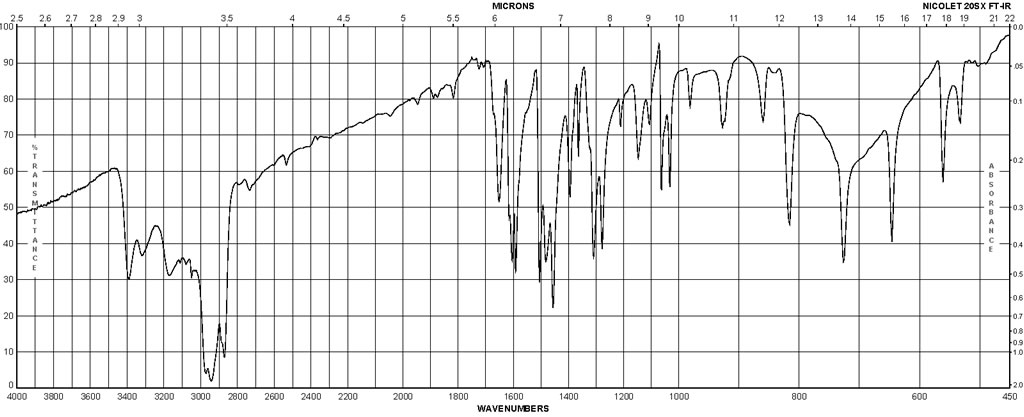
| Description (IR Spectroscopy) | Solvent (IR Spectroscopy) |
| Bands | neat (no solvent, solid phase) |
| Spectrum |
| Description (Mass Spectrometry) | |
| high resolution mass spectrometry (HRMS), electrospray ionisation (ESI), spectrum | |
| electron impact (EI), spectrum |
| Description (UV/VIS Spectroscopy) |
| Spectrum |
Route of Synthesis (ROS)
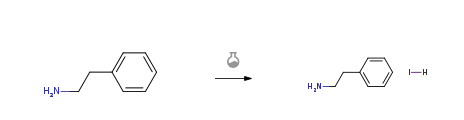
| Conditions | Yield |
| With hydrogen In ethyl acetate at 20℃; under 7600.51 Torr; for 6h; Autoclave; | 99% |
| With 0.2C27H36N2*Pt; hydrogen In tetrahydrofuran at 60℃; under 3000.3 Torr; for 5h; chemoselective reaction; | 99% |
| With hydrogen In ethyl acetate under 760.051 Torr; for 2h; Heating; Flow reactor; Green chemistry; | 99% |
| With hydrogen; triethylamine In ethanol; water at 110℃; under 30003 Torr; for 24h; Autoclave; | 98% |
| With hydrogen In 2-methyltetrahydrofuran; water at 40℃; under 15001.5 Torr; for 24h; chemoselective reaction; | 98% |
| With sodium tetrahydroborate In water at 20℃; for 1.5h; chemoselective reaction; Experimental Procedure General procedure: In a typical experiment, 0.5mmol of nitroarene and 0.002g(2mol%) NiNPs/DNA were added to 2mL water and thenstirred for 2-3min for thoroughly mixing. Subsequently,1mmol of NaBH4was added to the reaction mixture undermagnetic stirring at room temperature. The extent of thereaction was monitored by thin layer chromatography.Reproducibility of the results was checked by repeating theruns at least three times and was found to be within acceptablelimits (± 3%). When the reaction was completed, thereaction mixture was diluted with ethyl acetate and the catalystwas recovered by centrifugation. The combined organicfractions were dried over Na2SO4and evaporated underreduced pressure. The crude product was purified by columnchromatography on silica gel with a mixture of ethyl acetateand n-hexane as the eluent, and the ratio of ethyl acetate andn-hexane was depended on the structure of the products.The structure of isolated products was verified by 1H NMR. | 97% |
Safety and Hazards
| Pictogram(s) |  |
| Signal | Warning |
| GHS Hazard Statements | H302 (33.3%): Harmful if swallowed [Warning Acute toxicity, oral] H315 (100%): Causes skin irritation [Warning Skin corrosion/irritation] H319 (100%): Causes serious eye irritation [Warning Serious eye damage/eye irritation] H335 (33.3%): May cause respiratory irritation [Warning Specific target organ toxicity, single exposure; Respiratory tract irritation] Information may vary between notifications depending on impurities, additives, and other factors. |
| Precautionary Statement Codes | P261, P264, P264+P265, P270, P271, P280, P301+P317, P302+P352, P304+P340, P305+P351+P338, P319, P321, P330, P332+P317, P337+P317, P362+P364, P403+P233, P405, and P501 (The corresponding statement to each P-code can be found at the GHS Classification page.) |
Other Data
| Transportation | NONH for all modes of transport |
| Under the room temperature and away from light | |
| HS Code | No data available |
| Storage | Under the room temperature and away from light |
| Shelf Life | 1 year |
| Market Price | USD |
| Druglikeness | |
| Lipinski rules component | |
| 分子量 | 249.094 |
| logP | 2.352 |
| HBA | 1 |
| HBD | 1 |
| Matching Lipinski Rules | 4 |
| Veber rules component | |
| Polar Surface Area (PSA) | 26.02 |
| Rotatable Bond (RotB) | 2 |
| Matching Veber Rules | 2 |
| Use Pattern |
| used in the production of Perovskite Solar Cells, where they play a crucial role in enhancing the efficiency and stability of the cells. |
试剂采购 | |
| 没有试剂厂商? | 向凯望发送快速询价 |
| 想要被列为试剂厂商? (付费服务) | 点击这里联系凯望 |
认证生产商 | |
| WatsonChem Advanced Chemical Materials | https://www.watsonchem.com/ |
| 想要被列为认证生产商 (需要通过认证)? | 请下载并填写 这份表格并发邮件到approved-manufacturers@chemwhat.com |
其他供应商 | |
| Watson International Limited | 访问Watson官网 |
如需其他帮助,请联系我们 | |
| 联系我们获取其它信息或服务 | 点击这里联系凯望 |