2,2-Dimorpholinodiethylether CAS#: 6425-39-4; 凯望编码 (ChemWhat Code): 918838

Identification
| 英文名 | 2,2-Dimorpholinodiethylether |
| IUPAC Name | 4-[2-(2-morpholin-4-ylethoxy)ethyl]morpholine |
| 分子结构 | 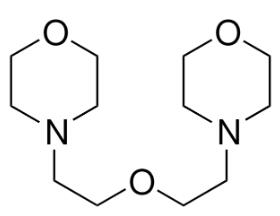 |
| CAS编号 | 6425-39-4 |
| EINECS Number | 229-194-7 |
| MDL Number | MFCD00072740 |
| Beilstein Registry Number | No data available |
| 别名 | DMDEEdimorpholino diethyl ether2,2′-dimorpholinodiethyl ether |
| 分子式 | C12H24N2O3 |
| 分子量 | 244.335 |
| InChI | InChI=1S/C12H24N2O3/c1-7-15-8-2-13(1)5-11-17-12-6-14-3-9-16-10-4-14/h1-12H2 |
| InChI Key | ZMSQJSMSLXVTKN-UHFFFAOYSA-N |
| Canonical SMILES | C1CN(CCOCCN2CCOCC2)CCO1 |
| Patent Information | ||
| Patent ID | Title | Publication Date |
| EP716084 | Preparation of 4,4′-(oxydi-2,1-ethanediyl)bis-morpholine and hydroxyethoxyethyl morpholine | 1996 |
| US6111100 | Preparation of bis(2-morpholinoethyl) ether | 2000 |
| US3976593 | Amine bisulfites | 1976 |
Physical Data
| Appearance | Colorless or pale yellow, transparent liquid |
| Solubility | No data available |
| Flash Point | No data available |
| Refractive index | No data available |
| Sensitivity | No data available |
| Boiling Point, °C | Pressure (Boiling Point), Torr |
| 140 | |
| 120 | 0.7 |
| 188 – 192 | 15 |
| 178 – 180.5 | 7 |
| Refractive Index | Wavelength (Refractive Index), nm | Temperature (Refractive Index), °C |
| 1.4772 | 589 | 25 |
Spectra
| Description (NMR Spectroscopy) | Nucleus (NMR Spectroscopy) | Solvents (NMR Spectroscopy) | Frequency (NMR Spectroscopy), MHz |
| Chemical shifts, Spectrum | 1H | chloroform-d1 | 400 |
| Chemical shifts, Spectrum | 13C | chloroform-d1 | 100 |
| Description (Mass Spectrometry) |
| liquid chromatography mass spectrometry (LCMS), tandem mass spectrometry, fragmentation pattern, spectrum |
Route of Synthesis (ROS)

| Conditions | Yield |
| Stage #1: morpholine; diethylene glycol With hydrogen at 220℃; under 11251.1 – 37503.8 Torr; for 10h; Autoclave; Stage #2: dimethyl amine at 190℃; under 33753.4 Torr; for 16h; Reagent/catalyst; Temperature; Pressure; Autoclave; Experimental Procedure 1.2; 2-1; 4-1-4-2; 5-1-5-2; 6; 7-1; 7-2 2) Reaction process: 2.1) Add 212.2g (2.0mol) of diethylene glycol and 522.7g (6.0mol) of morpholine into a 1L autoclave, and add 21.2g of amination catalyst-Cu/Ni/Co/Al metal catalyst I into the autoclave. Then close the autoclave, replace the gas in the autoclave with nitrogen 3 times, and replace the gas in the autoclave with hydrogen 3 times. After the replacement is completed, pressurize with hydrogen to an initial pressure of 1.5MPa. Then start to heat up to the reaction temperature, stir and react for 10 hours at a temperature of 220 and a pressure of about 3.5-5.0MPa (light components are generated during the reaction, so the pressure increases), and obtain reaction solution I. In addition to DMDEE and 2-(2-morpholineethoxy)ethanol as an intermediate, the reaction solution I also contains unreacted morpholine and amination catalyst.2.2) Set the reaction temperature to 190 and the reaction pressure to 4.5MPa;After step 2.1), cool the autoclave to the set reaction temperature (190), use a plunger pump to intermittently pump dimethylamine into the autoclave, and pump a total of 67.6g (1.5mol) dimethylamine into the autoclave within about 10 hours. After the dimethylamine is pumped in, keep warm (190) and continue to react at a set reaction pressure of 4.5MPa for 6 hours to obtain reaction solution II, which contains DMAEEM and DMDEE, as well as unreacted dimethylamine, unreacted morpholine and amination catalyst.Note: During the process of intermittently pumping dimethylamine, the pressure in the autoclave is controlled at 4.0-5.0MPa, that is, when the pressure is higher than 5.0MPa, stop pumping dimethylamine; when the pressure of dimethylamine drops to 4.0MPa due to consumption, continue pumping dimethylamine.2.3) After step 2.2), the obtained reaction solution II containing DMAEEM and DMDEE is cooled to 60°C, and the vent valve on the autoclave is slowly opened at this temperature to release the unreacted dimethylamine, which is absorbed with water to obtain a 40% mass concentration of dimethylamine aqueous solution (about 50g); after the recovery of dimethylamine, it is cooled to room temperature, the vent valve is opened, the autoclave is left to stand for 4 hours, and filtered to obtain a filtrate and a filter cake respectively. The filtrate is a mixed solution containing morpholine, DMAEEM and DMDEE; the filter cake is washed with water 3 times and then recovered to obtain a catalyst that can be used for recycling;The filtrate is distilled, and the morpholine fraction at 50°C is collected at a water pump of -0.1MPa, the fraction at 120°C is collected under a pressure of 300Pa of the oil pump under reduced pressure as DMAEEM, and the fraction at 155°C is collected under a pressure of 300Pa of the oil pump under reduced pressure as DMDEE.Therefore, 194.2 g of DMAEEM with a purity of 99.1% was obtained as a product, and the yield of DMAEEM was 48.0%; 198.6 g of DMDEE with a purity of 99.5% was obtained as a product, and the yield of DMDEE was 40.7%; the total yield of DMAEEM and DMDEE was 88.7%. 250 g of morpholine and 20 g of amination catalyst were recovered. | A 48% B 40.7% |
Safety and Hazards
| Pictogram(s) |  |
| Signal | Warning |
| GHS Hazard Statements | H315 (19.4%): Causes skin irritation [Warning Skin corrosion/irritation] H319 (66%): Causes serious eye irritation [Warning Serious eye damage/eye irritation] Information may vary between notifications depending on impurities, additives, and other factors. |
| Precautionary Statement Codes | P264, P264+P265, P280, P302+P352, P305+P351+P338, P321, P332+P317, P337+P317, and P362+P364 (The corresponding statement to each P-code can be found at the GHS Classification page.) |
Other Data
| Transportation | NONH for all modes of transport |
| Store at room temperature; keep away from light. | |
| HS Code | No data available |
| Storage | Store at room temperature; keep away from light. |
| Shelf Life | 2 years |
| Market Price | USD |
| Druglikeness | |
| Lipinski rules component | |
| 分子量 | 244.334 |
| logP | -1.074 |
| HBA | 5 |
| HBD | 0 |
| Matching Lipinski Rules | 4 |
| Veber rules component | |
| Polar Surface Area (PSA) | 34.17 |
| Rotatable Bond (RotB) | 6 |
| Matching Veber Rules | 2 |
| Use Pattern |
| A moisture-curing catalyst specifically designed for one-component polyurethane (1K PU) systems, balancing “long-term storage stability” with “rapid curing/foaming upon contact with moisture.” |
| One-Component Polyurethane Foams (Primary Application) Building Insulation: Spray-applied rigid foam for walls, insulation layers for cold storage/refrigerators, pipe insulation. Filling/Sealing: Foam sealants for doors and windows, injection grouts for wall cracks, leak-sealing for tunnels and underground structures. Features: With the addition of DMDEE, the packaged material can be stored for 6–12 months without gelling; during application, it foams and cures rapidly upon contact with moisture, producing a uniform cell structure with minimal shrinkage. |
| One-Component Sealants and Adhesives (1K PU Adhesives) Construction: Structural sealants for curtain walls, weather-resistant sealants, concrete joint sealants. Automotive: Windshield adhesives, body seam sealants, interior trim bonding. Industrial: Pipe sealing, equipment flange sealing, container sealants. Features: Does not compromise shelf life; offers rapid tack-free time, excellent deep-section curing, and strong adhesion; low odor, making it suitable for indoor and automotive interior applications. |
| One-Component Elastomers and Coatings (1K PU Coatings/Elastomers) Running Tracks/Flooring: Polyurethane running tracks, sports court flooring, elastic flooring systems. Synthetic/Artificial Leather: 1K PU resins for synthetic leather, surface treatment agents for artificial leather. Waterproofing Coatings: PU waterproofing coatings for roofs and basements, anti-corrosion coatings for bridges. Features: Promotes moisture-induced crosslinking, resulting in a tough, abrasion-resistant, and water-resistant film; does not compromise the shelf life of the coating. |
| Two-Component PU (Auxiliary Application) Acts as an auxiliary foaming catalyst in flexible foams, semi-rigid foams, and CASE materials (Coatings, Adhesives, Sealants, Elastomers); used in conjunction with DABCO and organotin catalysts to balance the rates of foaming and gelling. |
试剂采购 | |
| 没有试剂厂商? | 向凯望发送快速询价 |
| 想要被列为试剂厂商? (付费服务) | 点击这里联系凯望 |
认证生产商 | |
| Warshel Chemical Ltd | http://www.warshel.com/ |
| 想要被列为认证生产商 (需要通过认证)? | 请下载并填写 这份表格并发邮件到approved-manufacturers@chemwhat.com |
其他供应商 | |
| Watson International Limited | 访问Watson官网 |
如需其他帮助,请联系我们 | |
| 联系我们获取其它信息或服务 | 点击这里联系凯望 |