2,6-dimethoxyphenol CAS#: 91-10-1; 凯望编码 (ChemWhat Code): 1416946

Identification
| 英文名 | 2,6-dimethoxyphenol |
| IUPAC名称 | 2,6-dimethoxyphenol |
| 分子结构 | 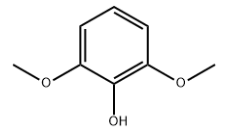 |
| CAS编号 | 91-10-1 |
| EINECS Number | 202-041-1 |
| MDL Number | MFCD00064434 |
| 别名 | 2,6-DIMETHOXYPHENOL 91-10-1 Syringol Pyrogallol 1,3-dimethyl ether Phenol, 2,6-dimethoxy- 2-Hydroxy-1,3-dimethoxybenzene 1,3-Dimethyl pyrogallate 1,3-Dimethoxy-2-hydroxybenzene Aldrich 1,3-Di-o-methylpyrogallol 2,6-dimethoxy phenol 2,6-dimethoxy-phenol Pyrogallol dimethylether 2,6-Dwumetoksyfenol FEMA No. 3137 2,6-Dimethoxyphenyl CHEBI:955 4UQT464H8K DTXSID2052607 2,6-Dimethoxyphenol(Chunk or Granule or Flakes) 2,6-Dimethoxyphenol 99+% 2,6-Dwumetoksyfenol [Polish] EINECS 202-041-1 MFCD00064434 UNII-4UQT464H8K 33-51-2 3DM 2,6-dimetoxyphenol 2,6-di-methoxyphenol bmse010203 2,6-Dimethoxyphenol, 99% SCHEMBL156388 CHEMBL109652 2,6-Dimethoxyphenol (syringol) DTXCID0031180 FEMA 3137 2,6-DIMETHOXYPHENOL [FHFI] Tox21_303953 2,6-DIMETHOXY PHENOL [FCC] BDBM50409535 2,6-Dimethoxyphenol, >=98%, FG AKOS000120263 CS-W003972 FS-1188 HY-W003972 2,6-Dimethoxyphenol, natural, >=96% CAS-91-10-1 2,6-Dimethoxyphenol, analytical standard NCGC00357187-01 BP-10363 D0639 FT-0631436 EN300-20299 F13351 A843720 Q421420 2,6-Dimethoxyphenol Pyrogallol 1,3-dimethyl ether Q-200214 Z104477654 25511-61-9 |
| 分子式 | C8H10O3 |
| 分子量 | 154.16 |
| InChI | InChI=1S/C8H10O3/c1-10-6-4-3-5-7(11-2)8(6)9/h3-5,9H,1-2H3 |
| InChI Key | KLIDCXVFHGNTTM-UHFFFAOYSA-N |
| Isomeric SMILES | COC1=C(C(=CC=C1)OC)O |
| Patent Information | ||
| Patent ID | Title | Publication Date |
| WO2023/139053 | ARTHROPOD CONTROL COMPOSITIONS | 2023 |
| CN116514727 | 5-fluoro-2,4-dioxo-3,4-dihydropyrimidine acetate derivative and preparation method and application thereof | 2023 |
| WO2022/226416 | MONOMERIC AND POLYMERIC COMPOSITIONS AND METHODS OF PRODUCING AND USING THE SAME | 2022 |
| CN115536498 | Method for oxidative coupling of substituted phenol under catalysis of butanedione | 2022 |
| CN112209975 | Method for preparing aromatic substances and small-molecular alcohols through catalysis of lignocellulose in one step | 2011 |
Physical Data
| Appearance | White or off-white lyophilized powder |
| Melting Point, °C | Solvent (Melting Point) |
| 50 | |
| 49 – 51 | |
| 56 – 61 | |
| 53 – 55 | |
| 46 – 47 | |
| 56 – 57 | |
| 97 – 98 | diethyl ether |
| Boiling Point, °C | Pressure (Boiling Point), Torr |
| 262 | |
| 133 – 134 | 17 |
| 102 – 103 | 2 |
| 262.7 |
| Description (Association (MCS)) | Solvent (Association (MCS)) | Partner (Association (MCS)) |
| UV/VIS spectrum of the complex | CH2Cl2 | benzoquinone |
Spectra
| Description (NMR Spectroscopy) | Nucleus (NMR Spectroscopy) | Solvents (NMR Spectroscopy) | Temperature (NMR Spectroscopy), °C | Frequency (NMR Spectroscopy), MHz |
| Chemical shifts, Spectrum | 1H | chloroform-d1 | ||
| Chemical shifts, Spectrum | 13C | chloroform-d1 | ||
| Chemical shifts, Spectrum | 1H | dimethylsulfoxide-d6 | 80 | |
| Chemical shifts, Spectrum | 13C | dimethylsulfoxide-d6 | 80 | |
| Chemical shifts, Spectrum | 1H | chloroform-d1 | 400 |
| Description (IR Spectroscopy) | Solvent (IR Spectroscopy) |
| Bands, Spectrum | |
| Bands | neat (no solvent, solid phase) |
| Bands | tetrachloromethane |
| Spectrum | CCl4 |
| Description (UV/VIS Spectroscopy) | Solvent (UV/VIS Spectroscopy) | Absorption Maxima (UV/VIS), nm | Ext./Abs. Coefficient, l·mol-1cm-1 |
| 470 | |||
| water | 264, 273, 280 | ||
| Spectrum | methanol | ||
| Spectrum | hexane |
Route of Synthesis (ROS)

Route of Synthesis (ROS) of 2,6-dimethoxyphenol CAS 91-10-1
| Conditions | Yield |
| With hydrogen In decane at 349.84℃; under 22502.3 Torr; for 3h; Temperature; Autoclave; Experimental Procedure General procedure: Take 0.05g of catalyst and place it in the autoclave batch reactor, and then add 0.50g of 2,6-dimethoxyphenol and 10ml of n-decane into the autoclave batch reactor. The reactor was sealed, and the reactor was purged with nitrogen for 3 times, and then 3.0 MPa hydrogen was introduced. The temperature of the reactor was raised to 573K, and the stirring rate was 700 rpm and the reaction was continued for 2 hours. | 95.6% |
| With hydrogen In water at 160℃; for 6h; Experimental Procedure To 1 g syringol in 40 ml of H20, HRO/H-β catalyst (100 mg) was added in a reactor vessel. The reactor vessel was then heated at 160 °C and H2 was added at a flow rate of 10 ml/min though a mass flow controller (MFC) for 6 h under stirring. After completion of the reaction, the catalyst was separated by using centrifuge and the obtained clear product mixture was analyzed by GC-MS. The reaction gave 100% conversion of guaiacol with 80% yield ofcyclohexanol. | 80% |
Safety and Hazards
| Pictogram(s) |  |
| Signal | Warning |
| GHS Hazard Statements | H302 (100%): Harmful if swallowed [Warning Acute toxicity, oral] |
| Precautionary Statement Codes | P264, P270, P301+P317, P330, and P501 (The corresponding statement to each P-code can be found at the GHS Classification page.) |
Other Data
No data available
| Druglikeness | |
| Lipinski rules component | |
| 分子量 | 154.166 |
| logP | 1.178 |
| HBA | 0 |
| HBD | 1 |
| Matching Lipinski Rules | 4 |
| Veber rules component | |
| Polar Surface Area (PSA) | 38.69 |
| Rotatable Bond (RotB) | 2 |
| Matching Veber Rules | 2 |
| Quantitative Results | ||
| 1 of 265 | Comment (Pharmacological Data) | Bioactivities present |
| Reference | Process for producing alkylphenols | |
| 2 of 265 | Comment (Pharmacological Data) | Bioactivities present |
| Reference | Process for producing alkylphenols | |
| 3 of 265 | Comment (Pharmacological Data) | Bioactivities present |
| Reference | Cannabinoids selective for the CB2 receptor | |
| 4 of 265 | Comment (Pharmacological Data) | Bioactivities present |
| Reference | Structure-activity relations in an imidazoline series prepared for their analgesic properties. |
| Use Pattern |
| 2,6-dimethoxyphenol CAS 91-10-1 can be used as a preservative to protect wood, paper, and other materials from microbial and fungal degradation. Volatile flavor constituents in shoyu (soy sause), wine and wood smoke. Used for the measure of laccase activity. |
试剂采购 | |
| 没有试剂厂商? | 向凯望发送快速询价 |
| 想要被列为试剂厂商? (付费服务) | 点击这里联系凯望 |
认证生产商 | |
| 想要被列为认证生产商 (需要通过认证)? | 请下载并填写 这份表格并发邮件到approved-manufacturers@chemwhat.com |
其他供应商 | |
| Watson International Limited | 访问Watson官网 |
如需其他帮助,请联系我们 | |
| 联系我们获取其它信息或服务 | 点击这里联系凯望 |