2,7-Dibromotriphenylene CAS#: 888041-37-0; 凯望编码 (ChemWhat Code): 1411604

Identification
| 英文名 | 2,7-Dibromotriphenylene |
| IUPAC名称 | 2,7-dibromotriphenylene |
| 分子结构 | 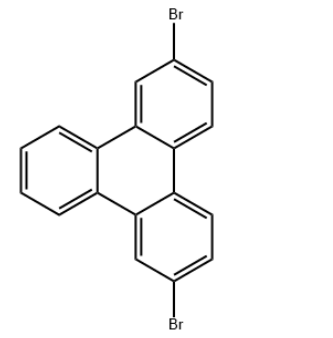 |
| CAS编号 | 888041-37-0 |
| MDL Number | MFCD22571695 |
| 别名 | 2,7-dibromotriphenylene 888041-37-0 2,7-Dibromo-triphenylene 1219091-69-6 SCHEMBL12580921 DTXSID80583088 MFCD22571695 AKOS024462942 DS-7796 CS-0022186 D4801 FT-0706138 F18762 A854403 |
| 分子式 | C18H10Br2 |
| 分子量 | 386.1 |
| InChI | InChI=1S/C18H10Br2/c19-11-5-7-15-16-8-6-12(20)10-18(16)14-4-2-1-3-13(14)17(15)9-11/h1-10H |
| InChI Key | BPGPBYGXGRDFQG-UHFFFAOYSA-N |
| Canonical SMILES | C1=CC=C2C(=C1)C3=C(C=CC(=C3)Br)C4=C2C=C(C=C4)Br |
| Patent Information | ||
| Patent ID | Title | Publication Date |
| CN108329270 | Organic electroluminescence material containing triphenylene and benzimidazole structure and organic light-emitting device of organic electroluminescence material | 2018 |
| EP2679581 | COMPOUND CONTAINING SUBSTITUTED TRIPHENYLE RING STRUCTURE, AND ORGANIC ELECTROLUMINESCENT ELEMENT | 2014 |
Physical Data
| Appearance | White powder |
| Melting Point, °C | Solvent (Melting Point) |
| 220 – 223 | acetonitrile |
Spectra
| Description (NMR Spectroscopy) | Nucleus (NMR Spectroscopy) | Solvents (NMR Spectroscopy) | Temperature (NMR Spectroscopy), °C | Frequency (NMR Spectroscopy), MHz |
| Chemical shifts | 13C | CDCl3 | 25 | 125.691 |
| Spectrum | 13C | CDCl3 | 25 | 125.691 |
| Chemical shifts | 1H | CDCl3 | 500 | |
| Spectrum | 1H | CDCl3 | 500 |
| Description (IR Spectroscopy) | Solvent (IR Spectroscopy) |
| Bands | NaCl |
Route of Synthesis (ROS)

Route of Synthesis (ROS) of 2,7-Dibromotriphenylene CAS 888041-37-0
| Conditions | Yield |
| With palladium bis[bis(diphenylphosphino)ferrocene] dichloride; anhydrous potassium acetate In 1,4-dioxane for 72h; Inert atmosphere; Reflux; | 89% |
| With palladium (II) [1,1′-bis(diphenylphosphanyl)ferrocene] dichloride; anhydrous potassium acetate In 1,4-dioxane at 85℃; for 12h; Inert atmosphere; | 76% |
| With dichloro(1,1′-bis(diphenylphosphanyl)ferrocene)palladium(II) dichloromethane adduct; anhydrous potassium acetate In 1,4-dioxane at 80℃; for 10h; Molecular sieve; Inert atmosphere; | 70% |
| With dichloro(1,1′-bis(diphenylphosphanyl)ferrocene)palladium(II) dichloromethane adduct; anhydrous potassium acetate In 1,4-dioxane at 80℃; for 10h; Molecular sieve; Inert atmosphere; | 70% |
| Experimental Procedure 5.5 g of the obtained 2,7-dibromotriphenylene,7.9 g of bis (pinacolato) diboron,4.2 g of potassium acetate,50 ml of 1,4-dioxane previously dehydrated with Molecular Sieves 4 A,0.4 g of [1,1′-bis (diphenylphosphino) ferrocene] palladium (II) dichloride-dichloromethane complex (1: 1) was added to a reaction vessel purged with nitrogen and heated,Followed by stirring at 80 ° C. for 10 hours.After cooling to 50 ° C.,150 ml of chloroform was added,And the mixture was stirred for 30 minutes.Insoluble matter was removed by filtration,The crude product was obtained by concentration.The crude product was purified by column chromatography [carrier: silica gel, eluent: ethyl acetate / n-hexane = 1/5 (v / v)],4.8 g (yield: 70%) of a white powder of 2,7-bis (4,4,5,5-tetramethyl- [1,3,2] dioxaborolan-2-yl) triphenylene was obtained. |
Safety and Hazards
| Pictogram(s) |  |
| Signal | Warning |
| GHS Hazard Statements | H315 (100%): Causes skin irritation [Warning Skin corrosion/irritation] H319 (100%): Causes serious eye irritation [Warning Serious eye damage/eye irritation] |
| Precautionary Statement Codes | P264, P264+P265, P280, P302+P352, P305+P351+P338, P321, P332+P317, P337+P317, and P362+P364 (The corresponding statement to each P-code can be found at the GHS Classification page.) |
Other Data
| Transportation | Not dangerous goods |
| Under room temperature away from light | |
| HS Code | |
| Storage | Under room temperature away from light |
| Shelf Life | 2 years |
| Market Price |
| Druglikeness | |
| Lipinski rules component | |
| 分子量 | 386.085 |
| logP | 7.416 |
| HBA | 0 |
| HBD | 0 |
| Matching Lipinski Rules | 3 |
| Veber rules component | |
| Polar Surface Area (PSA) | 0 |
| Rotatable Bond (RotB) | 0 |
| Matching Veber Rules | 2 |
| Toxicity/Safety Pharmacology |
| Quantitative Results |
| Use Pattern |
| 2,7-Dibromotriphenylene CAS 888041-37-0 is uesed as an intermediate in organic synthesis. Through further chemical reactions, it can be used to synthesize organic compounds with different structures and properties. The bromine groups can undergo substitution reactions, allowing for the introduction of other functional groups and expanding the compound’s application range. |
试剂采购 | |
| 没有试剂厂商? | 向凯望发送快速询价 |
| 想要被列为试剂厂商? (付费服务) | 点击这里联系凯望 |
认证生产商 | |
| Warshel Chemical Ltd | http://www.warshel.com/ |
| 想要被列为认证生产商 (需要通过认证)? | 请下载并填写 这份表格并发邮件到approved-manufacturers@chemwhat.com |
其他供应商 | |
| Watson International Limited | 访问Watson官网 |
如需其他帮助,请联系我们 | |
| 联系我们获取其它信息或服务 | 点击这里联系凯望 |