2,7-Dihydroxy-9-fluorenone CAS#: 42523-29-5; 凯望编码 (ChemWhat Code): 445546

Identification
| 英文名 | 2,7-Dihydroxy-9-fluorenone |
| IUPAC名称 | 2,7-dihydroxyfluoren-9-one |
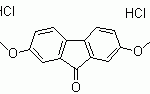
| 分子结构 |  |
| CAS编号 | 42523-29-5 |
| EINECS Number | No data available |
| MDL Number | No data available |
| Beilstein Registry Number | No data available |
| 别名 | 2,7-dihydroxy-9H-fluoren-9-one, 2,7-dihydroxy-fluoren-9-one, 2,7-Dihydroxy-9-fluorenone, 2,7-Dihydroxyfluoren-9-one, 2,7-dioxy-9H-fluoren-9-one, 2,7-dihydroxyfluorenone, 2,7-Fluorenonediol;2,7-Dihydroxy-9-fluorenone CAS Number: 42523-29-5;CAS No.: 42523-29-5 |
| 分子式 | C13H8O3 |
| 分子量 | 212.20 |
| InChI | InChI=1S/C13H8O3/c14-7-1-3-9-10-4-2-8(15)6-12(10)13(16)11(9)5-7/h1-6,14-15H |
| InChI Key | CWHPQXRTQSNTRR-UHFFFAOYSA-N |
| Canonical SMILES | C1=CC2=C(C=C1O)C(=O)C3=C2C=CC(=C3)O |
| Patent Information | ||
| Patent ID | Title | Publication Date |
| JP2019/77634 | Production of […] (by machine translation) | 2019 |
| US2005/234031 | Amino-substituted tricyclic derivatives and methods of use | 2005 |
Physical Data
| Appearance | Dark red crystal or powder |
| Density | 1.497±0.06 g/cm3(Predicted) |
| Melting Point, °C | Solvent (Melting Point) |
| 336 – 337 | |
| 326 – 329 | ethanol |
| 230 | |
| 338 | aq. ethanol |
| 320 – 322 | ethanol |
| 335 – 338 |
Spectra
| Description (NMR Spectroscopy) | Nucleus (NMR Spectroscopy) | Solvents (NMR Spectroscopy) | Frequency (NMR Spectroscopy), MHz |
| Chemical shifts | 1H | dimethylsulfoxide-d6 | 300 |
| Chemical shifts, Spectrum | 1H | [(2)H6]acetone | 500 |
| Chemical shifts, Spectrum | 13C | [(2)H6]acetone | 126 |
| Chemical shifts | 1H | dimethylsulfoxide-d6 | 300 |
| Chemical shifts | 1H | [(2)H6]acetone | 300 |
| Chemical shifts | 13C | dimethylsulfoxide-d6 | 75.5 |
| 1H | dimethylsulfoxide-d6 |
| Description (IR Spectroscopy) | Solvent (IR Spectroscopy) |
| Bands | neat (no solvent, solid phase) |
| Bands | potassium bromide |
| Bands,Spectrum | potassium bromide |
| Description (Mass Spectrometry) |
| APCI (atmospheric pressure chemical ionization), spectrum |
| high resolution mass spectrometry (HRMS), electrospray ionisation (ESI), time-of-flight mass spectra (TOFMS), liquid chromatography mass spectrometry (LCMS), spectrum |
| electrospray ionisation (ESI), spectrum |
Route of Synthesis (ROS)

| Conditions | Yield |
| With trifluorormethanesulfonic acid at 150℃; for 10h; Inert atmosphere; Experimental Procedure 1.1 Synthesis of 2,7-dihydroxy-9,9-bis-(4-aminophenyl)fluorene 0.05 mol of 2,7-dihydroxy-9-fluorenone,0.40 mol of aniline and 0.015 mol of trifluoromethanesulfonic acid were successively added to a flask equipped with a stirred rotor,Condenser,Thermometer and gas inlet in a four-necked flask,Access to nitrogen,Reaction at 150 ° C for 10 h,Then cooled to room temperature,The product was poured into a 100 mL solution of 5 g / L sodium hydroxide in ethanol,The precipitate is filtered,Ethanol wash,Vacuum drying,To give 2,7-dihydroxy-9,9-bis- (4-aminophenyl) fluorene (M-1)The yield was 92.3%. | 92.3% |
| With methanesulfonic acid at 150℃; for 10h; | 86% |
| With aniline hydrochloride at 180℃; for 1h; | 73.6% |
| With methanesulfonic acid at 150℃; for 10h; | |
| With methanesulfonic acid at 150℃; for 14h; |
Safety and Hazards
| Pictogram(s) |   |
| Signal | Danger |
| GHS Hazard Statements | H301 (25%): Toxic if swallowed [Danger Acute toxicity, oral] H302 (25%): Harmful if swallowed [Warning Acute toxicity, oral] H312 (50%): Harmful in contact with skin [Warning Acute toxicity, dermal] H315 (50%): Causes skin irritation [Warning Skin corrosion/irritation] H319 (50%): Causes serious eye irritation [Warning Serious eye damage/eye irritation] H332 (50%): Harmful if inhaled [Warning Acute toxicity, inhalation] H335 (25%): May cause respiratory irritation [Warning Specific target organ toxicity, single exposure; Respiratory tract irritation] Information may vary between notifications depending on impurities, additives, and other factors. |
| Precautionary Statement Codes | P261, P264, P270, P271, P280, P301+P310, P301+P312, P302+P352, P304+P312, P304+P340, P305+P351+P338, P312, P321, P322, P330, P332+P313, P337+P313, P362, P363, P403+P233, P405, and P501 (The corresponding statement to each P-code can be found at the GHS Classification page.) |
Other Data
| Transportation | Under the room temperature and away from light |
| HS Code | 294200 |
| Storage | Under the room temperature and away from light |
| Shelf Life | 1 year |
| Market Price | USD |
| Druglikeness | |
| Lipinski rules component | |
| 分子量 | 212.205 |
| logP | 2.682 |
| HBA | 1 |
| HBD | 2 |
| Matching Lipinski Rules | 4 |
| Veber rules component | |
| Polar Surface Area (PSA) | 57.53 |
| Rotatable Bond (RotB) | 0 |
| Matching Veber Rules | 2 |
| Bioactivity |
| In vitro: Efficacy |
| Quantitative Results |
| pX | Parameter | Value (quant) | Unit | Target |
| 4.6 | Kd (dissociation constant)(Dissociation constant) | 25~50 | µM | Lanosterol 14-alpha demethylase [Mycobacterium tuberculosis]:Wild |
| Quantitative Results |
| 1 of 1 | Results | virus-inhibiting activity in regard to the influenza virus A/FPV (H7N7) in the cell culture of chicken emryo fibroblast |
| Use Pattern |
| 2,7-Dihydroxy-9-fluorenone CAS#: 42523-29-5 is mostly used as an anti-cancer interferon. |
Related Chemicals
试剂采购 | |
| 没有试剂厂商? | 向凯望发送快速询价 |
| 想要被列为试剂厂商? (付费服务) | 点击这里联系凯望 |
认证生产商 | |
| Caming Pharmaceutical Ltd | http://www.caming.com/ |
| 想要被列为认证生产商 (需要通过认证)? | 请下载并填写 这份表格并发邮件到approved-manufacturers@chemwhat.com |
其他供应商 | |
| Watson International Limited | 访问Watson官网 |
如需其他帮助,请联系我们 | |
| 联系我们获取其它信息或服务 | 点击这里联系凯望 |