3-Formyl-4-methoxyphenylboronic acid CAS#: 121124-97-8; 凯望编码 (ChemWhat Code): 346610

Identification
| 英文名 | 3-Formyl-4-methoxyphenylboronic acid |
| IUPAC Name | (3-formyl-4-methoxyphenyl)boronic acid |
| 分子结构 | 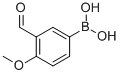 |
| CAS编号 | 121124-97-8 |
| MDL Number | MFCD02093661 |
| 别名 | 3-Formyl-4-methoxyphenylboronic acid 121124-97-8 (3-formyl-4-methoxyphenyl)boronic acid 3-Formyl-4-Methoxybenzeneboronic Acid 5-BORONO-O-ANISALDEHYDE MFCD02093661 3-Formyl-4-methoxyphenylboronicacid Boronic acid, (3-formyl-4-methoxyphenyl)- 3-formyl-4-methoxyphenyl boronic acid (3-formyl-4-methoxy-phenyl)boronic Acid SCHEMBL426071 DTXSID60374693 YJQDBKGGRPJSOI-UHFFFAOYSA-N AMY29889 AKOS004116392 AB10795 CS-W016010 3-formyl 4-methoxy phenyl boronic acid 3-formyl-4-methoxy-phenyl boronic acid 3-formyl-4-methoxy-phenyl-boronic acid (3-formyl-4-methoxyphenyl)-boronic acid AC-24808 DS-12249 SY024837 DB-016009 EN300-781034 A804662 J-512572 (3-formyl-4-methoxy-phenyl)boronic acid;3-Formyl-4-methoxyphenylboronic acid |
| 分子式 | C8H9BO4 |
| 分子量 | 179.97 |
| InChI | InChI=1S/C8H9BO4/c1-13-8-3-2-7(9(11)12)4-6(8)5-10/h2-5,11-12H,1H3 |
| InChI Key | YJQDBKGGRPJSOI-UHFFFAOYSA-N |
| Isomeric SMILES | B(C1=CC(=C(C=C1)OC)C=O)(O)O |
Physical Data
| Appearance | White to Light yellow to Light orange solid |
| Melting Point, °C | Solvent (Melting Point) |
| 206 – 208 | ethanol |
Spectra
| Description (NMR Spectroscopy) | Nucleus (NMR Spectroscopy) | Solvents (NMR Spectroscopy) | Frequency (NMR Spectroscopy), MHz |
| Chemical shifts | 1H | [(2)H6]acetone | 400 |
| Chemical shifts | 13C | [(2)H6]acetone |
Route of Synthesis (ROS)

| Conditions | Yield |
| With potassium carbonate; tetrakis(triphenylphosphine) palladium(0) In 1,2-dimethoxyethane; water at 20 – 85℃; for 16.25h; Suzuki Coupling; Experimental Procedure Experimental Procedure 2-Methoxy-5-(2-methyl-pyridin-4-yl)-benzaldehyde (87) EPO A stirred suspension of 3-formyl-4-methoxybenzeneboronic acid (700 mg, 3.89 mmol), 4-chloro-2-picoline (494 mg, 3.89 mmol), potassium carbonate (1.45 g, 10.5 mmol) and tetrakis(triphenylphosphine)palladium(0) (225 mg, 0.19 mmol) in 1,2- dimethoxyethane (14 mL) and water (5 mL) is degassed at RT with N2 for 15 minutes then warmed for 16 h at 85°C. The reaction mixture is then cooled to RT and 2 M HCl (15 mL) added. The aqueous layer is washed with TBME (15 mL) then basified to pH 10 with aqueous K2CO3 and extracted into EtOAc (3 x 50 mL). The combined organic phases are dried over Na2SO4 and the solvents removed in vacuo to give the title compound. Yield: 820 mg (93%). LC/MS tr 0.91 min. MS(ES+) m/z 228 (M+H). | 93% |
| Stage #1: 4-chIoro-2-methylpyridine; 3-formyl-4-methoxyphenylboronic acid With potassium carbonate; tetrakis(triphenylphosphine) palladium(0) In 1,2-dimethoxyethane; water at 20 – 85℃; for 16.25h; Stage #2: With hydrogenchloride In 1,2-dimethoxyethane; water at 20℃; Stage #3: With potassium carbonate In water pH=10; Experimental Procedure 2-Methoxy-5-(2-methyI-pyridin-4-yI)-benzaldehyde (87) A stirred suspension of 3-formyl-4-methoxybenzeneboronic acid (700 mg, 3.89 mmol), 4-chloro-2-picoline (494 mg, 3.89 mmol), potassium carbonate (1.45 g, 10.5 mmol) and tetrakis(triphenylphosphine)palladiurn(0) (225 mg, 0.19 mmol) in 1,2- dimethoxyethane (14 mL) and water (5 mL) was degassed at RT with N2 for 15 minutes then warmed for 16 h at 85°C. The reaction mixture was then cooled to RT and 2 M HCl (15 mL) added. The aqueous layer was washed with TBME (15 mL) then basifed to pH 10 with aqueous K2CO3 and extracted into EtOAc (3 x 50 mL). The combined organic phases were dried over Na2SO4 and the solvents removed in vacuo to give the title compound. Yield: 820 mg (93%). LC/MS _γ 0.91 min. MS(ES+) m/z 228 (M+H). | 93% |
| With potassium carbonate In 1,2-dimethoxyethane; water at 20 – 85℃; for 16.25h; Experimental Procedure 2-Methoxy-5-(2-methyl-pyridin-4-yl)-benzaldehyde (87); EPO A stirred suspension of 3-formyl-4-methoxybenzeneboronic acid (700 mg, 3.89 mmol), 4-chloro-2-picoline (494 mg, 3.89 mmol), potassium carbonate (1.45 g, 10.5 mmol) and tetrakis(triphenylphosphine)palladium(0) (225 mg, 0.19 mmol) in 1,2- dimethoxyethane (14 mL) and water (5 mL) is degassed at RT with N2 for 15 minutes then warmed for 16 h at 85 °C. The reaction mixture is then cooled to RT and 2 M HCl (15 mL) added. The aqueous layer is washed with TBME (15 mL) then basified to pH 10 with aqueous K2CO3 and extracted into EtOAc (3 x 50 mL). The combined organic phases are dried over Na2SO4 and the solvents removed in vacuo to give the title compound. Yield: 820 mg (93%). LC/MS U 0.91 min. MS(ES+) m/z 228 (M+H). | 93% |
| Stage #1: 4-chIoro-2-methylpyridine; 3-formyl-4-methoxyphenylboronic acid With potassium carbonate; tetrakis(triphenylphosphine) palladium(0) In 1,2-dimethoxyethane; water at 20 – 85℃; for 16.25h; Stage #2: With hydrogenchloride In 1,2-dimethoxyethane; water at 20℃; Stage #3: With potassium carbonate In water pH=10; Experimental Procedure Synthesis of Compound 331 (RIl).; 2-Methoxy-5-(2-methyl-pyridin-4-yl)-benzaldehyde (87); A stirred suspension of 3-formyl-4-methoxybenzeneboronic acid (700 mg, 3.89 mmol), 4-chloro-2-picoline (494 mg, 3.89 mmol), potassium carbonate (1.45 g, 10.5 mmol) and tetrakis(triphenylphosphine)palladium(0) (225 mg, 0.19 mmol) in 1 ,2- dimethoxyethane (14 mL) and water (5 mL) is degassed at RT with N2 for 15 minutes then warmed for 16 h at 85°C. The reaction mixture is then cooled to RT and 2 M HCl (15 mL) added. The aqueous layer is washed with TBME (15 mL) then basified to pH 10 with aqueous K2CO3 and extracted into EtOAc (3 x 50 mL). The combined organic phases are dried over Na2SO4 and the solvents removed in vacuo to give the title compound. Yield: 820 mg (93%). LC/MS /r 0.91 min. MS(ES+) m/z 228 (M+H). | 93% |
Safety and Hazards
| Pictogram(s) |   |
| Signal | Danger |
| GHS Hazard Statements | H314 (88.64%): Causes severe skin burns and eye damage [Danger Skin corrosion/irritation] H315 (11.36%): Causes skin irritation [Warning Skin corrosion/irritation] H319 (11.36%): Causes serious eye irritation [Warning Serious eye damage/eye irritation] H335 (13.64%): May cause respiratory irritation [Warning Specific target organ toxicity, single exposure; Respiratory tract irritation] |
| Precautionary Statement Codes | P260, P261, P264, P264+P265, P271, P280, P301+P330+P331, P302+P352, P302+P361+P354, P304+P340, P305+P351+P338, P305+P354+P338, P316, P319, P321, P332+P317, P337+P317, P362+P364, P363, P403+P233, P405, and P501 (The corresponding statement to each P-code can be found at the GHS Classification page.) |
Other Data
| Transportation | Under room temperature away from light |
| HS Code | |
| Storage | Under room temperature away from light |
| Shelf Life | 2 years |
| Market Price |
| Druglikeness | |
| Lipinski rules component | |
| 分子量 | 179.968 |
| logP | 0.658 |
| HBA | 3 |
| HBD | 2 |
| Matching Lipinski Rules | 4 |
| Veber rules component | |
| Polar Surface Area (PSA) | 66.76 |
| Rotatable Bond (RotB) | 3 |
| Matching Veber Rules | 2 |
| Use Pattern |
| 3-Formyl-4-methoxyphenyl boronic acid CAS 121124-97-8 can be used as an intermediate in the synthesis of active pharmaceutical ingredients (APIs). Its unique structure makes it valuable in the synthesis of biologically active molecules. In materials science, 3-Formyl-4-methoxyphenyl boronic acid can be used to synthesize functional polymers, especially those requiring specific optical, electrical, or mechanical properties. 3-Formyl-4-methoxyphenyl boronic acid can serve as a precursor to ionic liquids, which have wide applications in catalysis, electrochemistry, and materials science. |
试剂采购 | |
| 没有试剂厂商? | 向凯望发送快速询价 |
| 想要被列为试剂厂商? (付费服务) | 点击这里联系凯望 |
认证生产商 | |
| Caming Pharmaceutical Limited | http://www.caming.com/ |
| 想要被列为认证生产商 (需要通过认证)? | 请下载并填写 这份表格并发邮件到approved-manufacturers@chemwhat.com |
其他供应商 | |
| Watson International Limited | 访问Watson官网 |
如需其他帮助,请联系我们 | |
| 联系我们获取其它信息或服务 | 点击这里联系凯望 |