4,4′-Trimethylenedipyridine CAS#: 17252-51-6; 凯望编码 (ChemWhat Code): 12712

Identification
| 英文名 | 4,4′-Trimethylenedipyridine |
| IUPAC名称 | 4-(3-pyridin-4-ylpropyl)pyridine |
| 分子结构 | 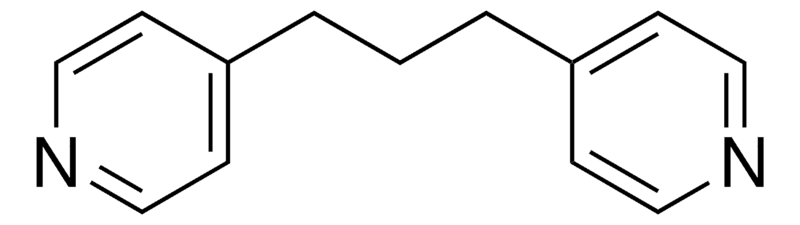 |
| CAS编号 | 17252-51-6 |
| EINECS Number | 241-284-8 |
| MDL Number | MFCD00038046 |
| Beilstein Registry Number | No data available |
| 别名 | 1,3-di(4-pyridyl)propane1,3-bis(4-pyridyl)propane4,4′-trimethylenedipyridine4,4′-trimethylene dipyridinebpp1,3-di(pyridine-4-yl)propane1,3-di(pyridin-4-yl)propanetmdp |
| 分子式 | C13H14N2 |
| 分子量 | 198.269 |
| InChI | InChI=1S/C13H14N2/c1(2-12-4-8-14-9-5-12)3-13-6-10-15-11-7-13/h4-11H,1-3H2 |
| InChI Key | OGNCVVRIKNGJHQ-UHFFFAOYSA-N |
| Canonical SMILES | c1cc(CCCc2ccncc2)ccn1 |
| Patent Information | ||
| Patent ID | Title | Publication Date |
| EP3498694 | NEW BENZAMIDE DERIVATIVES AS PPAR-GAMMA MODULATORS | 2019 |
| WO2019/126730 | CHROMENOPYRIDINE DERIVATIVES AS PHOSPHATIDYLINOSITOL PHOSPHATE KINASE INHIBITORS | 2019 |
| US2018/230157 | PYRROLO[1,2-b]PYRIDAZINE DERIVATIVES | 2018 |
| WO2018/169373 | PYRROLOTRIAZINE DERIVATIVES AS KINASE INHIBITOR | 2018 |
| WO2018/203194 | DIAZABICYCLOOCTANE DERIVATIVES COMPRISING A QUATERNERY AMMONIUM GROUP FOR USE AS ANTIBACTERIAL AGENTS | 2018 |
Physical Data
| Appearance | White to off-white or light yellow crystalline powder |
| Solubility | Slightly soluble in water |
| Flash Point | 142°C/2mm |
| Sensitivity | Hygroscopic |
| Melting Point, °C |
| 60 |
| 53 – 56 |
| 245 |
| Boiling Point, °C |
| 77 |
| 158 – 162 |
| Measurement Temperature, °C | Type (Density) | Comment (Density) |
| -173.16 | crystallographic | Density: 1.225 g/cm3 |
| Description (Association (MCS)) | Solvent (Association (MCS)) | Temperature (Association (MCS)), °C | Partner (Association (MCS)) |
| IR spectrum of the complex | KBr | CuSO4*5H2O | |
| UV/VIS spectrum of the complex | 20 | disodium terephthalate | |
| Stability constant of the complex with … | toluene | 20 – 55 | cyclic Zn-porphyrin trimer |
Spectra
| Description (NMR Spectroscopy) | Nucleus (NMR Spectroscopy) | Solvents (NMR Spectroscopy) |
| Chemical shifts, Spectrum | 1H | chloroform-d1 |
| Chemical shifts, Spectrum | 13C | chloroform-d1 |
| DEPT (Distorsionless Enhancement by Polarisation Transfer), Spectrum | 13C | |
| Spectrum | 1H | dimethylsulfoxide-d6 |
| Description (IR Spectroscopy) | Solvent (IR Spectroscopy) | Temperature (IR Spectroscopy), °C |
| Bands | potassium bromide | |
| Spectrum | potassium bromide | |
| ATR (attenuated total reflectance), Spectrum |
| Description (Mass Spectrometry) |
| spectrum |
| Description (UV/VIS Spectroscopy) | Absorption Maxima (UV/VIS), nm |
| Spectrum | |
| Band assignment, Spectrum | 248, 284 |
| Description (Raman Spectroscopy) |
| Bands, Spectrum |
Route of Synthesis (ROS)

| Conditions | Yield |
| With sodium hydroxide In water at 20℃; for 48h; | 53.1% |
Safety and Hazards
| Pictogram(s) |   |
| Signal | Danger |
| GHS Hazard Statements | H301 (19.1%): Toxic if swallowed [Danger Acute toxicity, oral] H302 (80.6%): Harmful if swallowed [Warning Acute toxicity, oral] H312 (80.6%): Harmful in contact with skin [Warning Acute toxicity, dermal] H315 (97.1%): Causes skin irritation [Warning Skin corrosion/irritation] H319 (97.1%): Causes serious eye irritation [Warning Serious eye damage/eye irritation] H332 (80.6%): Harmful if inhaled [Warning Acute toxicity, inhalation] H335 (81.5%): May cause respiratory irritation [Warning Specific target organ toxicity, single exposure; Respiratory tract irritation] Information may vary between notifications depending on impurities, additives, and other factors. |
| Precautionary Statement Codes | P261, P264, P264+P265, P270, P271, P280, P301+P316, P301+P317, P302+P352, P304+P340, P305+P351+P338, P317, P319, P321, P330, P332+P317, P337+P317, P362+P364, P403+P233, P405, and P501 (The corresponding statement to each P-code can be found at the GHS Classification page.) |
Other Data
| Transportation | NONH for all modes of transport |
| Under the room temperature and away from light | |
| HS Code | No data available |
| Storage | Under the room temperature and away from light |
| Shelf Life | 2 years |
| Market Price | USD |
| Druglikeness | |
| Lipinski rules component | |
| 分子量 | 198.268 |
| logP | 2.433 |
| HBA | 2 |
| HBD | 0 |
| Matching Lipinski Rules | 4 |
| Veber rules component | |
| Polar Surface Area (PSA) | 25.78 |
| Rotatable Bond (RotB) | 4 |
| Matching Veber Rules | 2 |
| Use Pattern |
| 1.Coordination chemistry and metal complex synthesis Due to the presence of two pyridine nitrogen atoms, this compound is often used as a bidentate ligand to form stable complexes with transition metals (such as Ru, Ir, Pt, Pd, etc.). 2.Photoelectric functional materials In OLED, solar cells, photoluminescent and electroluminescent materials, it is used as an electron transport layer or photosensitive ligand. Some metal-organic complexes are based on this type of bipyridine derivatives for light-emitting devices. 3.Metal-organic frameworks (MOFs) or coordination polymers Using its bridging ability, high-dimensional MOF materials can be constructed for functional material design such as gas storage, catalysis or separation. 4.Molecular recognition and self-assembly system In the field of supramolecular chemistry, this compound is often used as a building block for self-assembly structure and molecular device design. |
试剂采购 | |
| 没有试剂厂商? | 向凯望发送快速询价 |
| 想要被列为试剂厂商? (付费服务) | 点击这里联系凯望 |
认证生产商 | |
| WatsonChem Advanced Chemical Materials | https://www.watsonchem.com/ |
| 想要被列为认证生产商 (需要通过认证)? | 请下载并填写 这份表格并发邮件到approved-manufacturers@chemwhat.com |
其他供应商 | |
| Watson International Limited | 访问Watson官网 |
如需其他帮助,请联系我们 | |
| 联系我们获取其它信息或服务 | 点击这里联系凯望 |