5-Chloro-2-(methylamino)benzophenone CAS#: 1022-13-5; 凯望编码 (ChemWhat Code): 62757

Identification
| 英文名 | 5-Chloro-2-(methylamino)benzophenone |
| IUPAC Name | [5-chloro-2-(methylamino)phenyl]-phenylmethanone |
| 分子结构 | 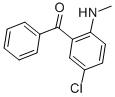 |
| CAS编号 | 1022-13-5 |
| EINECS Number | 213-822-1 |
| MDL Number | MFCD00008284 |
| 别名 | 1022-13-5 5-Chloro-2-(methylamino)benzophenone 5-Chloro-2-methylaminobenzophenone (5-Chloro-2-(methylamino)phenyl)(phenyl)methanone 2-Methylamino-5-chlorobenzophenone Methanone, [5-chloro-2-(methylamino)phenyl]phenyl- [5-chloro-2-(methylamino)phenyl]-phenylmethanone BENZOPHENONE, 5-CHLORO-2-(METHYLAMINO)- 2-benzoyl-4-chloro-N-methylaniline MFCD00008284 (5-Chloro-2-(methylamino)phenyl)phenylmethanone Methanone, (5-chloro-2-(methylamino)phenyl)phenyl- D4GD5770PI [5-Chloro-2-(methylamino)phenyl]phenylmethanone [5-Chloro-2-(methylamino)phenyl]-phenylmethanone (5-Chloro-2-(methylamino)benzophenone) BRN 0882187 EINECS 213-822-1 UNII-D4GD5770PI 2-(Methylamino)-5-chlorobenzophenone Oprea1_680102 BIDD:GT0238 SCHEMBL333291 DTXSID4061416 2-Methylamino-5-chlorbenzophenon 2-Methylamino-5-chlorbenzophenone AC1105 Benzophenone, 2-acetamido-5-chloro- AKOS000120857 CS-W012707 HY-W011991 2-(N-methylamino)-5-chlorobenzophenone AC-10169 AS-11966 DIAZEPAM IMPURITY D [EP IMPURITY] PD163859 SY037878 TEMAZEPAM IMPURITY A [EP IMPURITY] DB-014567 RO-5-4365 5-Chloro-2-(methylamino)benzophenone, 99% C2281 CHLORO-2-METHYLAMINOBENZOPHENONE, 5- NS00023126 EN300-20890 A800545 SR-01000395967 Q-200536 SR-01000395967-1 [5-chloranyl-2-(methylamino)phenyl]-phenyl-methanone Q27276093 Z104484472 |
| 分子式 | C14H12ClNO |
| 分子量 | 245.7 |
| InChI | InChI=1S/C14H12ClNO/c1-16-13-8-7-11(15)9-12(13)14(17)10-5-3-2-4-6-10/h2-9,16H,1H3 |
| InChI Key | WPNMLCMTDCANOZ-UHFFFAOYSA-N |
| Isomeric SMILES | CNC1=C(C=C(C=C1)Cl)C(=O)C2=CC=CC=C2 |
| Patent Information | ||
| Patent ID | Title | Publication Date |
| CN117229206 | Preparation method for synthesizing polysubstituted 2-quinolinone compound through base catalysis | 2023 |
| US6407111 | Phenyl substituted pyridine and benzene derivatives | 2002 |
Physical Data
| Appearance | Yellow crystalline powder |
| Melting Point, °C |
| 89 – 91 |
| 93 – 94 |
| 94.2 – 95.4 |
| 94.3 – 95.4 |
| 94.3 – 95.2 |
| 94.2 – 95.3 |
| 94.2 – 95.1 |
| Density, g·cm-3 |
| 1.385 |
Spectra
| Description (NMR Spectroscopy) | Nucleus (NMR Spectroscopy) | Solvents (NMR Spectroscopy) | Frequency (NMR Spectroscopy), MHz |
| Chemical shifts, Spectrum | 1H | chloroform-d1 | 600 |
| Chemical shifts, Spectrum | 13C | chloroform-d1 | 150 |
| DEPT (Distorsionless Enhancement by Polarisation Transfer), Spectrum | 13C | chloroform-d1 | 150 |
| Chemical shifts, Spectrum | 13C | chloroform-d1 | 100 |
| Chemical shifts, Spectrum | 1H | chloroform-d1 | 400 |
| Chemical shifts | 1H | chloroform-d1 | 400 |
| Chemical shifts | 13C | chloroform-d1 | 101 |
| Description (IR Spectroscopy) | Solvent (IR Spectroscopy) |
| ATR (attenuated total reflectance), Bands | |
| Bands | neat (no solvent, solid phase), sodium chloride |
| Intensity of IR bands, Bands | potassium bromide |
| Bands | |
| Bands | potassium bromide |
| Bands | KBr |
| Description (UV/VIS Spectroscopy) | Solvent (UV/VIS Spectroscopy) | Comment (UV/VIS Spectroscopy) | Absorption Maxima (UV/VIS), nm | Ext./Abs. Coefficient, l·mol-1cm-1 |
| Oscillator strength, Band assignment, Spectrum | ethanol | 406 | ||
| ethanol | 532 | |||
| Absorption maxima | methanol | 235, 400 | 20300, 6410 | |
| Spectrum | acetonitrile | 210 – 470 nm | ||
| Absorption maxima | acetonitrile | 236 | 19800 | |
| Absorption maxima | 412 | 6950 | ||
Route of Synthesis (ROS)
| Conditions | Yield |
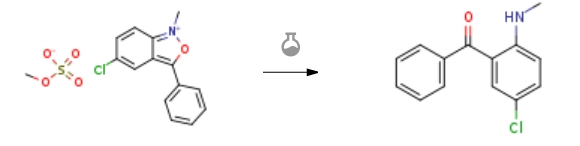
| With hydrazine hydrate; zinc(II) chloride In water at 20 – 30℃; for 4h; Temperature; Experimental Procedure 3 Example 3: Add to the reaction bottleAqueous solution of N-methyl-3-phenyl-5-chloro-2,1-benzisoxazole methyl quaternary ammonium salt 500g(containing N-methyl-3-phenyl-5-chloro-2,1-benzisoxazole methyl quaternary ammonium salt 200g),3 g of zinc chloride and 90 g of an aqueous solution of hydrazine hydrate.The reaction was carried out at 20 to 30 ° C for 3 hours. Cool down, filter,Wash the filter cake with 200g of purified water and dry it.2-methylamino-5-chlorobenzophenone 135g,The yield was 97.7%, the melting point was 94.3 to 95.2 ° C, and the HPLC purity was 99.2%. | 97.7% |
| With hydrazine hydrate; methylamine In water at 25 – 30℃; for 5h; Temperature; Experimental Procedure 3 Example 3: 500 g of an aqueous solution of N-methyl-3-phenyl-5-chloro-2,1-benzisoxazole methyl quaternary ammonium salt was added to the reaction flask (containingN-methyl-3-phenyl-5-chloro-2,1-benzisoxazole methyl quaternary ammonium salt 200 g), 2.4 g of monomethylamine aqueous solution and 60 g of aqueous hydrazine hydrate solution. The reaction was carried out at 25 to 30 ° C for 5 hours. The mixture was cooled, filtered, and washed with 200 g of purified water, and dried to obtain 135 g of 2-methylamino-5-chlorobenzophenone, the yield was 97.7%, the melting point was 94.3 to 95.1 ° C, and the HPLC purity was 99.3%. | 97.7% |
| With Saccharomyces cerevisiae bakers’ yeast In methanol at 20℃; for 8h; pH=7; aq. phosphate buffer; Microbiological reaction; shaking; | 92% |
| With aluminium trichloride; zinc In tetrahydrofuran for 8h; Ambient temperature; | 62% |
Safety and Hazards
| Pictogram(s) |  |
| Signal | Warning |
| GHS Hazard Statements | H315 (97.8%): Causes skin irritation [Warning Skin corrosion/irritation] H319 (97.8%): Causes serious eye irritation [Warning Serious eye damage/eye irritation] H335 (95.6%): May cause respiratory irritation [Warning Specific target organ toxicity, single exposure; Respiratory tract irritation] |
| Precautionary Statement Codes | P261, P264, P264+P265, P271, P280, P302+P352, P304+P340, P305+P351+P338, P319, P321, P332+P317, P337+P317, P362+P364, P403+P233, P405, and P501 (The corresponding statement to each P-code can be found at the GHS Classification page.) |
Other Data
| Druglikeness | |
| Lipinski rules component | |
| 分子量 | 245.708 |
| logP | 4.273 |
| HBA | 2 |
| HBD | 1 |
| Matching Lipinski Rules | 4 |
| Veber rules component | |
| Polar Surface Area (PSA) | 29.1 |
| Rotatable Bond (RotB) | 3 |
| Matching Veber Rules | 2 |
| Use Pattern |
| 2-Methylamino-5-chlorobenzophenone is an essential intermediate primarily used in synthesizing diazepam and medazepam. These medications are widely used for their anxiolytic, sedative, and anticonvulsant properties. The structural characteristics of 2-Methylamino-5-chlorobenzophenone make it a valuable precursor for synthesizing various pharmacologically active compounds, especially in the benzodiazepine drug class. In diazepam synthesis, 2-Methylamino-5-chlorobenzophenone plays a crucial role by providing the necessary amino and chloroaromatic groups required for the cyclization process, forming the core structure of the medication. Medazepam, another benzodiazepine derivative, has similar sedative effects and is structurally related to diazepam. |
试剂采购 | |
| 没有试剂厂商? | 向凯望发送快速询价 |
| 想要被列为试剂厂商? (付费服务) | 点击这里联系凯望 |
认证生产商 | |
| 想要被列为认证生产商 (需要通过认证)? | 请下载并填写 这份表格并发邮件到approved-manufacturers@chemwhat.com |
其他供应商 | |
| Watson International Limited | 访问Watson官网 |
如需其他帮助,请联系我们 | |
| 联系我们获取其它信息或服务 | 点击这里联系凯望 |