Bis[4-(diphenylsulfonio)phenyl]sulfide bis(hexafluoroantimonate) CAS#: 89452-37-9; 凯望编码 (ChemWhat Code): 36565

Identification
| 英文名 | Bis[4-(diphenylsulfonio)phenyl]sulfide bis(hexafluoroantimonate) |
| IUPAC Name | [4-(4-diphenylsulfoniophenyl)sulfanylphenyl]-diphenylsulfanium;hexafluoroantimony(1-) |
| 分子结构 | 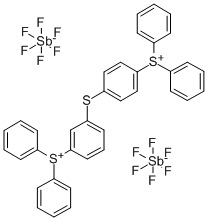 |
| CAS编号 | 89452-37-9 |
| MDL Number | MFCD25292913 |
| 别名 | 89452-37-9 Bis[4-(diphenylsulfonio)phenyl]sulfide bis(hexafluoroantimonate) Sulfonium, (thiodi-4,1-phenylene)bis(diphenyl-, bis((OC-6-11)-hexafluoroantimonate(1-)) Bis(4-(diphenylsulfonio)phenyl)sulfide, bis(hexafluoroantimonate) [4-(4-diphenylsulfoniophenyl)sulfanylphenyl]-diphenylsulfanium;hexafluoroantimony(1-) Sulfonium, (thiodi-4,1-phenylene)bis(diphenyl-, (OC-6-11)-hexafluoroantimonate(1-) (1:2) Sulfonium, (thiodi-4,1-phenylene)bis[diphenyl-, bis[(OC-6-11)-hexafluoroantimonate(1-)] DTXSID30909315 Bis[4-(diphenylsulfonio)phenyl] sulfide bis(hexafluoroantimonate) MFCD25292913 AKOS026745462 |
| 分子式 | C36H28F12S3Sb2 |
| 分子量 | 1028.3 |
| InChI | InChI=1S/C36H28S3.12FH.2Sb/c1-5-13-31(14-6-1)38(32-15-7-2-8-16-32)35-25-21-29(22-26-35)37-30-23-27-36(28-24-30)39(33-17-9-3-10-18-33)34-19-11-4-12-20-34;;;;;;;;;;;;;;/h1-28H;12*1H;;/q+2;;;;;;;;;;;;;2*+5/p-12 |
| InChI Key | DREXYWKFHDOSNT-UHFFFAOYSA-B |
| Isomeric SMILES | C1=CC=C(C=C1)[S+](C2=CC=CC=C2)C3=CC=C(C=C3)SC4=CC=C(C=C4)[S+](C5=CC=CC=C5)C6=CC=CC=C6.F[Sb-](F)(F)(F)(F)F.F[Sb-](F)(F)(F)(F)F |
Physical Data
| Appearance | White Powder |
Spectra
No data available
Route of Synthesis (ROS)
No data available
Safety and Hazards
| Pictogram(s) |   |
| Signal | Warning |
| GHS Hazard Statements | H302+H332 (56.5%): Harmful if swallowed or if inhaled [Warning Acute toxicity, oral; acute toxicity, inhalation] H302 (94.8%): Harmful if swallowed [Warning Acute toxicity, oral] H332 (94.8%): Harmful if inhaled [Warning Acute toxicity, inhalation] H411 (94.2%): Toxic to aquatic life with long lasting effects [Hazardous to the aquatic environment, long-term hazard] |
| Precautionary Statement Codes | P261, P264, P270, P271, P273, P301+P317, P304+P340, P317, P330, P391, and P501 (The corresponding statement to each P-code can be found at the GHS Classification page.) |
Source: European Chemicals Agency (ECHA)
License Note: Use of the information, documents and data from the ECHA website is subject to the terms and conditions of this Legal Notice, and subject to other binding limitations provided for under applicable law, the information, documents and data made available on the ECHA website may be reproduced, distributed and/or used, totally or in part, for non-commercial purposes provided that ECHA is acknowledged as the source: “Source: European Chemicals Agency, http://echa.europa.eu/”. Such acknowledgement must be included in each copy of the material. ECHA permits and encourages organisations and individuals to create links to the ECHA website under the following cumulative conditions: Links can only be made to webpages that provide a link to the Legal Notice page.
License URL: https://echa.europa.eu/web/guest/legal-notice
Record Name: (1-Cyano-2-ethoxy-2-oxoethylidenaminooxy)dimethylamino-morpholino-carbenium hexafluorophosphate
URL: https://echa.europa.eu/information-on-chemicals/cl-inventory-database/-/discli/details/213446
Description: The information provided here is aggregated from the “Notified classification and labelling” from ECHA’s C&L Inventory. Read more: https://echa.europa.eu/information-on-chemicals/cl-inventory-database
Other Data
No data available
| Use Pattern |
| Bis[4-(diphenylsulfonio)phenyl]sulfide bis(hexafluoroantimonate) is often associated with its role as a cationic photoinitiator. This class of compounds plays an important role in photocuring and polymerization reactions. The compound is often used in photocuring systems, such as polymerization reactions of epoxy resins and vinyl ether systems. It can generate cations under the irradiation of ultraviolet light or visible light to initiate the polymerization reaction of the resin. Compared with free radical initiators, cationic photoinitiators are still effective under conditions of lower oxygen content, which can overcome the problem that some free radical initiators have a decreased polymerization efficiency in air. High transparency and heat-resistant materials: Bis[4-(diphenylsulfonio)phenyl]sulfide bis(hexafluoroantimonate) can help manufacture high transparency photocurable materials, such as optical adhesives, electronic packaging materials, etc. Cationic polymerized materials tend to exhibit excellent heat resistance and mechanical properties, so this compound is suitable for applications in high temperature or high stress environments, such as electronic components and automotive coatings. |
试剂采购 | |
| 没有试剂厂商? | 向凯望发送快速询价 |
| 想要被列为试剂厂商? (付费服务) | 点击这里联系凯望 |
认证生产商 | |
| Warshel Chemical Ltd | http://www.warshel.com/ |
| 想要被列为认证生产商 (需要通过认证)? | 请下载并填写 这份表格并发邮件到approved-manufacturers@chemwhat.com |
其他供应商 | |
| Watson International Limited | 访问Watson官网 |
如需其他帮助,请联系我们 | |
| 联系我们获取其它信息或服务 | 点击这里联系凯望 |