Cyclopropyl bromide CAS#: 4333-56-6; 凯望编码 (ChemWhat Code): 30599

Identification
| 英文名 | Cyclopropyl bromide |
| IUPAC Name | bromocyclopropane |
| 分子结构 | 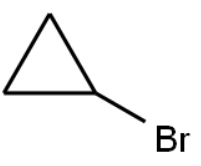 |
| CAS编号 | 4333-56-6 |
| EINECS Number | 224-375-7 |
| MDL Number | MFCD00001271 |
| Beilstein Registry Number | 1900287 |
| 别名 | cyclopropyl bromidebromocyclopropanecyclopropane bromide1-bromocyclopropane |
| 分子式 | C3H5Br |
| 分子量 | 120.977 |
| InChI | InChI=1S/C3H5Br/c4-3-1-2-3/h3H,1-2H2 |
| InChI Key | LKXYJYDRLBPHRS-UHFFFAOYSA-N |
| Canonical SMILES | BrC1CC1 |
| Patent Information | ||
| Patent ID | Title | Publication Date |
| US2025/59174 | Pharmaceutical Compounds and Compositions as C-Kit Kinase Inhibitors | 2025 |
| CN118978477 | Areca-arecoline derivative containing amino acid fragment as well as preparation method and application of arecoline derivative | 2024 |
| WO2022/249788 | METHOD FOR PRODUCING CYCLOALKYL BROMIDE | 2022 |
Physical Data
| Appearance | Light yellow to colorless liquid |
| Solubility | Chloroform (slightly soluble), methanol (slightly soluble) |
| Flash Point | 20 °F |
| Refractive index | n20/D 1.458(lit.) |
| Sensitivity | No data available |
| Boiling Point, °C | Pressure (Boiling Point), Torr |
| 67 – 69 | |
| 69 | 760 |
| 68 – 70 | |
| 68.5 – 70 | 760 |
| Refractive Index | Wavelength (Refractive Index), nm | Temperature (Refractive Index), °C |
| 1.457 | 589 | 25 |
| 1.4596 | 589 | 20 |
| 1.4572 | 589 | 25 |
| Density, g·cm-3 | Reference Temperature, °C | Measurement Temperature, °C |
| 1.505 | 4 | 20 |
| 1.5165 | 4 | 20 |
| 1.5052 | 4 | 25 |
| Description (Association (MCS)) | Solvent (Association (MCS)) | Temperature (Association (MCS)), °C | Partner (Association (MCS)) |
| IR spectrum of the complex | CCl4 | 25 | 4-Fluorophenol |
| Stability constant of the complex with … | CCl4 | 25 | 4-Fluorophenol |
| IR spectrum of the complex | gaseous matrix | -257.15 | trimethylamine |
| IR spectrum of the complex | gaseous matrix | -257.15 | NH3 |
| Further physical properties of the complex | HCl |
Spectra
| Description (NMR Spectroscopy) | Nucleus (NMR Spectroscopy) | Solvents (NMR Spectroscopy) | Frequency (NMR Spectroscopy), MHz |
| Chemical shifts, Spectrum | 1H | chloroform-d1 | |
| Chemical shifts | 13C | CDCl3 | |
| Spectrum | 1H | dimethylsulfoxide-d6 |
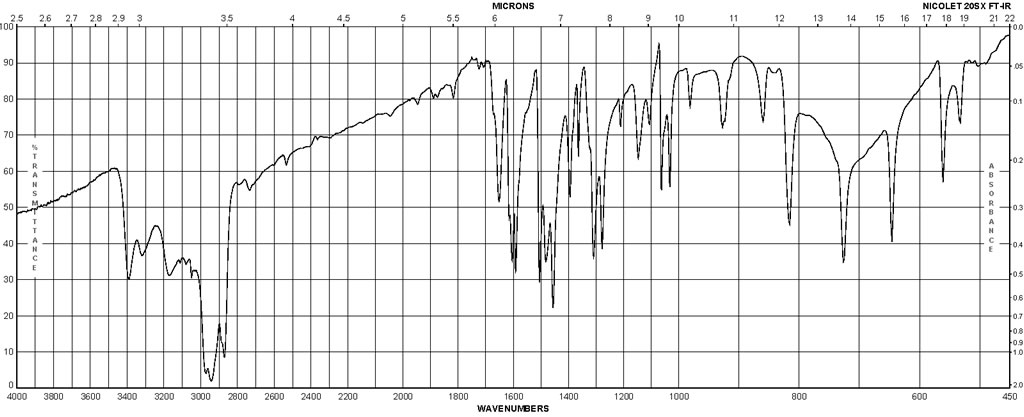
| Description (IR Spectroscopy) | Solvent (IR Spectroscopy) | Temperature (IR Spectroscopy), °C | Comment (IR Spectroscopy) |
| Spectrum | gaseous matrix | -257.15 | |
| Spectrum | gas | 14.85 – 54.85 | 4000 – 200 cm**(-1) |
| Bands | gaseous matrix | 1025 cm**(-1) | |
| Spectrum | various solvent(s) | 2620 – 520 cm**(-1) |
| Description (Mass Spectrometry) | Comment (Mass Spectrometry) |
| chemical ionization (CI), spectrum | collisional activation |
| Description (UV/VIS Spectroscopy) |
| Absorption maxima |
Route of Synthesis (ROS)

| Conditions | Yield |
| With lithium tert-butoxide In N,N-dimethyl-formamide at 30℃; under 760.051 Torr; for 3h; Irradiation; | 82% |
| With copper(l) iodide; lithium methanolate; triphenylphosphine In N,N-dimethyl-formamide at 37℃; for 24h; Inert atmosphere; | 65% |
| With catalyst: CuI/P(C6H5)3; LiOCH3 In N,N-dimethyl-formamide under Ar; at 37°C for 24 h; | 65% |
| Stage #1: bis(pinacol)diborane With potassium tert-butylate; [1,3-bis(2,4,6-trimethylphenyl)imidazol]-2-ylidene; zinc(II) chloride In tert-butyl methyl ether for 0.5h; Inert atmosphere; Schlenk technique; Glovebox; Stage #2: cyclopropyl bromide In tert-butyl methyl ether at 20℃; for 1h; Inert atmosphere; Schlenk technique; Glovebox; | 93 %Spectr. |
| With potassium methanolate; [1,3-bis(2,4,6-trimethylphenyl)imidazol]-2-ylidene; copper dichloride In tetrahydrofuran at 20℃; |
Safety and Hazards
| Pictogram(s) |   |
| Signal | Danger |
| GHS Hazard Statements | H225 (100%): Highly Flammable liquid and vapor [Danger Flammable liquids] H315 (96.3%): Causes skin irritation [Warning Skin corrosion/irritation] H319 (96.3%): Causes serious eye irritation [Warning Serious eye damage/eye irritation] H335 (94.4%): May cause respiratory irritation [Warning Specific target organ toxicity, single exposure; Respiratory tract irritation] Information may vary between notifications depending on impurities, additives, and other factors. |
| Precautionary Statement Codes | P210, P233, P240, P241, P242, P243, P261, P264, P264+P265, P271, P280, P302+P352, P303+P361+P353, P304+P340, P305+P351+P338, P319, P321, P332+P317, P337+P317, P362+P364, P370+P378, P403+P233, P403+P235, P405, and P501 (The corresponding statement to each P-code can be found at the GHS Classification page.) |
Other Data
| Transportation | Class 3; Packaging Group: II; UN Number: 1993 |
| Under the room temperature and away from light | |
| HS Code | No data available |
| Storage | Under the room temperature and away from light |
| Shelf Life | 1 year |
| Market Price | USD |
| Druglikeness | |
| Lipinski rules component | |
| 分子量 | 120.977 |
| logP | 1.693 |
| HBA | 0 |
| HBD | 0 |
| Matching Lipinski Rules | 4 |
| Veber rules component | |
| Polar Surface Area (PSA) | 0 |
| Rotatable Bond (RotB) | 0 |
| Matching Veber Rules | 2 |
| Use Pattern |
| It is primarily used as a pharmaceutical intermediate, serving as a key building block for introducing cyclopropyl groups into active pharmaceutical ingredients. The strained three-membered ring structure enhances the bioactivity, metabolic stability, and physicochemical properties of drug molecules, making it valuable in the synthesis of various antiviral, antibacterial, and anti-inflammatory compounds. |
试剂采购 | |
| 没有试剂厂商? | 向凯望发送快速询价 |
| 想要被列为试剂厂商? (付费服务) | 点击这里联系凯望 |
认证生产商 | |
| Caming Pharmaceutical Ltd | http://www.caming.com/ |
| 想要被列为认证生产商 (需要通过认证)? | 请下载并填写 这份表格并发邮件到approved-manufacturers@chemwhat.com |
其他供应商 | |
| Watson International Limited | 访问Watson官网 |
如需其他帮助,请联系我们 | |
| 联系我们获取其它信息或服务 | 点击这里联系凯望 |