Dibenzyl disulfide CAS#: 150-60-7; 凯望编码 (ChemWhat Code): 76013

Identification
| 英文名 | Dibenzyl disulfide |
| IUPAC Name | (benzyldisulfanyl)methylbenzene |
| 分子结构 | 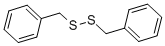 |
| CAS编号 | 150-60-7 |
| EINECS Number | 205-764-0 |
| MDL Number | MFCD00004783 |
| Beilstein Registry Number | 1110443 |
| 别名 | Dibenzyl disulfide 150-60-7 Benzyl disulfide Disulfide, bis(phenylmethyl) 1,2-dibenzyldisulfane Dibenzyl disulphide Benzyl bisulfide Dibenzyldisulfid Di(phenylmethyl)disulfide (benzyldisulfanyl)methylbenzene DISULFIDE, DIBENZYL Bis(phenylmethyl) disulfide 1,4-Diphenyl-2,3-dithiabutane Di(phenylmethyl) disulfide Benzyldisulfide alpha-(Benzyldithio)toluene Dibenzyldisulfide 1,4-Diphenyl-2,3-dithiobutane [(Benzyldisulfanyl)methyl]benzene Diphenylmethyl disulfide FEMA No. 3617 NSC 6841 .alpha.-(Benzyldithio)toluene NSC 677465 BDS 4,4′-Biphenyldiglyoxal disodium bisulfite MFCD00004783 1,1′-[dithiobis(methylene)]dibenzene NSC-677465 ghl.PD_Mitscher_leg0.312 1,1′-(disulfanediyldimethanediyl)dibenzene CHEBI:72752 NSC-6841 NSC677465 BG7680605N Dibenzyldisulfid [Czech] CCRIS 6924 EINECS 205-764-0 benzyl disulphide dibenzyldisulphide UNII-BG7680605N dibenzyl-disulfide 1,3-dithiabutane Benzyl disulfide, 8CI Benzyl disulfide (8CI) Dibenzyl disulfide, 98% WLN: R1SS1R DAILUBE S 700 Benzyl disulfide, 98%, FG benzyldisulfanyl-methyl-benzene SCHEMBL160895 CHEMBL121047 BENZYL DISULFIDE [FHFI] DIBENZYL DISULFIDE [MI] DTXSID6059738 FEMA 3617 NSC6841 BENZYL DISULFIDE [USP-RS] Bis(phenylmethyl) disulfide, 9CI [(Benzyldisulfanyl)methyl]benzene # STK831913 AKOS005177808 CS-W010232 Dibenzyl disulfide, analytical standard HY-W009516 SY008111 DB-003625 B0417 NS00020151 EN300-16500 D77707 Dibenzyl disulfide 2 microg/mL in Transformer Oil Dibenzyl disulfide 10 microg/mL in Transformer Oil J-008720 Q27140119 Z55949860 Benzyl disulfide, United States Pharmacopeia (USP) Reference Standard InChI=1/C14H14S2/c1-3-7-13(8-4-1)11-15-16-12-14-9-5-2-6-10-14/h1-10H,11-12H |
| 分子式 | C14H14S2 |
| 分子量 | 246.4 |
| InChI | IInChI=1S/C14H14S2/c1-3-7-13(8-4-1)11-15-16-12-14-9-5-2-6-10-14/h1-10H,11-12H2 |
| InChI Key | GVPWHKZIJBODOX-UHFFFAOYSA-N |
| Isomeric SMILES | C1=CC=C(C=C1)CSSCC2=CC=CC=C2 |
| Patent Information | ||
| Patent ID | Title | Publication Date |
| WO2023/38522 | COMPOSITIONS AND METHODS FOR TREATING BIOFILM DISORDERS AND INFECTION | 2023 |
| CN116478004 | Redox click chemical reaction for synthesizing disulfide compound | 2023 |
| CN116789579 | Ultrafast preparation method of metal-free and solvent-free disulfide bond-containing compound | 2023 |
| WO2023/200340 | COMPOUNDS FOR REDUCING LACTATION AND IMPROVING HEALTH | 2023 |
| CN114292220 | Photocatalytic synthesis method of thioether compound | 2022 |
| CN114920673 | Method for preparing disulfide | 2022 |
Physical Data
| Melting Point, °C |
| 71 – 72 |
| 72.4 |
| 70 – 71 |
| 72.4 |
| 66 – 68 |
| 68 – 69 |
| 72.4 |
| Boiling Point, °C | Pressure (Boiling Point), Torr |
| 150 – 180 | 0.6 – 0.8 |
| 71 – 73 | 5 |
| 142 – 148 | 0.05 – 0.1 |
| 210 – 216 | 18 |
| 175 – 180 | 3 |
| Density, g·cm-3 | Reference Temperature, °C | Measurement Temperature, °C |
| 1.302 | 4 | 25 |
| 1.105 – 1.075 | 75.2 – 112.5 |
| Description (Association (MCS)) | Partner (Association (MCS)) |
| Further physical properties of the adsorbed molecule | silver |
| Further physical properties of the adsorbed molecule | silver, SiO2 |
| Further physical properties of the adsorbed molecule | Ag |
Spectra
| Description (NMR Spectroscopy) | Nucleus (NMR Spectroscopy) | Solvents (NMR Spectroscopy) | Temperature (NMR Spectroscopy), °C |
| Chemical shifts, Spectrum | 1H | chloroform-d1 | |
| Chemical shifts, Spectrum | 13C | chloroform-d1 | |
| Chemical shifts, Spectrum | 1H | chloroform-d1 | |
| Chemical shifts, Spectrum | 1H | chloroform-d1 | 24.84 |
| Chemical shifts | 1H | chloroform-d1 | |
| Chemical shifts, Spectrum | 13C | chloroform-d1 |
| Description (IR Spectroscopy) | Solvent (IR Spectroscopy) |
| Bands | potassium bromide |
| Bands | neat (no solvent, solid phase) |
| Bands | neat (no solvent), sodium chloride |
| Bands, Spectrum | potassium bromide |
| Bands | neat (no solvent, solid phase) |
| ATR (attenuated total reflectance), Bands | |
| Bands | potassium bromide |
| Description (UV/VIS Spectroscopy) | Solvent (UV/VIS Spectroscopy) | Comment (UV/VIS Spectroscopy) | Absorption Maxima (UV/VIS), nm | Ext./Abs. Coefficient, l·mol-1cm-1 |
| methanol | 239, 279 | 9200, 340 | ||
| Absorption maxima | N,N-dimethyl-acetamide, various solvent(s) | 260 | 1850 | |
| Spectrum | ||||
| Absorption maxima | ||||
| Spectrum | ethanol | |||
| Spectrum | 2,2,4-trimethyl-pentane | 220 – 280 nm |
Route of Synthesis (ROS)
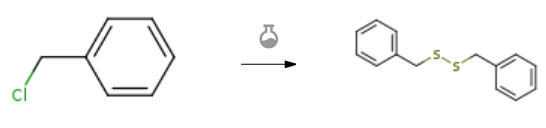
| Conditions | Yield |
| With lithium sulfide; sulfur; acetyltrimethylammonium bromide In chloroform; water for 2h; Ambient temperature; | 98% |
| With potassium 5-methyl-1,3,4-oxadiazole-2-thiolate In water at 25℃; for 0.5h; Reagent/catalyst; Temperature; Time; Experimental Procedure Experimental procedure General procedure: A mixture of benzyl chloride (2.0 mmol) and PMOxT (I) (3.0mmol) was added to aflask containing 0.5 mL H2O. The reaction continued at room temperature under atmospheric conditions until completion. The reaction progress was monitored by thin-layer chromatography. The reaction mixture was then filtered, CH2Cl2 (10 ml) was added to the filtrate and the mixture was washed with H2O (2×10 ml). The organic layer was dried over anhydrous Na2SO4. The solvent was evaporated to yield the crude dibenzyl disulfide, which was purified by preparative chromatography (silica gel, n-hexane-ethylacetate, 20: 1). | 98% |
| With PEG-400; sodium hydroxide; sulfur In benzene at 65℃; for 1h; | 95% |
Safety and Hazards
| Pictogram(s) |  |
| Signal | Warning |
| GHS Hazard Statements | H317 (28.5%): May cause an allergic skin reaction [Warning Sensitization, Skin] |
| Precautionary Statement Codes | P261, P272, P280, P302+P352, P321, P333+P317, P362+P364, and P501 (The corresponding statement to each P-code can be found at the GHS Classification page.) |
Other Data
| Druglikeness | |
| Lipinski rules component | |
| 分子量 | 246.397 |
| logP | 4.456 |
| HBA | 0 |
| HBD | 0 |
| Matching Lipinski Rules | 4 |
| Veber rules component | |
| Polar Surface Area (PSA) | 50.6 |
| Rotatable Bond (RotB) | 5 |
| Matching Veber Rules | 2 |
| Use Pattern |
| Dibenzyl disulfide CAS 150-60-7 is commonly used in the rubber industry as a vulcanization accelerator. It enhances the vulcanization process, improving the durability and physical properties of rubber products. Dibenzyl disulfide CAS 150-60-7 acts as an extreme pressure additive in lubricants, helping improve the wear resistance of lubricants under high-temperature and high-pressure conditions, thus protecting mechanical equipment. It serves as a sulfur source in organic synthesis and is widely used for producing sulfur-containing compounds, such as intermediates in pharmaceuticals and agrochemicals. |
试剂采购 | |
| 没有试剂厂商? | 向凯望发送快速询价 |
| 想要被列为试剂厂商? (付费服务) | 点击这里联系凯望 |
认证生产商 | |
| Warshel Chemical Ltd | http://www.warshel.com/ |
| 想要被列为认证生产商 (需要通过认证)? | 请下载并填写 这份表格并发邮件到approved-manufacturers@chemwhat.com |
其他供应商 | |
| Watson International Limited | 访问Watson官网 |
如需其他帮助,请联系我们 | |
| 联系我们获取其它信息或服务 | 点击这里联系凯望 |