DIETHYL SEC-BUTYLMALONATE CAS#: 83-27-2; 凯望编码 (ChemWhat Code): 1178635

Identification
| 英文名 | DIETHYL SEC-BUTYLMALONATE |
| IUPAC Name | diethyl 2-butan-2-ylpropanedioate |
| 分子结构 | 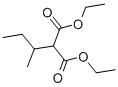 |
| CAS编号 | 83-27-2 |
| MDL Number | MFCD00015194 |
| 别名 | 83-27-2 Diethyl sec-butylmalonate Diethyl 2-(sec-butyl)malonate sec-Butylmalonic acid diethyl ester diethyl 2-butan-2-ylpropanedioate Diethyl (1-methylpropyl)malonate Diethyl 1-methylpropylmalonate sec-Butylmalonic acid, diethyl ester 1,3-diethyl 2-(butan-2-yl)propanedioate Diethyl 2-sec-butylmalonate DIETHYL(1-METHYLPROPYL)MALONATE (1-Methylpropyl)propanedioic Acid Diethyl Ester; Diethyl sec-Butylmalonate; NSC 127865; NSC 30679; NSC 41157; sec-Butylmalonic Acid Diethyl Ester EINECS 201-463-3 Diethyl s-butylmalonate 1,3-diethyl 2-(sec-butyl)propanedioate diethyl sec-butyl-malonate Propanedioic acid, (1-methylpropyl)-, diethyl ester Diethyl 2-sec-butylmalonate # SCHEMBL4191467 |
| 分子式 | C11H20O4 |
| 分子量 | 216.27 |
| InChI | InChI=1S/C11H20O4/c1-5-8(4)9(10(12)14-6-2)11(13)15-7-3/h8-9H,5-7H2,1-4H3 |
| InChI Key | MIIZSUOEOUHAIZ-UHFFFAOYSA-N |
| Isomeric SMILES | CCC(C)C(C(=O)OCC)C(=O)OCC |
Physical Data
No data available
| Boiling Point, °C | Pressure (Boiling Point), Torr |
| 76 – 78 | 2 |
| 110 – 117 | 21 |
| 121 – 123 | 20 |
| 117 | 13 |
| 107 – 108 | 10 |
| 104 | 18 – 20 |
| 90 – 103 | 4.5 – 5 |
| Density, g·cm-3 | Measurement Temperature, °C |
| 0.988 | 15 |
Spectra
| Description (NMR Spectroscopy) | Nucleus (NMR Spectroscopy) | Solvents (NMR Spectroscopy) | Frequency (NMR Spectroscopy), MHz |
| Chemical shifts, Spectrum | 1H | chloroform-d1 | 400 |
| Chemical shifts, Spectrum | 13C | chloroform-d1 | 100 |
| Chemical shifts | 13C | CDCl3 | 50 |
| Chemical shifts | 1H | CDCl3 | 400 |
| 1H | CDCl3 | 400 | |
| Chemical shifts | 1H | CDCl3 | |
| Chemical shifts | 13C | CDCl3 |
| Description (IR Spectroscopy) | Solvent (IR Spectroscopy) | Comment (IR Spectroscopy) |
| Bands | CHCl3 | 1720 cm**(-1) |
| Bands | dimethylsulfoxide | 11732 cm**(-1) |
| Bands |
Route of Synthesis (ROS)

| Conditions | Yield |
| Stage #1: sec-butyl-malonic acid diethyl ester; guanidine hydrochloride With sodium In ethanol at 20℃; for 4h; Inert atmosphere; Stage #2: In ethanol for 1h; Inert atmosphere; Reflux; General procedure for the preparation of 5-substituted2-amino-4,6-dihydroxypyrimidines A2-A11 General procedure: Metallic sodium (12.9 g, 0.56 mol) was dissolved in absolute ethanol (300 mL) under argon while being intensively stirred with a mechanical stirrer. The reaction flask was equipped with a reflux condenser with a chlorocalcium tube. After all the sodium was dissolved and the reaction mixture was cooled to room temperature; guanidine hydrochloride(21.02 g, 0.22 mol) was added under intensive stirring, followed by the corresponding monosubstituted malonic acid diester (0.2 mol). The reaction mixture was further intensively stirred due to the production of the solid product,which is so massive that after 2 h it already practically precludes stirring. After another 2 h, absolute ethanol (200 mL) was added and the reaction mixture was refluxed for 1 h while being stirred. Afterward, ethanol (ca200-300 mL) was evaporated on a vacuum rotary evaporatorand water (500 mL) was added to the reaction mixture. After stirring, the product (in the form of sodium salt) was almost dissolved. The obtained mixture was subsequently neutralized by dropwise addition of acetic acid, resulting in immediate and quantitative precipitation of the desired product in the form of a fine solid. This mixture was subsequently heated under reflux for 10 min and then cooled to laboratory temperature. This heating and cooling was repeated twice to get a well-filterable solid product. The solid product was filtered off, washed with water (2 x 50 mL),ethanol (2 x 50 mL), and acetone (2 x 50 mL). The product was dried under high vacuum at 60 °C for 2 days. The obtained purity of the product prepared in this manner is sufficient for the following reaction and based on analyses contains only crystalline water. | 93% |
| With sodium In ethanol Inert atmosphere; Experimental Procedure General procedure for the preparation of 5-substituted2-amino-4,6-dihydroxypyrimidines A2-A11 General procedure: Metallic sodium (12.9 g, 0.56 mol) was dissolved in absolute ethanol (300 mL) under argon while being intensively stirred with a mechanical stirrer. The reaction flask was equipped with a reflux condenser with a chlorocalcium tube. After all the sodium was dissolved and the reaction mixture was cooled to room temperature; guanidine hydrochloride (21.02 g, 0.22 mol) was added under intensive stirring, followed by the corresponding monosubstituted malonicacid diester (0.2 mol). The reaction mixture was further intensively stirred due to the production of the solid product, which is so massive that after 2 h it already practically precludes stirring. After another 2 h, absolute ethanol (200 mL) was added and the reaction mixture was refluxed for 1 h while being stirred. Afterward, ethanol (ca 200-300 mL) was evaporated on a vacuum rotary evaporator and water (500 mL) was added to the reaction mixture. After stirring, the product (in the form of sodium salt) was almost dissolved. The obtained mixture was subsequently neutralized by dropwise addition of acetic acid, resulting in immediate and quantitative precipitation of the desired product in the form of a fine solid. This mixture was subsequently heated under reflux for 10 min and then cooled to laboratory temperature. This heating and cooling was repeated twice to get a well-filterable solid product. The solid product was filtered off, washed with water (2 9 50 mL), ethanol (2 9 50 mL), and acetone (2 9 50 mL). The product was dried under high vacuum at 60 °C for 2 days. The obtained purity of the product prepared in this manner is sufficient for the following reaction and based on analyses contains only crystalline water. | 93% |
| With sodium In ethanol for 5h; Inert atmosphere; Reflux; |
Safety and Hazards
| Pictogram(s) |  |
| Signal | Warning |
| GHS Hazard Statements | H315 (100%): Causes skin irritation [Warning Skin corrosion/irritation] H319 (100%): Causes serious eye irritation [Warning Serious eye damage/eye irritation] H335 (100%): May cause respiratory irritation [Warning Specific target organ toxicity, single exposure; Respiratory tract irritation] |
| Precautionary Statement Codes | P261, P264, P264+P265, P271, P280, P302+P352, P304+P340, P305+P351+P338, P319, P321, P332+P317, P337+P317, P362+P364, P403+P233, P405, and P501 (The corresponding statement to each P-code can be found at the GHS Classification page.) |
Other Data
No data available
| Druglikeness | |
| Lipinski rules component | |
| 分子量 | 216.277 |
| logP | 3.049 |
| HBA | 4 |
| HBD | 0 |
| Matching Lipinski Rules | 4 |
| Veber rules component | |
| Polar Surface Area (PSA) | 52.6 |
| Rotatable Bond (RotB) | 8 |
| Matching Veber Rules | 2 |
| Use Pattern |
| DIETHYL SEC-BUTYLMALONATE CAS 83-27-2 be used for spices. |
试剂采购 | |
| 没有试剂厂商? | 向凯望发送快速询价 |
| 想要被列为试剂厂商? (付费服务) | 点击这里联系凯望 |
认证生产商 | |
| Caming Pharmaceutical Limited | http://www.caming.com/ |
| 想要被列为认证生产商 (需要通过认证)? | 请下载并填写 这份表格并发邮件到approved-manufacturers@chemwhat.com |
其他供应商 | |
| Watson International Limited | 访问Watson官网 |
如需其他帮助,请联系我们 | |
| 联系我们获取其它信息或服务 | 点击这里联系凯望 |