Furan, 3-[4-[(5-broMo-2-chlorophenyl)Methyl]phenoxy]tetrahydro-, (3S)- CAS#: 915095-89-5; 凯望编码 (ChemWhat Code): 1346643

Identification
| 英文名 | Furan, 3-[4-[(5-broMo-2-chlorophenyl)Methyl]phenoxy]tetrahydro-, (3S)- |
| IUPAC名称 | (3S)-3-[4-[(5-bromo-2-chlorophenyl)methyl]phenoxy]oxolane |
| 分子结构 | 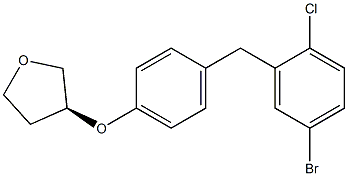 |
| CAS编号 | 915095-89-5 |
| MDL Number | MFCD27920793 |
| 别名 | 915095-89-5 (S)-3-(4-(5-Bromo-2-chlorobenzyl)phenoxy)tetrahydrofuran (3S)-3-[4-[(5-Bromo-2-chlorophenyl)methyl]phenoxy]tetrahydro-furan (3S)-3-[4-[(5-bromo-2-chlorophenyl)methyl]phenoxy]oxolane 4WR8P4HZ8G (3S)-3-{4-[(5-bromo-2-chlorophenyl)methyl]phenoxy}oxolane (3S)-3-[4-[(5-bromo-2-chlorophenyl)methyl]phenoxy]tetrahydrofuran Furan, 3-[4-[(5-broMo-2-chlorophenyl)Methyl]phenoxy]tetrahydro-, (3S)- Furan, 3-(4-((5-bromo-2-chlorophenyl)methyl)phenoxy)tetrahydro-, (3S)- (3s)-3-(4-((5-bromo-2-chlorophenyl)methyl)phenoxy)tetrahydrofuran MFCD27920793 (S)-3-(4-(5-bromo-2-chlorobenzyl)phenoxy) tetrahydrofuran C17H16BrClO2 UNII-4WR8P4HZ8G SCHEMBL2638119 AMY16484 BCP11193 AKOS022186156 DS-7819 AC-26974 CS-0015036 EN300-7402882 |
| 分子式 | C17H16BrClO2 |
| 分子量 | 367.7 |
| InChI | InChI=1S/C17H16BrClO2/c18-14-3-6-17(19)13(10-14)9-12-1-4-15(5-2-12)21-16-7-8-20-11-16/h1-6,10,16H,7-9,11H2/t16-/m0/s1 |
| InChI Key | HUNLNKBDQXGMAP-INIZCTEOSA-N |
| Isomeric SMILES | C1COC[C@H]1OC2=CC=C(C=C2)CC3=C(C=CC(=C3)Br)Cl |
| Patent Information | ||
| Patent ID | Title | Publication Date |
| CN115785045 | Photocatalytic Endagliflozin precursor and synthesis method thereof | 2023 |
| CN116120299 | Preparation method of 1-C-substituted phenyl glucopyranose carbon glycoside | 2023 |
| CN114907396 | Method for continuous flow synthesis of liflozin drug intermediates | 2022 |
| CN115160264 | Preparation method of empagliflozin intermediate | 2022 |
| Preparation process of empagliflozin intermediate | Preparation process of empagliflozin intermediate | 2021 |
Physical Data
| Appearance | Light yellow to white solid powder |
| Melting Point, °C |
| 89.5 – 91.1 |
| 89.3 – 91 |
Spectra
| Description (NMR Spectroscopy) | Nucleus (NMR Spectroscopy) | Solvents (NMR Spectroscopy) | Temperature (NMR Spectroscopy), °C | Frequency (NMR Spectroscopy), MHz |
| Chemical shifts | 1H | chloroform-d1 | 600 | |
| Chemical shifts | 13C | chloroform-d1 | 150 | |
| Chemical shifts | 1H | chloroform-d1 | 400 | |
| Chemical shifts | 13C | chloroform-d1 | ||
| Chemical shifts, Spectrum | 1H | chloroform-d1 | 29.84 |
| Description (IR Spectroscopy) |
| Bands, Spectrum |
Route of Synthesis (ROS)
![Route of Synthesis (ROS) of Furan, 3-[4-[(5-broMo-2-chlorophenyl)Methyl]phenoxy]tetrahydro-, (3S)-](http://www.chemwhat.com/wp-content/uploads/2018/12/Route-of-Synthesis-ROS-of-Furan-3-4-5-broMo-2-chlorophenylMethylphenoxytetrahydro-3S-.png)
| Conditions | Yield |
| Stage #1: (S)-4-bromo-1-chloro-2-(4-tetrahydrofuran-3-yloxy-benzyl)benzene With n-butyllithium In tetrahydrofuran; hexane; toluene at -78℃; for 1h; Inert atmosphere; Large scale; Stage #2: (3R,4S,5R,6R)-3,4,5-tris((trimethylsilyl)oxy)-6-(((trimethylsilyl)oxy)methyl)tetrahydro-2H-pyran-2-one In tetrahydrofuran; hexane; toluene at -78℃; for 3h; Large scale; Stage #3: methanol With methanesulfonic acid In tetrahydrofuran; hexane; toluene at 0 – 40℃; for 10h; Large scale; Experimental Procedure 7 Example 7 preparation of 1-Chloro-4-(1-methoxy-D-glucopyranose-1-yl)2-(4-(S)-tetrahydrofuran-3-yloxy-benzyl)-benzene (VII) Take (S)-3-(4-(5-bromo-2-chlorobenzyl)phenoxy) tetrahydrofuran 183kg,400kg anhydrous THF/toluene (1:4) was added to the nitrogen-dried 3000 litre reactor.The liquid nitrogen was cooled to -78°, and hexane solution of 1. 6 mol·L-1 n-butyllithium was slowly added dropwise.Stirring was continued at this temperature for 1 h; 600 kg of a 2,3,4,6-tetra-O-trimethylsilyl-D-glucono-lactone (256 kg) in toluene solution cooled to -78°C was slowly added dropwise to the above 600 kg. In the reaction solution,-78° reaction for 3 h, after the basic reaction of TLC detection is completed,At this temperature is added 500kg of methanesulfonic acid in methanol solution (methanesulfonic acid 225kg + methanol 275kg);The reaction was stirred at 0 ° C 4h, and then warmed to 40 ° C stirred reaction 6h;5 mol•L-1 sodium hydroxide aqueous solution was added to the reaction solution, and the pH was adjusted to 7-8; stirring for 30 min,Extract with ethyl acetate (300kg×2)The organic phase is washed with saturated aqueous sodium chloride solution until neutral, then dried over anhydrous sodium sulfate and filtered.The filtrate was concentrated to dryness to give 208 kg of a light yellow viscous oil with a yield of 87%. | 87% |
| Stage #1: (S)-4-bromo-1-chloro-2-(4-tetrahydrofuran-3-yloxy-benzyl)benzene; (3R,4S,5R,6R)-3,4,5-tris((trimethylsilyl)oxy)-6-(((trimethylsilyl)oxy)methyl)tetrahydro-2H-pyran-2-one With n-butyllithium In tetrahydrofuran; hexane; toluene at -78℃; for 3h; Inert atmosphere; Large scale; Stage #2: methanol With methanesulfonic acid In tetrahydrofuran; hexane; toluene at 0 – 40℃; for 10h; Inert atmosphere; Large scale; Experimental Procedure 6 Example 6 1-Chloro-4-(1-methoxy-D-glucopyranose-1-yl)-2-(4-(S)-tetrahydrofuran-3-yloxy-benzyl) – Preparation of Benzene (VII) Take (5)-3-(4-(5-bromo-2-chlorobenzyl)phenoxy) tetrahydrofuran (91 kg), anhydrous tetrahydrofuran/toluene (200 kg (1:4)), and add it to a nitrogen-dried 2000-liter reactor. , Liquid nitrogen was cooled to -78 °C, was slowly added dropwise 1. 6 mol-L” 1 n-butyllithium hexane solution 120L, maintaining the temperature stirred for 1h;A 300 kg toluene solution of 2,3,4,6-tetra-O-trimethylsilyl-D-glucono lactone (130 kg) cooled to -78C was slowly added dropwise to the above reaction solution, -78 °C reaction 3 h, TLC test after the completion of the basic reaction, at this temperature was added 300kg of methanol solution of methanesulfonic acid (methanesulfonic acid 115kg + methanol 185kg); stirred at 0 °C reaction 4.0h, and then heated to 40 °C The reaction was stirred for 6 h. After the reaction was completed, 5 mol.I/1 aqueous sodium hydroxide solution was added to the reaction solution to adjust the pH to 7 – 8; stirred for 30 min, extracted with ethyl acetate (200 kg X 2), and the organic phase was washed with a saturated aqueous solution of sodium chloride. Neutral, then dried over anhydrous sodium sulfate, filtered, and the filtrate was concentrated to dryness to give 100 kg of pale yellow viscous oil in a yield of 84%. | 84% |
Safety and Hazards
| Pictogram(s) |   |
| Signal | Warning |
| GHS Hazard Statements | H302 (50%): Harmful if swallowed [Warning Acute toxicity, oral] H351 (50%): Suspected of causing cancer [Warning Carcinogenicity] H413 (50%): May cause long lasting harmful effects to aquatic life [Hazardous to the aquatic environment, long-term hazard] |
| Precautionary Statement Codes | P203, P264, P270, P273, P280, P301+P317, P318, P330, P405, and P501 (The corresponding statement to each P-code can be found at the GHS Classification page.) |
Other Data
| HS Code | |
| Storage | Under the room temperature and away from light |
| Shelf Life | 2 years |
| Market Price |
| Druglikeness | |
| Lipinski rules component | |
| 分子量 | 367.67 |
| logP | 5.107 |
| HBA | 1 |
| HBD | 0 |
| Matching Lipinski Rules | 3 |
| Veber rules component | |
| Polar Surface Area (PSA) | 18.46 |
| Rotatable Bond (RotB) | 4 |
| Matching Veber Rules | 2 |
| Use Pattern |
| As a reactant, it serves as an effective intermediate for the synthesis of SGLT-2 inhibitor empagliflozin using AlCl3-promoted silane reduction of β-pyranose fructoside. It is utilized in the production of empagliflozin, an intermediate in the synthesis of the drug. |
试剂采购 | |
| 没有试剂厂商? | 向凯望发送快速询价 |
| 想要被列为试剂厂商? (付费服务) | 点击这里联系凯望 |
认证生产商 | |
| Caming Pharmaceutical Limited | Caming Pharmaceutical Limited |
| 想要被列为认证生产商 (需要通过认证)? | 请下载并填写 这份表格并发邮件到approved-manufacturers@chemwhat.com |
其他供应商 | |
| Watson International Limited | 访问Watson官网 |
如需其他帮助,请联系我们 | |
| 联系我们获取其它信息或服务 | 点击这里联系凯望 |