Indinavir CAS#: 150378-17-9; 凯望编码 (ChemWhat Code): 122584

Identification
| 英文名 | Indinavir |
| IUPAC名称 | (2S)-1-[(2S,4R)-4-benzyl-2-hydroxy-5-[[(1S,2R)-2-hydroxy-2,3-dihydro-1H-inden-1-yl]amino]-5-oxopentyl]-N–tert-butyl-4-(pyridin-3-ylmethyl)piperazine-2-carboxamide |
| 分子结构 | 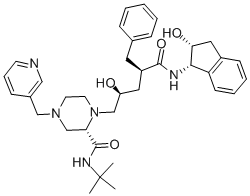 |
| CAS编号 | 150378-17-9 |
| NACRES | NA.77 |
| 别名 | Crixivan hydrate, L-735,524 hydrate, MK-639 hydrate, indinavir, Indinavir, (1(1S,2R),5(S))-2,3,5-trideoxy-N-(2,3-dihydro-2-hydroxy-1H-inden-1-yl)-5-(2-(((1,1-dimethylethyl)amino)carbonyl)-4-(3-pyridinylmethyl)-1-piperazinyl)-2-(phenylmethyl)-D-erythro-pentonamide, (2S)-1-[(2S,4R)-4-benzyl-2-hydroxy-5-{[(1S,2R)-2-hydroxy-2,3-dihydro-1H-inden-1-yl]amino}-5-oxopentyl]-N-(2-methyl-2-propanyl)-4-(3-pyridinylmethyl)-2-piperazinecarboxamide, (2S)-1-[(2S,4R)-4-benzyl-2-hydroxy-5-[[(1S,2R)-2-hydroxy-2,3-dihydro-1H-inden-1-yl]amino]-5-oxopentyl]-N-tert-butyl-4-(pyridin-3-ylmethyl)piperazine-2-carboxamide, (2S)-1-[(2S,4R)-4-benzyl-2-hydroxy-4-{[(1S,2R)-2-hydroxy-2,3-dihydro-1H-inden-1-yl]carbamoyl}butyl]-N-tert-butyl-4-(pyridin-3 ylrnethyl)piperazine-2-carboxarnide, (2S)-1-[(2S,4R)-4-benzyl-2-hydroxy-4-{[(1S,2R)-2-hydroxy-2,3-dihydro-1H-inden-l-yl]carbamoyl}butyl]-N-tert-butyl-4-(pyridin-3-ylmethyl)piperazine-2-carboxamide |
| 分子式 | C36H47N5O4 |
| 分子量 | 613.8 |
| InChI | InChI=1S/C36H47N5O4/c1-36(2,3)39-35(45)31-24-40(22-26-12-9-15-37-21-26)16-17-41(31)23-29(42)19-28(18-25-10-5-4-6-11-25)34(44)38-33-30-14-8-7-13-27(30)20-32(33)43/h4-15,21,28-29,31-33,42-43H,16-20,22-24H2,1-3H3,(H,38,44)(H,39,45)/t28-,29+,31+,32-,33+/m1/s1 |
| InChI Key | CBVCZFGXHXORBI-PXQQMZJSSA-N |
| Canonical SMILES | CC(C)(C)NC(=O)C1CN(CCN1CC(CC(CC2=CC=CC=C2)C(=O)NC3C(CC4=CC=CC=C34)O)O)CC5=CN=CC=C5 |
| Patent Information | ||
| Patent ID | Title | Publication Date |
| US2011/245283 | Methods for predicting the response to statins | 2011 |
| US2004/116692 | Reductive alkylation of saturated cyclic amines | 2004 |
Physical Data
| Appearance | White to off-white powder |
| Solubility | H2O: ≥15 mg/mL |
| Melting Point, °C | Solvent (Melting Point) | Comment (Melting Point) |
| 167.5 – 168 | ethyl acetate | Crystallization with 0.65 Mol(s) H2O |
| Type (Optical Rotatory Power) | Concentration (Optical Rotatory Power) | Solvent (Optical Rotatory Power) | Optical Rotatory Power, deg | Wavelength (Optical Rotatory Power), nm | Temperature (Optical Rotatory Power), °C |
| [alpha] | 0.0133 g/100ml | CHCl3 | 24.1 | 589 | 22 |
| Description (Association (MCS)) | Solvent (Association (MCS)) | Temperature (Association (MCS)), °C | Partner (Association (MCS)) |
| Further physical properties of the complex | aq. phosphate buffer, dimethylsulfoxide | 37 | 1,2-dioleoyl-sn-glycero-3-phosphoethanolamine, 1,2-Dioleoylphosphatidylserine, dioleoylphosphatidylcholine |
| Further physical properties of the complex | aq. phosphate buffer, dimethylsulfoxide | 37 | 2-oleoyl-1-palmitoyl-sn-glycero-3-phosphocholine |
| IR spectrum of the complex | CHCl3 | acrylic acid |
Spectra
| Description (NMR Spectroscopy) | Nucleus (NMR Spectroscopy) | Solvents (NMR Spectroscopy) | Original Text (NMR Spectroscopy) |
| Chemical shifts | 1H | CDCl3 | |
| 1H, 13C | chloroform-d1 | 1H NMR (400 MHz, CDCl3) δ 8.53 (dd J=1.6), 8.52 (d, J=2.0), 7.68 (bs), 7.60 (d, J=7.9, 2.0), 7.29 (m), 7.23 (m), 1.18-7.09 (m), 6.19 (d, J=8.5), 5.27 (dd, J=8.5, 4.8), 4.27 (m), 3.92 (br s), 3.81 (m), 3.49 (s), 3.12 (t, J=3.6), 3.02 (dd, J=16.7, 5.2), 2.98-2.47 (m), 2.34 (br s), 1.97, 1.56 (m), 1.50 (br s), 1.34 (s). 13C NMR (100 MHz, CDCl3) δ 175.0, 169.4, 151, 149, 140.4, 140.3, 139.9, 137, 133, 129.1, 128.5, 127.9 126.7, 123.9, 126.5, 125.1 123.4, 73.0, 65.8, 64.1, 61.4, 60, 57.4, 54.6, 52.7, 51.1, 47.9, 46.5, 39.6, 39.1, 38.1, 29.0. | |
| Chemical shifts | 13C | CDCl3 |
| Description (IR Spectroscopy) | Solvent (IR Spectroscopy) | Comment (IR Spectroscopy) |
| Bands | CHCl3 | 3019 – 1366 cm**(-1) |
| Description (UV/VIS Spectroscopy) | Solvent (UV/VIS Spectroscopy) | Comment (UV/VIS Spectroscopy) | Absorption Maxima (UV/VIS), nm | Ext./Abs. Coefficient, l·mol-1cm-1 |
| Spectrum | methanol | Remark: first derivative spectrum, concentration dependence | ||
| methanol | Remark: first derivative spectrum | 273 | 9.284 |
Route of Synthesis (ROS)
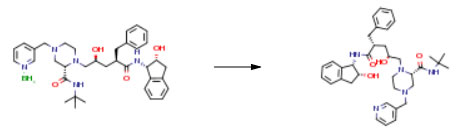
| Conditions | Yield |
| With methanol; hydrogen; platinum(IV) oxide In tetrahydrofuran for 3h; Experimental Procedure PtO2 (87 mg, 0.38 mmol) was added to the organic solution containing indinavir and its borane complex, whereupon the red-brown oxide immediately converted to very fine platinum black. Methanol (10 mL) was added and a mild evolution of hydrogen occurred over a period of about one hour. The batch was aged an additional two hours, whereupon HPLC analysis showed cleavage of the borane complex to be complete. The batch was then concentrated to remove THF, methanol and trimethoxyborate, and the concentrated batch was then diluted with isopropyl acetate. The batch was heated to 70° C., saturated with water and allowed to slowly cool to 0-5° C. to promote crystallization. The product was removed by filtration and washed with isopropyl acetate. Yield of 1=2.16 g, 92percent at a purity of 100percent by HPLC. 1H NMR (400 MHz, CDCl3) δ 8.53 (dd J=1.6), 8.52 (d, J=2.0), 7.68 (bs), 7.60 (d, J=7.9, 2.0), 7.29 (m), 7.23 (m), 1.18-7.09 (m), 6.19 (d, J=8.5), 5.27 (dd, J=8.5, 4.8), 4.27 (m), 3.92 (br s), 3.81 (m), 3.49 (s), 3.12 (t, J=3.6), 3.02 (dd, J=16.7, 5.2), 2.98-2.47 (m), 2.34 (br s), 1.97, 1.56 (m), 1.50 (br s), 1.34 (s). 13C NMR (100 MHz, CDCl3) δ 175.0, 169.4, 151, 149, 140.4, 140.3, 139.9, 137, 133, 129.1, 128.5, 127.9 126.7, 123.9, 126.5, 125.1 123.4, 73.0, 65.8, 64.1, 61.4, 60, 57.4, 54.6, 52.7, 51.1, 47.9, 46.5, 39.6, 39.1, 38.1, 29.0. | 92% |
Safety and Hazards
| GHS Hazard Statements | Not Classified |
| Acute Toxicity | LD50 Oral – Rat – > 5,000 mg/kg LD50 Oral – Mouse – > 5,000 mg/kg LD50 Oral – Dog – > 640 mg/kg Remarks: Gastrointestinal disturbance Inhalation: No data available Dermal: No data available LD50 Intraperitoneal – Rat – > 5,000 mg/kg LD50 Intraperitoneal – Mouse – > 5,000 mg/kg LD50 Intraperitoneal – Dog – > 640 mg/kg Remarks: Gastrointestinal disturbance |
Other Data
| Transportation | Not dangerous goods |
| Under room temperature and away from light | |
| HS Code | 294200 |
| Storage | Under 2-8°C away from light |
| Shelf Life | 1 year |
| Market Price |
| Use Pattern |
| Indinavir CAS#: 150378-17-9 may be used in HIV-related cell signaling studies. |
| Indinavir CAS#: 150378-17-9 is an antiviral HIV protease inhibitor. Indinavir suppresses the replication of HIV and is an important component of antiretroviral therapy for initial treatment of HIV infection. It is known to cause renal and urologic toxicity. |
| reducing HIV- 1 reservoir in combination with antibody or a fragment that specifically binds to interferon-alpha/beta receptor to inhibit type I interferon signaling |
试剂采购 | |
| 没有试剂厂商? | 向凯望发送快速询价 |
| 想要被列为试剂厂商? (付费服务) | 点击这里联系凯望 |
认证生产商 | |
| Caming Pharmaceutical Ltd | http://www.caming.com/ |
| 想要被列为认证生产商 (需要通过认证)? | 请下载并填写 这份表格并发邮件到approved-manufacturers@chemwhat.com |
其他供应商 | |
| Watson International Limited | 访问Watson官网 |
如需其他帮助,请联系我们 | |
| 联系我们获取其它信息或服务 | 点击这里联系凯望 |