ISOXAZOLE-5-CARBOXYLIC ACID CAS#: 21169-71-1; 凯望编码 (ChemWhat Code): 225976

Identification
| 英文名 | ISOXAZOLE-5-CARBOXYLIC ACID |
| IUPAC Name | 1,2-oxazole-5-carboxylic acid |
| 分子结构 |  |
| CAS编号 | 21169-71-1 |
| 别名 | 1,2-oxazole-5-carboxylic Acid 673-088-7 Isoxazole-5-carboxylic acid 21169-71-1 5-isoxazolecarboxylic acid ISOXAZOLE-5-CARBOXYLICACID MFCD00156151 F2158-0308 isoxazole-5-carboxylic isoxazole 5-carboxylic acid SCHEMBL112293 SCHEMBL3618206 SCHEMBL5188508 SCHEMBL15880622 DTXSID70366185 MIIQJAUWHSUTIT-UHFFFAOYSA-N Isoxazole-5-carboxylic acid, 97% SMSSF-0017806 BBL100210 GEO-01628 SBB004319 STL553782 AKOS001042457 CS-W000637 PS-5358 SY018290 DB-011149 ST50339231 EN300-06774 Z56943419 |
| 分子式 | C4H3NO3 |
| 分子量 | 113.07 |
| InChI | InChI=1S/C4H3NO3/c6-4(7)3-1-2-5-8-3/h1-2H,(H,6,7) |
| InChI Key | MIIQJAUWHSUTIT-UHFFFAOYSA-N |
| SMILES | C1=C(ON=C1)C(=O)O |
| Patent Information | ||
| Patent ID | Title | Publication Date |
| EP2567958 | Substituted 2-(chroman-6-yloxy)-thiazoles and their use as pharmaceuticals | 2013 |
| US2013/217702 | INDOLE DERIVATIVES | 2013 |
| WO2012/59776 | INDOLE DERIVATIVES | 2012 |
| US2005/171346 | Hexahydropyridazine-3-carboxylic acid derivatives, pharmaceutical compositions containing same and methods of preparation | 2005 |
Physical Data
| Appearance | Light brown crystal or powder |
| Melting Point, °C | Solvent (Melting Point) |
| 138 – 140 | |
| 146 | |
| 145 – 146 | |
| 147 – 148 | benzene, methanol |
| 145.5 – 146.5 | toluene |
| 148 – 149 | toluene |
Spectra
| Description (NMR Spectroscopy) | Nucleus (NMR Spectroscopy) | Solvents (NMR Spectroscopy) | Temperature (NMR Spectroscopy), °C | Frequency (NMR Spectroscopy), MHz |
| Chemical shifts | 1H | chloroform-d1 | 400 | |
| Chemical shifts | 13C | chloroform-d1 | 100 | |
| Chemical shifts | 1H | CDCl3 | 24.85 | 80 |
| Chemical shifts | 13C | CDCl3 | 24.85 | 20 |
| Chemical shifts | 17O | CD3CN | 39.85 | 54.25 |
| Chemical shifts | 1H | CDCl3, dimethylsulfoxide-d6 |
Route of Synthesis (ROS)
| Conditions | Yield |
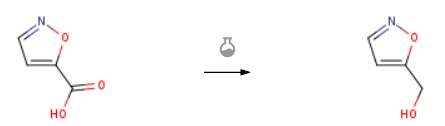
| With borane-THF In tetrahydrofuran at 0 – 20℃; Experimental Procedure To a solution of isoxazole-5-carboxylic acid (1.0 g, 8.8 mmol,) in THF (10 mL) was added borane-THF complex (26.4 mL,26.4 mmol) at 0 °C. The reaction was stirred at room temperature until the substrate was consumed. The reaction was quenched with ethanol (5 mL) at 0 °C. The reaction mixture was partitioned between ethyl acetate and water. The combined organic phase was dried over sodium sulfate, filtered and concentrated to give a crude product which was purified by column chromatography eluting with petroleum ether/ ethyl acetate (2: 1 to give isoxazol-5-ylmethanol (670 mg, 77.0% yield) as a light yellow oil. LCMS retention time 0.329 min; LCMS MH+ 100. | 77% |
| Stage #1: isoxazole-5-carboxylic acid With chloroformic acid ethyl ester; triethylamine In tetrahydrofuran at 0℃; for 0.25h; Stage #2: With sodium tetrahydroborate In tetrahydrofuran; water at 0℃; for 1h; Experimental Procedure Example 55.2-(6-Fluoro- 1 -methyl- 1 H-indazol-3 -yl)-5H-pyrrolo [2,3 -b]pyrazine-7-carboxylic acid (1 – isoxazol-5 – l-ethyl)-amideIn a round-bottomed flask, isoxazole-5-carboxylic acid (1.0 g, 8.84 mmol) was dissolved in THF (35 ml). The solution was cooled to 0°C and triethylamine (1.4 ml, 10.0 mmol) was added followed by ethyl chloroformate (0.94 ml, 9.8 mmol). A thick precipitate was formed upon the addition of the latter. The suspension was stirred at 0°C for 15 min then a solution of sodium borohydride (1.00 g, 26.5 mmol) in water (14 ml) was added portionwise via pipet. Vigorous gas evolution was observed. The reaction mixture was stirred at 0°C for 1 h then diluted with water and saturated aqueous NH4C1 and extracted with dichloromethane (3x). The organic layers were combined, dried over sodium sulfate, filtered and concentrated. The residue waschromato graphed over silica gel with EtOAc/hexanes (gradient 0-50% EtOAc) to afford 513 mg (59%) of isoxazol-5-yl-methanol as a colorless oil. 1H NMR (CDC13, 300 MHz): ? (ppm) 8.23 (d, J=1.9 Hz, 1H), 6.26 – 6.30 (m, 1H), 4.82 (s, 2H), 2.13 (br. s., 1H). | 59% |
Safety and Hazards
| Pictogram(s) |  |
| Signal | Warning |
| GHS Hazard Statements | H315 (100%): Causes skin irritation [Warning Skin corrosion/irritation] H319 (100%): Causes serious eye irritation [Warning Serious eye damage/eye irritation] H335 (90%): May cause respiratory irritation [Warning Specific target organ toxicity, single exposure; Respiratory tract irritation] |
| Precautionary Statement Codes | P261, P264, P264+P265, P271, P280, P302+P352, P304+P340, P305+P351+P338, P319, P321, P332+P317, P337+P317, P362+P364, P403+P233, P405, and P501 (The corresponding statement to each P-code can be found at the GHS Classification page.) |
Other Data
| Transportation | Under the room temperature and away from light |
| Storage | Under the room temperature and away from light |
| Shelf Life | 2 years |
| Market Price |
| Druglikeness | |
| Lipinski rules component | |
| 分子量 | 113.073 |
| logP | 0.372 |
| HBA | 2 |
| HBD | 1 |
| Matching Lipinski Rules | 4 |
| Veber rules component | |
| Polar Surface Area (PSA) | 63.33 |
| Rotatable Bond (RotB) | 1 |
| Matching Veber Rules | 2 |
试剂采购 | |
| 没有试剂厂商? | 向凯望发送快速询价 |
| 想要被列为试剂厂商? (付费服务) | 点击这里联系凯望 |
认证生产商 | |
| Caming Pharmaceutical Ltd | http://www.caming.com/ |
| 想要被列为认证生产商 (需要通过认证)? | 请下载并填写 这份表格并发邮件到approved-manufacturers@chemwhat.com |
其他供应商 | |
| Watson International Limited | 访问Watson官网 |
如需其他帮助,请联系我们 | |
| 联系我们获取其它信息或服务 | 点击这里联系凯望 |