L-(+)-Selenomethionine CAS#: 3211-76-5; 凯望编码 (ChemWhat Code): 94010

Identification
| 英文名 | L-(+)-Selenomethionine |
| IUPAC Name | (2S)-2-amino-4-methylselanylbutanoic acid |
| 分子结构 | 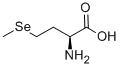 |
| CAS编号 | 3211-76-5 |
| MDL Number | MFCD00037210 |
| 别名 | L-selenomethionine 3211-76-5 Seleno-L-methionine Selenium-L-methionine L-Selenomethioninum SeMet (S)-2-Amino-4-(methylselanyl)butanoic acid (2S)-2-amino-4-methylselanylbutanoic acid (S)-2-Amino-4-(methylseleno)butyric acid (S)-2-Amino-4-(methylseleno)butanoic acid (2S)-2-amino-4-(methylseleno)butanoic acid L-(+)-Selenomethionine MFCD00037210 Butyric acid, 2-amino-4-(methylselenyl)-, L- Butanoic acid, 2-amino-4-(methylseleno)-, (S)- NSC-760370 964MRK2PEL DTXSID8046824 CHEBI:30021 NCGC00181044-01 Selenomethionine [USAN] MSE (2s)-2-amino-4-(methylselanyl)butanoic acid SelenoSource AF 2000 C5H11NO2Se UNII-964MRK2PEL Butanoic acid, 2-amino-4-(methylseleno)-, (2S)- (2S)-2-amino-4-methylselanyl-butanoic acid Megavite RX Seleno-DL-methionine;DL-Selenomethionine (2S)-2-Amino-4-(methylseleno)-butanoic acid; L-2-Amino-4-(methylselenyl)-butyric acid; Seleno-L-methionine Methionine, seleno- L-Seleno-L-methionine Seleno-D,L-methionine L(+)-Selenomethionine bmse000169 SELENOMETHIONINE, L- SCHEMBL63322 SELENOMETHIONINE [MI] L-SelenoMethionine (Standard) SELENOMETHIONINE [HSDB] CHEMBL113178 HY-B1000AR DTXCID6026824 L-SELENOMETHIONINE [FCC] SELENOMETHIONINE [MART.] HY-B1000A SELENOMETHIONINE [USP-RS] SELENOMETHIONINE [WHO-DD] 2-amino-4-(methylseleno)butanoate HMS3264C04 Pharmakon1600-01506163 2-Amino-4-(methylselenyl)butyrate Tox21_112692 NSC760370 s3973 AKOS015853989 AKOS015889703 AC-5676 CCG-207973 CS-5178 DB11142 FS09881 NSC 760370 (S)-2-Amino-4-(methylseleno)butanoate NCGC00181044-04 (2S)-2-amino-4-(methylseleno)butanoate (S)-2-amino-4-(methylseleno)-Butanoate CAS-3211-76-5 L-2-amino-4-(methylselenyl)-Butyric acid NS00074298 S0442 (S)-2-amino-4-(methylseleno)-Butanoic acid Seleno-L-methionine, >=98% (TLC), powder C05335 F20529 AB01563198_01 BRD-K74664543-213-01-2 Q27096144 .ALPHA.-AMINO-.GAMMA.-(METHYLSELENO)BUTYRIC ACID 2905D820-1EFF-4468-93D0-BD1605569F30 Selenomethionine, United States Pharmacopeia (USP) Reference Standard |
| 分子式 | C5H11NO2Se |
| 分子量 | 196.12 |
| InChI | InChI=1S/C5H11NO2Se/c1-9-3-2-4(6)5(7)8/h4H,2-3,6H2,1H3,(H,7,8)/t4-/m0/s1 |
| InChI Key | RJFAYQIBOAGBLC-BYPYZUCNSA-N |
| SMILES | C[Se]CC[C@@H](C(=O)O)N |
| Patent Information | ||
| Patent ID | Title | Publication Date |
| CN115475228 | Application of L-selenomethionine-containing oligopeptide in preparation of antitumor drugs | 2022 |
| CN109627198 | 2-acetonyl seleno-benzamide compound and preparation method and application thereof | 2019 |
| US2015/152139 | Peptide Tyrosinase Activators | 2015 |
Physical Data
| Appearance | Off-white to white powder |
| Solubility | 50mg in 1ml water clear soluble |
| Melting Point, °C | Solvent (Melting Point) |
| 275 | |
| 228 | |
| 275 | |
| 266 – 268 | aq. HCl |
| Description (Association (MCS)) | Solvent (Association (MCS)) | Temperature (Association (MCS)), °C | Partner (Association (MCS)) |
| Association with compound | aq. buffer | 37 | iron(III) protoporphyrin IX chloride |
| Association with compound | aq. phosphate buffer | 37 | human hemoglobin A |
Spectra
| Description (NMR Spectroscopy) | Nucleus (NMR Spectroscopy) | Solvents (NMR Spectroscopy) | Frequency (NMR Spectroscopy), MHz |
| Chemical shifts | 1H | water-d2 | |
| Chemical shifts | 13C | water-d2 | |
| Chemical shifts | 1H | water-d2 | 400 |
| Chemical shifts | 1H | water-d2 | |
| Chemical shifts | 13C | water-d2 | |
| Chemical shifts, Spectrum | 1H | water-d2 | |
| Chemical shifts, Spectrum | 1H | heavy water |
| Description (IR Spectroscopy) | Solvent (IR Spectroscopy) |
| Bands | potassium bromide |
| FT-IR, in KBr |
| Description (UV/VIS Spectroscopy) |
| Spectrum |
Route of Synthesis (ROS)

| Conditions | Yield |
| Stage #1: Seleno-L-methionine With sodium hydrogencarbonate In 1,4-dioxane; water for 0.333333h; Cooling with ice; Stage #2: di-tert-butyl dicarbonate In 1,4-dioxane; water at 20℃; for 13h; Cooling with ice; Experimental Procedure 2 Example 2: Preparation of Boc-L-selenomethionine 0.4 g L-selenomethionine was dissolved in 40 ml dioxane-water (volume ratio 1:1) solution, add 0.5 g NaHCO3. The resulting solution under ice bath was stirred for 20 min. Slowly add dropwise 1.5 eq Boc anhydride in dioxane solution. After ice bath stir for 1 h, raise the temperature to room temperature and react for 12 h. After the reaction is finished, extracted with ethyl acetate twice, the retention of the aqueous phase. For 1 mol/L hydrochloric acid aqueous solution of the aqueous phase is adjusted to pH 1 the left and right, extracted with ethyl acetate twice, rollup organic phase and drying with anhydrous sodium sulfate, concentrated under reduced pressure to obtain the Boc-L-selenomethionine (0.6 g, yield 98%), without further purification, can be directly used for the next step reaction. | 98% |
| With sodium hydroxide In 1,4-dioxane; water at 20℃; for 20h; Experimental Procedure To a solution of LSM in 2M NaOH was added a solution of di-t-butyl pyrocarbonate in dioxane and the mixture was stirred at room temperature for about 20 hrs. Dioxane was removed from the reaction mixture. The aqueous solution was acidified with 10% KHSO4 solution and the liberated Boc-LSM was extracted into ethyl acetate. The ethyl acetate solution was washed with water, dried and concentrated. Precipitation was done using petroleum ether (60-800). | |
| With hydrogen In ethyl acetate under 760.051 With sodium hydrogencarbonate In 1,4-dioxane; water at 25℃; Experimental Procedure 3.3. Procedure of the Preparation of Selenomethionine-Substituted Curcuminoids and Methionine-Substituted Curcuminoids General procedure: According to the procedure previously reported [33], selenomethionine (8) was prepared. Methionine (2) was used as the starting material in a three-pot, seven-step procedure to obtain selenomethionine in 47% yield. In a 100-mL round-bottomed flask, selenomethionine or methionine was dissolved in water and NaHCO3 (3 eq.) was added. A solution of (BOC)2O (1.5 eq.) in dioxane was added to this mixture. The reaction mixture was stirred at 25 °C overnight. The reaction mixture was washed with ethyl acetate. The resulting aqueous layer was acidified to pH 2 with concentrated hydrochloric acid and extracted with ethyl acetate. The combined organic extracts were dried over Na2SO4, filtered and concentrated in vacuo to give 9a or 9b as colorless gums. | |
| With sodium hydrogencarbonate In 1,4-dioxane; water at 20℃; for 12h; Experimental Procedure 3.3. General Method for Synthesizing Compounds 15-16 General procedure: The appropriate amino acid (13 or 14, 1 equiv.) and sodium bicarbonate (3 equiv.) was dissolved in a 1:1 mixture of water and 1,4-dioxane. Di-tert-butyl dicarbonate (1.2 equiv.) was added and the mixture was stirred at room temperature for 12 h. The 1,4-dioxane was removed under reduced pressure and the mixture was extracted with ethyl acetate. Then the solution was acidified using 1 M hydrochloric acid solution and extracted three times with ethyl acetate. The combined organic layers were washed with brine, dried over sodium sulfate, filtered, and the solvent was evaporated.The crude protected amino acids 15-16 were used without any further purification. |
Safety and Hazards
| Pictogram(s) |    |
| Signal | Danger |
| GHS Hazard Statements | H301 (100%): Toxic if swallowed [Danger Acute toxicity, oral] H331 (100%): Toxic if inhaled [Danger Acute toxicity, inhalation] H373 (97.9%): May causes damage to organs through prolonged or repeated exposure [Warning Specific target organ toxicity, repeated exposure] H400 (99%): Very toxic to aquatic life [Warning Hazardous to the aquatic environment, acute hazard] H410 (99%): Very toxic to aquatic life with long lasting effects [Warning Hazardous to the aquatic environment, long-term hazard] |
| Precautionary Statement Codes | P260, P261, P264, P270, P271, P273, P301+P316, P304+P340, P316, P319, P321, P330, P391, P403+P233, P405, and P501 (The corresponding statement to each P-code can be found at the GHS Classification page.) |
Other Data
| Transportation | Under the room temperature |
| HS Code | |
| Storage | Transport at room temperature, long-term preservation at 0 ~ 5° |
| Shelf Life | 1 year |
| Market Price |
| Druglikeness | |
| Lipinski rules component | |
| 分子量 | 196.108 |
| logP | -2.108 |
| HBA | 3 |
| HBD | 2 |
| Matching Lipinski Rules | 4 |
| Veber rules component | |
| Polar Surface Area (PSA) | 63.32 |
| Rotatable Bond (RotB) | 4 |
| Matching Veber Rules | 2 |
| Use Pattern |
| Selenomethionine exhibits antioxidant properties by enhancing glutathione peroxidase activity, thereby protecting cells from oxidative damage such as DNA strand breaks and protein dysfunction. It induces dose-dependent growth inhibition and apoptosis in various human cancer cell lines at micromolar concentrations, while normal fibroblasts are only affected at much higher levels (1 mM). |
试剂采购 | |
| 没有试剂厂商? | 向凯望发送快速询价 |
| 想要被列为试剂厂商? (付费服务) | 点击这里联系凯望 |
认证生产商 | |
| Apnoke Scientific Ltd | http://www.apnoke.com/ |
| 想要被列为认证生产商 (需要通过认证)? | 请下载并填写 这份表格并发邮件到approved-manufacturers@chemwhat.com |
其他供应商 | |
| Watson International Limited | 访问Watson官网 |
如需其他帮助,请联系我们 | |
| 联系我们获取其它信息或服务 | 点击这里联系凯望 |