Orotic acid CAS#: 65-86-1; 凯望编码 (ChemWhat Code): 136373

Identification
| 英文名 | Orotic acid |
| IUPAC名称 | 2,4-dioxo-1H-pyrimidine-6-carboxylic acid |
| 分子结构 | 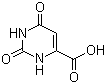 |
| CAS编号 | 65-86-1 |
| EINECS Number | 200-619-8 |
| MDL Number | MFCD00006027 |
| Beilstein Registry Number | 383901 |
| 别名 | orotic acid2,6-dioxo-1,2,3,6-tetrahydro-pyrimidine-4-carboxylic acidorotate |
| 分子式 | C5H4N2O4 |
| 分子量 | 156.096 |
| InChI | InChI=1S/C5H4N2O4/c8-3-1-2(4(9)10)6-5(11)7-3/h1H,(H,9,10)(H2,6,7,8,11) |
| InChI Key | PXQPEWDEAKTCGB-UHFFFAOYSA-N |
| Canonical SMILES | c1c([nH]c(=O)[nH]c1=O)C(=O)O |
| Patent Information | ||
| Patent ID | Title | Publication Date |
| US6299892 | Composition of matter having bioactive properties | 2001 |
| US2006/153899 | Palatinose for enhancing dietary supplement and pharmaceutical delivery | 2006 |
Physical Data
| Appearance | White powder |
| Solubility | No data available |
| Flash Point | No data available |
| Refractive index | No data available |
| Sensitivity | No data available |
| Melting Point, °C |
| 347.9 – 352.1 |
| 350.9 |
| 342.48 |
| 345 – 346 |
| Description (Association (MCS)) | Solvent (Association (MCS)) | Temperature (Association (MCS)), °C | Comment (Association (MCS)) | Partner (Association (MCS)) |
| Formation constant of a complex | H2O | 37 | CaCl2 | |
| UV/VIS spectrum of the complex | H2O | 37 | pH dependence | CaCl2 |
| IR spectrum of the complex | H2O | 37 | pH dependence | CaCl2 |
| Stability constant of the complex with … | H2O | 37 | in the presence of salts. Object(s) of Study: pH dependence | ZnCl2 |
Spectra
| Description (NMR Spectroscopy) | Nucleus (NMR Spectroscopy) | Solvents (NMR Spectroscopy) | Temperature (NMR Spectroscopy), °C | Frequency (NMR Spectroscopy), MHz |
| Chemical shifts, Spectrum | 1H | water-d2 | 0 | 400 |
| Chemical shifts, Spectrum | 13C | 26.84 | ||
| MAS (Magic-Angle Spinning), Solid state NMR, Spectrum | 1H | 0.056 | ||
| MAS (Magic-Angle Spinning), Solid state NMR, Chemical shifts, Spectrum | 1H | 25 | 0.035 |
| Description (IR Spectroscopy) | Solvent (IR Spectroscopy) | Original Text (IR Spectroscopy) | Signals, cm-1 |
| ATR (attenuated total reflectance), Bands, Spectrum | |||
| Intensity of IR bands, Bands, Spectrum | potassium bromide | ||
| Bands, Spectrum | |||
| Bands | potassium bromide | ||
| Spectrum | potassium bromide | ||
| Mid IR (MIR), Bands | potassium bromide | IR (cm-1): ν(NH) 3152 br, 3110s | 3152, 3110 |
| potassium bromide |
| Description (Mass Spectrometry) |
| liquid chromatography mass spectrometry (LCMS), spectrum |
| Description (UV/VIS Spectroscopy) | Solvent (UV/VIS Spectroscopy) | Comment (UV/VIS Spectroscopy) | Absorption Maxima (UV/VIS), nm | Ext./Abs. Coefficient, l·mol-1cm-1 |
| Absorption maxima | H2O, H2SO4 | Ratio of solvents: 66percent | 258 | 5740 |
| Absorption maxima | H2O, NaOH | Ratio of solvents: 0.1N | 232, 290 | 8600, 3120 |
Route of Synthesis (ROS)
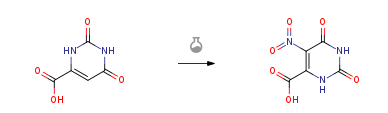
| Conditions | Yield |
| With sulfuric acid; nitric acid at 15 – 48℃; for 6h; Temperature; Cooling with ice; | 95% |
| With sulfuric acid; nitric acid In water at 50 – 55℃; for 3h; | 90% |
| Stage #1: orotic acid With sodium hydroxide In water for 3h; Stage #2: With sulfuric acid; nitric acid In water at 25 – 45℃; Inert atmosphere; | 88.6% |
| With sulfuric acid; nitric acid at 50 – 55℃; for 3h; | 78% |
| With sulfuric acid; nitric acid In water at 50 – 55℃; |
Safety and Hazards
| Pictogram(s) |  |
| Signal | Warning |
| GHS Hazard Statements | H315 (91.8%): Causes skin irritation [Warning Skin corrosion/irritation] H319 (91.8%): Causes serious eye irritation [Warning Serious eye damage/eye irritation] H335 (89.8%): May cause respiratory irritation [Warning Specific target organ toxicity, single exposure; Respiratory tract irritation] Information may vary between notifications depending on impurities, additives, and other factors. |
| Precautionary Statement Codes | P261, P264, P264+P265, P271, P280, P302+P352, P304+P340, P305+P351+P338, P319, P321, P332+P317, P337+P317, P362+P364, P403+P233, P405, and P501 (The corresponding statement to each P-code can be found at the GHS Classification page.) |
Other Data
| Transportation | NONH for all modes of transport |
| Under the room temperature and away from light | |
| HS Code | No data available |
| Storage | Under the room temperature and away from light |
| Shelf Life | 2 years |
| Market Price | USD |
| Druglikeness | |
| Lipinski rules component | |
| 分子量 | 156.098 |
| logP | -1.247 |
| HBA | 6 |
| HBD | 3 |
| Matching Lipinski Rules | 4 |
| Veber rules component | |
| Polar Surface Area (PSA) | 95.5 |
| Rotatable Bond (RotB) | 1 |
| Matching Veber Rules | 2 |
| Use Pattern |
| It can be used as an anti-anemia and nutritional tonic, daily cosmetics and medicine, nucleic acid, and biological research. It can be used in medicine to prepare jaundice, liver medicine, heart disease medicine, etc. |
试剂采购 | |
| 没有试剂厂商? | 向凯望发送快速询价 |
| 想要被列为试剂厂商? (付费服务) | 点击这里联系凯望 |
认证生产商 | |
| 想要被列为认证生产商 (需要通过认证)? | 请下载并填写 这份表格并发邮件到approved-manufacturers@chemwhat.com |
其他供应商 | |
| Watson International Limited | 访问Watson官网 |
如需其他帮助,请联系我们 | |
| 联系我们获取其它信息或服务 | 点击这里联系凯望 |