Phosphoenolpyruvic acid cyclohexylammonium salt CAS#: 10526-80-4; 凯望编码 (ChemWhat Code): 38345

Identification
| 英文名 | Phosphoenolpyruvic acid cyclohexylammonium salt |
| IUPAC Name | cyclohexanamine;2-phosphonooxyprop-2-enoic acid |
| 分子结构 | 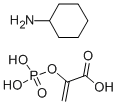 |
| CAS编号 | 10526-80-4 |
| EINECS Number | 234-084-7 |
| MDL Number | MFCD00036375 |
| 别名 | 10526-80-4 Cyclohexanamine 2-(phosphonooxy)acrylate Phospho(enol)pyruvic acid cyclohexylammonium salt PHOSPHOENOLPYRUVIC ACID CYCLOHEXYLAMMONIUM SALT EINECS 234-084-7 DTXSID3065110 2-(Phosphonooxy)-2-propenoic acid monopotassium salt MFCD00036375 cyclohexylamine; phosphoenolpyruvic acid 2-Propenoic acid, 2-phosphonoxy-, monocyclohexylammonium salt Phosphoenolpyruvic acid (cyclohexylammonium salt) C9H18NO6P Cyclohexylamine, Compound with 2-Hydroxyacrylic Acid, di-H Phosphate (1:1) (7CI)Cyclohexylammonium Phosphoenolpyruvate; 2-Phosphoenolpyruvate Monocyclohexylammonium(PEP) 2-(Phosphonooxy)acrylic acid, compound with cyclohexylamine (1:1) SCHEMBL1611871 DTXCID0032944 VHFCNZDHPABZJO-UHFFFAOYSA-N AKOS015895036 CS-W012420 P0758 P-6101 Phosphoenolpyruvic acid (cyclohexylammoniu salt) Phosphoenolpyruvic acid (cyclohexylammoniu?m salt) Phosphoenolpyruvic acid mono(cyclohexylammonium) salt Phospho(enol)pyruvic acid cyclohexylammonium salt, >=97% (enzymatic) |
| 分子式 | C9H18NO6P |
| 分子量 | 267.22 |
| InChI | InChI=1S/C6H13N.C3H5O6P/c7-6-4-2-1-3-5-6;1-2(3(4)5)9-10(6,7)8/h6H,1-5,7H2;1H2,(H,4,5)(H2,6,7,8) |
| InChI Key | VHFCNZDHPABZJO-UHFFFAOYSA-N |
| Isomeric SMILES | C=C(C(=O)O)OP(=O)(O)O.C1CCC(CC1)N |
Physical Data
| Appearance | White Powder |
| Melting Point, °C |
| 143 – 146 |
| 144 – 146 |
Spectra
No data available
Route of Synthesis (ROS)

| Conditions | Yield |
| (i) DCC, Py, (ii) /BRN= 1098229/; Multistep reaction; |
Safety and Hazards
| Pictogram(s) |  |
| Signal | Warning |
| GHS Hazard Statements | H315 (100%): Causes skin irritation [Warning Skin corrosion/irritation] H319 (100%): Causes serious eye irritation [Warning Serious eye damage/eye irritation] H335 (100%): May cause respiratory irritation [Warning Specific target organ toxicity, single exposure; Respiratory tract irritation] |
| Precautionary Statement Codes | P261, P264, P264+P265, P271, P280, P302+P352, P304+P340, P305+P351+P338, P319, P321, P332+P317, P337+P317, P362+P364, P403+P233, P405, and P501 (The corresponding statement to each P-code can be found at the GHS Classification page.) |
Other Data
| Transportation | Store at 2~8 ℃, Sealed and away from light. |
| HS Code | |
| Storage | Store at 2~8 ℃, Sealed and away from light. |
| Shelf Life | 1 year |
| Druglikeness | |
| Lipinski rules component | |
| 分子量 | 267.219 |
| logP | |
| HBA | 7 |
| HBD | 4 |
| Matching Lipinski Rules | 3 |
| Veber rules component | |
| Polar Surface Area (PSA) | 139.89 |
| Rotatable Bond (RotB) | 3 |
| Matching Veber Rules | 2 |
| Use Pattern |
| Phosphoenolpyruvate monocylohexylamine salt (PEP monocylohexylamine salt) is an important organophosphorus compound, primarily used in the fields of biochemistry and pharmaceutical research with the following applications: Substrate in Enzyme Reactions: Phosphoenolpyruvate (PEP) is a key intermediate in the glycolysis pathway. The monocylohexylamine salt form of PEP can be used in vitro to study substrate behavior in enzyme reactions, especially in research involving glycolysis or energy metabolism. Phosphoenolpyruvate Carboxykinase (PEPCK) Studies: PEP is a critical substrate in reactions catalyzed by PEPCK, a key enzyme in the gluconeogenesis pathway. Studying this process is essential for understanding metabolism, diabetes, and other metabolic disorders. ATP Synthesis: In vitro ATP synthesis experiments often use PEP to provide phosphate groups, generating ATP through reactions with ADP. This is highly valuable for research on cellular energy metabolism. Drug Development and Biomedical Research: PEP monocylohexylamine salt may be used in the development of metabolism-related drugs, particularly for research targeting metabolic pathways associated with diseases such as cancer or diabetes. |
试剂采购 | |
| 没有试剂厂商? | 向凯望发送快速询价 |
| 想要被列为试剂厂商? (付费服务) | 点击这里联系凯望 |
认证生产商 | |
| 想要被列为认证生产商 (需要通过认证)? | 请下载并填写 这份表格并发邮件到approved-manufacturers@chemwhat.com |
其他供应商 | |
| Watson International Limited | 访问Watson官网 |
如需其他帮助,请联系我们 | |
| 联系我们获取其它信息或服务 | 点击这里联系凯望 |