PROCYANIDIN C1 CAS#: 37064-30-5; 凯望编码 (ChemWhat Code): 98195

Identification
| 英文名 | PROCYANIDIN C1 |
| IUPAC Name | (2R,3R,4S)-2-(3,4-dihydroxyphenyl)-4-[(2R,3R)-2-(3,4-dihydroxyphenyl)-3,5,7-trihydroxy-3,4-dihydro-2H-chromen-8-yl]-8-[(2R,3R,4R)-2-(3,4-dihydroxyphenyl)-3,5,7-trihydroxy-3,4-dihydro-2H-chromen-4-yl]-3,4-dihydro-2H-chromene-3,5,7-triol |
| 分子结构 | 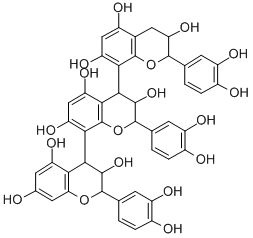 |
| CAS编号 | 37064-30-5 |
| 别名 | Procyanidin C1 37064-30-5 Procyanidol C1 Proanthocyanidin C1 Cinnamtannin A1 Procyanidin trimer C1 (2R,2’R,2”R,3R,3’R,3”R,4R,4’S)-2,2′,2”-Tris(3,4-dihydroxyphenyl)-[4,8′:4′,8”-terchroman]-3,3′,3”,5,5′,5”,7,7′,7”-nonaol UNII-33516LCW4F CHEBI:75643 33516LCW4F EC-(4b,8)-EC-(4b,8)-EC CHEMBL290632 (2r,2’r,2”r,3r,3’r,3”r,4r,4’s)-2,2′,2”-tris(3,4-dihydroxyphenyl)-3,3′,3”,4,4′,4”-hexahydro-2h,2’h,2”h-4,8′:4′,8”-terchromene-3,3′,3”,5,5′,5”,7,7′,7”-nonol Epicatechin-(4beta->8)-epicatechin-(4beta->8)-epicatechin PROCYANIDIN C1, (+)- DTXSID10190562 [Epicatechin(4b->8)]2-epicatechin (2R,3R,4S)-2-(3,4-dihydroxyphenyl)-4-[(2R,3R)-2-(3,4-dihydroxyphenyl)-3,5,7-trihydroxy-3,4-dihydro-2H-chromen-8-yl]-8-[(2R,3R,4R)-2-(3,4-dihydroxyphenyl)-3,5,7-trihydroxy-3,4-dihydro-2H-chromen-4-yl]-3,4-dihydro-2H-chromene-3,5,7-triol (4,8′:4′,8”-Ter-2H-1-benzopyran)-3,3′,3”,5,5′,5”,7,7′,7”-nonol, 2,2′,2”-tris(3,4-dihydroxyphenyl)-3,3′,3”,4,4′,4”-hexahydro-, stereoisomer [Epicatechin-(4beta->8)]2-epicatechin (Epicatechin(4b->8))2-epicatechin Procyanidin C-1 (Epicatechin-(4beta->8))2-epicatechin C45H38O18 PCC1 SCHEMBL678609 DTXCID50113053 HY-N2342 BDBM50240460 AKOS027321198 AC-35069 MS-31600 1ST166802 CS-0021304 C17624 Q7247556 PROCYANIDIN C1 (CONSTITUENT OF MARITIME PINE) epicatechin-(4beta-8)-epicatechin-(4beta-8)-epicatechin PROCYANIDIN C1 (CONSTITUENT OF MARITIME PINE) [DSC] Epicatechin-(4.beta.–>8)epicatechin-(4.beta.–>8)epicatechin EPICATECHIN-(4.BETA.->8)-EPICATECHIN-(4.BETA.->8)-EPICATECHIN (2R,3R,4R,2”R,3”R,4”S,2””R,3””R)-2,2”,2””-Tris-(3,4-dihydroxy-phenyl)-3,4,3”,4”,3””,4””-hexahydro-2H,2”H,2””H-[4,8”;4”,8””]terchromene-3,5,7,3”,5”,7”,3””,5””,7””-nonaol (2R,3R,4S)-2-(3,4-dihydroxyphenyl)-4-[(2R,3R)-2-(3,4-dihydroxyphenyl)-3,5,7-trihydroxy-chroman-8-yl]-8-[(2R,3R,4R)-2-(3,4-dihydroxyphenyl)-3,5,7-trihydroxy-chroman-4-yl]chromane-3,5,7-triol (2R,3R,4S)-2-(3,4-dihydroxyphenyl)-8-[(2R,3R,4R)-2-(3,4-dihydroxyphenyl)-3,5,7-trihydroxy-3,4-dihydro-2H-1-benzopyran-4-yl]-4-[(2R,3R)-2-(3,4-dihydroxyphenyl)-3,5,7-trihydroxy-3,4-dihydro-2H-1-benzopyran-8-yl]-3,4-dihydro-2H-1-benzopyran-3,5,7-triol |
| 分子式 | C45H38O18 |
| 分子量 | 866.8 |
| InChI | InChI=1S/C45H38O18/c46-18-10-27(54)33-32(11-18)61-42(16-2-5-21(48)25(52)8-16)39(59)37(33)35-29(56)14-30(57)36-38(40(60)43(63-45(35)36)17-3-6-22(49)26(53)9-17)34-28(55)13-23(50)19-12-31(58)41(62-44(19)34)15-1-4-20(47)24(51)7-15/h1-11,13-14,31,37-43,46-60H,12H2/t31-,37-,38+,39-,40-,41-,42-,43-/m1/s1 |
| InChI Key | MOJZMWJRUKIQGL-XILRTYJMSA-N |
| Isomeric SMILES | C1[C@H]([C@H](OC2=C1C(=CC(=C2[C@@H]3[C@H]([C@H](OC4=C(C(=CC(=C34)O)O)[C@@H]5[C@H]([C@H](OC6=CC(=CC(=C56)O)O)C7=CC(=C(C=C7)O)O)O)C8=CC(=C(C=C8)O)O)O)O)O)C9=CC(=C(C=C9)O)O)O |
Physical Data
| Appearance | Brown powder |
| Description (Association (MCS)) | Temperature (Association (MCS)), °C | Partner (Association (MCS)) |
| Association with compound | 23.84 | bovine milk β-lactoglobulin |
| Association with compound | 23.84 | bovine milk α-lactalbumin |
| Association with compound | 30.84 | bovine milk β-lactoglobulin |
| Association with compound | 30.84 | bovine milk α-lactalbumin |
| Association with compound | 37.84 | bovine milk β-lactoglobulin |
| Association with compound | 37.84 | bovine milk α-lactalbumin |
| Association with compound | bovine serum albumin |
Spectra
| Description (NMR Spectroscopy) | Nucleus (NMR Spectroscopy) | Solvents (NMR Spectroscopy) | Temperature (NMR Spectroscopy), °C | Frequency (NMR Spectroscopy), MHz |
| Chemical shifts | 1H | CD3OD | ||
| Chemical shifts | 13C | CD3OD | ||
| Chemical shifts | 1H | CD3OD | 400 | |
| Chemical shifts | 1H | CD3OD | -18.16 | 400 |
| Chemical shifts | 13C | CD3OD | -18.16 | 100 |
| Description (IR Spectroscopy) | Solvent (IR Spectroscopy) |
| Bands | potassium bromide |
| Spectrum | potassium bromide |
| Description (UV/VIS Spectroscopy) | Absorption Maxima (UV/VIS), nm |
| methanol | 200, 280 |
| aq. phosphate buffer | 280 |
| water | 280 |
| methanol, water | 281 |
Route of Synthesis (ROS)
| Conditions | Yield |
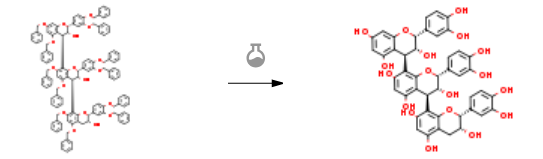
| With hydrogen; palladium(II) hydroxide/carbon In tetrahydrofuran; methanol; water under 750.075 Torr; for 1.33333h; Experimental Procedure 11.A Example 11; Preparation of Epicatechin (4β,8)-Oligomers from Benzyl-Protected Oligomers; A. Preparation of Epicatechin (4β,8)2-Trimer To a solution of 64.3 mg (33.0 μmol) of bis(5,7,3′,4′-tetra-O-benzyl)epicatechin (4β,8)-dimer in 5 mL of tetrahydrofuran were added 5 mL of methanol, 0.25 mL of water, and 57 mg of 20% Pearlman’s catalyst (Pd(OH)2/C). The mixture was stirred under 1 bar of hydrogen for 80 minutes and filtered over cotton. The filtration residue was washed two times with 10 mL of methanol. The combined filtrates were evaporated, and the residue was taken up in 10 mL of HPLC grade water. The solution was filtered and lyophilized to yield 32.4 mg (101%) of epicatechin (4β,8)2-trimer 6H2O as a fluffy, amorphous, off-white solid: [α]D+70.4°, [α]546+84.40 (MeOH, c 2.2 gL-1); (ref. 4c: [α]D+75.20, acetone, c 8.7 gL-1; ref. 4d: [α]578+90°, MeOH, c 2 gL-1; ref. 6: [α]D+76.40, acetone, c 8.6 gL-1; ref. 19b: []578+920, H2O, c 1.9 gL-1; ref. 19k: [α]D+800, MeOH, c 1.6 gL-1); 13C NMR (CD3OD, TMS; δ 60-85 region only) δ 79.73, 77.08, 73.47, 72.94, 66.84; MS (API/ES) m/z 865.4 (100%; calcd for [M-H]-: 865.2), 577.0 (6%), 288.9 (4%). Analysis: Calculated for C45H38O18.6H2O: C, 55.44; H, 5.17. Found: C, 55.71; H, 5.07. | 100% |
| With hydrogen; palladium dihydroxide In tetrahydrofuran; methanol | 95% |
| With hydrogen; palladium dihydroxide In tetrahydrofuran; methanol; water at 20℃; for 1h; | 95% |
| With 10 wt% Pd(OH)2 on carbon; hydrogen In tetrahydrofuran; methanol; water at 20℃; for 1h; | 92% |
Safety and Hazards
| GHS Hazard Statements | Not Classified |
| For more detailed information, please visit ECHA C&L website |
| Source: European Chemicals Agency (ECHA) License Note: Use of the information, documents and data from the ECHA website is subject to the terms and conditions of this Legal Notice, and subject to other binding limitations provided for under applicable law, the information, documents and data made available on the ECHA website may be reproduced, distributed and/or used, totally or in part, for non-commercial purposes provided that ECHA is acknowledged as the source: “Source: European Chemicals Agency, http://echa.europa.eu/”. Such acknowledgement must be included in each copy of the material. ECHA permits and encourages organisations and individuals to create links to the ECHA website under the following cumulative conditions: Links can only be made to webpages that provide a link to the Legal Notice page. License URL: https://echa.europa.eu/web/guest/legal-notice Record Name: (1-Cyano-2-ethoxy-2-oxoethylidenaminooxy)dimethylamino-morpholino-carbenium hexafluorophosphate URL: https://echa.europa.eu/information-on-chemicals/cl-inventory-database/-/discli/details/213446 Description: The information provided here is aggregated from the “Notified classification and labelling” from ECHA’s C&L Inventory. Read more: https://echa.europa.eu/information-on-chemicals/cl-inventory-database |
Other Data
| Transportation | Under the room temperature and away from light |
| HS Code | |
| Storage | Under the room temperature and away from light |
| Shelf Life | 2 years |
| Market Price |
| Druglikeness | |
| Lipinski rules component | |
| 分子量 | 866.786 |
| logP | 3.855 |
| HBA | 3 |
| HBD | 15 |
| Matching Lipinski Rules | 2 |
| Veber rules component | |
| Polar Surface Area (PSA) | 331.14 |
| Rotatable Bond (RotB) | 5 |
| Matching Veber Rules | 1 |
| Use Pattern |
| Procyanidin C1 CAS 37064-30-5, a complex polyphenolic compound, falls under the larger category of proanthocyanidins which are widely recognized for their potent antioxidant properties. These substances are found in a variety of plants, including fruits, vegetables, nuts, seeds, and bark, playing crucial roles in plant defense mechanisms against pathogens and environmental stressors. Among the diverse array of proanthocyanidins, Procyanidin C1 is particularly notable for its unique structure and significant health-promoting potentials. Chemically, Procyanidin C1 is a trimer, meaning it consists of three flavonoid units linked together. This structural complexity contributes to its strong antioxidant capacity, surpassing that of simpler flavonoids and even some vitamins known for their antioxidant properties, such as vitamin E and C. The antioxidant activity of Procyanidin C1 is essential in neutralizing free radicals, unstable molecules that can cause oxidative stress leading to cellular damage, aging, and various diseases. The health benefits associated with Procyanidin C1 are vast and have been the subject of numerous scientific studies. Research has shown that it can support cardiovascular health by improving blood circulation, reducing blood pressure, and preventing the oxidation of low-density lipoprotein (LDL) cholesterol, a key factor in the development of atherosclerosis. Moreover, its anti-inflammatory effects are crucial in mitigating chronic inflammation, a root cause of many chronic conditions, including cancer, diabetes, and neurodegenerative diseases. |
试剂采购 | |
| 没有试剂厂商? | 向凯望发送快速询价 |
| 想要被列为试剂厂商? (付费服务) | 点击这里联系凯望 |
认证生产商 | |
| Apnoke Scientific Ltd | http://www.apnoke.com/ |
| 想要被列为认证生产商 (需要通过认证)? | 请下载并填写 这份表格并发邮件到approved-manufacturers@chemwhat.com |
其他供应商 | |
| Watson International Limited | 访问Watson官网 |
如需其他帮助,请联系我们 | |
| 联系我们获取其它信息或服务 | 点击这里联系凯望 |