Propylene glycol CAS#: 57-55-6; 凯望编码 (ChemWhat Code): 80788

Identification
| 英文名 | Propylene glycol |
| IUPAC名称 | propane-1,2-diol |
| 分子结构 | 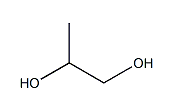 |
| CAS编号 | 57-55-6 |
| EINECS Number | 200-338-0 |
| MDL Number | MFCD00064272 |
| Beilstein Registry Number | 1340498 |
| 别名 | propylene glycol, 1,2-Propanediol, Propyleneglycol;CAS Namber: 57-55-6;CAS No:.57-55-6;57-55-6;CAS#: 57-55-6; |
| 分子式 | C5H6N2 |
| 分子量 | 94.116 |
| InChI | InChI=1S/C3H8O2/c1-3(5)2-4/h3-5H,2H2,1H3 |
| InChI Key | DNIAPMSPPWPWGF-UHFFFAOYSA-N |
| Canonical SMILES | CC(CO)O |
| Patent Information | ||
| Patent ID | Title | Publication Date |
| JP2020/63220 | Microbicidal composition (by machine translation) | 2020 |
| CN111217856 | Pentacyclic phosphate compound as well as preparation method and application thereof (by machine translation) | 2020 |
| CN111320530 | Preparation method 1 – hydroxyl -2 -alkyl ketone (by machine translation) | 2020 |
| CN111333607 | Method for synthesizing apple ester compound (by machine translation) | 2020 |
Physical Data
| Appearance | Colorless, viscous and stable absorbent liquid |
| Solubility | miscible |
| Refractive index | n20/D 1.432(lit.) |
| Sensitivity | Hygroscopic |
| Melting Point, °C |
| 187 |
| Boiling Point, °C | Pressure (Boiling Point), Torr |
| 214 | |
| 188 | |
| 101 – 102 | 6.0006 |
| 187.6 |
| Refractive Index | Wavelength (Refractive Index), nm | Temperature (Refractive Index), °C |
| 1.43 | 589 | 24.99 |
| 1.4272 | 589 | 34.99 |
| 1.4312 | 589 | 24.99 |
| 1.42246 | 589 | 49.99 |
| 1.42591 | 589 | 39.99 |
| Density, g·cm-3 | Measurement Temperature, °C |
| 1.0329 | 24.99 |
| 1.0356 | 24.99 |
| 1.0178 | 44.99 |
| 1.0256 | 34.99 |
| 1.0366 | 19.99 |
| Description (Association (MCS)) | Solvent (Association (MCS)) | Temperature (Association (MCS)), °C | Partner (Association (MCS)) |
| Adsorption and desorption isotherms | acetonitrile | -196.16 | chromium based metal-organic frameworks |
| Further physical properties of the adsorbed molecule | -103.16 | Pd(111) | |
| Adsorption | water | 24.84 | ruthenium, hydrogen |
| Adsorption | water | 24.84 | ruthenium |
| Further physical properties of the adsorbed molecule | CDCl3 | 1 wt% Au/TiO2 | |
| Further physical properties of the adsorbed molecule | M41S mesoporous silica | ||
| Further physical properties of the adsorbed molecule | 0 – 40 | sol-gel porous glass |
Spectra
| Description (NMR Spectroscopy) | Nucleus (NMR Spectroscopy) | Coupling Nuclei | Solvents (NMR Spectroscopy) | Temperature (NMR Spectroscopy), °C | Frequency (NMR Spectroscopy), MHz |
| Chemical shifts, Spectrum | 1H | chloroform-d1 | |||
| Chemical shifts | 1H | 13C | water, water-d2 | ||
| Chemical shifts | 13C | water, water-d2 | |||
| Spectrum | 13C | dimethylsulfoxide-d6 | 100.6 | ||
| Spectrum | 1H | dimethylsulfoxide-d6 | |||
| Chemical shifts, Spectrum | 1H | chloroform-d1 | 25 | 400 |
| Description (IR Spectroscopy) | Solvent (IR Spectroscopy) |
| Bands, Spectrum | |
| Intensity of IR bands, Bands, Spectrum | |
| Spectrum | |
| Bands, Spectrum | |
| ATR (attenuated total reflectance), Spectrum | |
| Bands | |
| ATR (attenuated total reflectance), Spectrum | neat liquid |
| Description (Mass Spectrometry) |
| time-of-flight mass spectra (TOFMS), gas chromatography mass spectrometry (GCMS), spectrum |
| gas chromatography mass spectrometry (GCMS), IT (ion trap), electron impact (EI), spectrum |
| MALDI (Matrix assisted laser desorption ionization), time-of-flight mass spectra (TOFMS), spectrum |
Route of Synthesis (ROS)
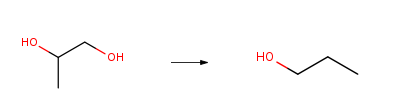
| Conditions | Yield |
| With [C6H3-2,6-(OP(tBu)2)2]IrH2; trifluorormethanesulfonic acid; water; hydrogen In 1,4-dioxane at 125℃; under 5171.62 Torr; Temperature; Pressure; Solvent; Autoclave; Experimental Procedure 11 Hydrogenation of 1,2 Propanediol. Hydrogenation of 1,2 Propanediol. Using (POCOP)IrH2 and trifluoromethanesulfonic acid, 1,2-propanediol (1,2 PD) was reduced to n-propanol in up to 95% yield in aqueous dioxane at 125° C. under 100 psi H2. The mild conditions of the reaction and the high selectivity observed are extraordinary. Even more remarkable is the stability of this catalyst to the aqueous environment. In fact, the presence of water is actually required to achieve high deoxygenation selectivity and hydrogenation efficiency, which also increased as the acid concentration in the reaction system was decreased. | 95% |
| With hydrogen In water at 210℃; under 30753.1 Torr; for 5h; Autoclave; Sealed tube; | |
| With hydrogen In water at 179.84℃; under 37503.8 Torr; for 12h; | 80 %Chromat. |
| at 315℃; Gas phase; |
Safety and Hazards
| GHS Hazard Statements | Not Classified |
Other Data
| Transportation | NONH for all modes of transport |
| Under the room temperature and away from light | |
| HS Code | 290532 |
| Storage | Under the room temperature and away from light |
| Shelf Life | 1 year |
| Market Price | USD |
| Druglikeness | |
| Lipinski rules component | |
| 分子量 | 76.0953 |
| logP | -0.748 |
| HBA | 2 |
| HBD | 2 |
| Matching Lipinski Rules | 4 |
| Veber rules component | |
| Polar Surface Area (PSA) | 40.46 |
| Rotatable Bond (RotB) | 1 |
| Matching Veber Rules | 2 |
| Bioactivity |
| In vitro: Efficacy |
| Quantitative Results |
| pX | Parameter | Value (qual) | Value (quant) | Unit |
| 2.55 | Km (Michaelis constant)(Michaelis-menten constant) | = | 2.8 | mM |
| 2.37 | EC50 | 325 – 3785 | mg/L | |
| 2.27 | LOAEC | 405 | mg/L | |
| 2.18 | EC50 | 500 | mg/L | |
| 2.04 | LC50 | 686 | mg/L | |
| 1.96 | Km (Michaelis constant)(Michaelis-menten constant) | = | 0.011 | M |
| Quantitative Results | ||
| 1 of 10 | Effect | antimicrobial agent |
| Assay Description | Bioassay : EXPERIMENTALS Experimental 1: Selection of Antimicrobial preservatives for Injectable Compound of Formula la. Study A (Large Antimicrobial preservative Screen) The efficacy of several different antimicrobial preservatives in combination with compound of Formula la and SBE-CD were investigated. Literature | |
| Results | title compound at 50% in combination with 5% sulfobutylether-p-cyclodextrin (SBE-CD) and formula 1a showed antimicrobial effect in USP test, European Pharmacopoeia, criteria A test and European Pharmacopoeia, criteria B test | |
| 2 of 10 | Effect | antibiotic agent |
| Biological material | Escherichia coli | |
| Assay Description | Effect : antibacterial Species : ATCC 29522 Example 1Synergistic Antimicrobial ActivityThis example provides the results for antimicrobial activity of components of exemplary invention’s compositions when the components were used alone (Tables 3A and 3B), or as a combination of two components (Tables 3A and 4), or of at least three components | |
| Results | log reduction (5.45 log inoculum) after treatment for 2/30/180 min: 1.83/2.24/2.55 (strawberry); 1.71/2.1/2.4 (spinach leaf) | |
| 3 of 10 | Effect | antibiotic agent |
| Biological material | Escherichia coli | |
| Assay Description | Effect : antibacterial Species : ATCC 43888 Example 1Synergistic Antimicrobial ActivityThis example provides the results for antimicrobial activity of components of exemplary invention’s compositions when the components were used alone (Tables 3A and 3B), or as a combination of two components (Tables 3A and 4), or of at least three components | |
| Results | log reduction (6.87 log inoculum) after treatment for 2/30/180 min: 2.23/2.69/4.47 (strawberry); 2.44/2.54/3.98 (spinach leaf) | |
| 4 of 10 | Biological material | rat |
| Assay Description | Effect of combining the compound (25) with 5 menthol on permeation coefficient of propofol through rat skin; n = 3 | |
| Results | kp not calculated | |
| 5 of 10 | Biological material | rat |
| Assay Description | Effect of combining the compound (29) with 1 lauric acid 1695 on permeation coefficient of propofol through rat skin; n = 3 | |
| Results | kp not calculated | |
| 6 of 10 | Biological material | rat |
| Assay Description | Effect of combining the compound (25) with 1 oleic acid 1570 on permeation coefficient of propofol through rat skin; n = 3 | |
| Results | kp not calculated | |
| 7 of 10 | Biological material | rat |
| Assay Description | Effect of combining the compound (29) with 1 lauric acid 1695 on flux of permeation of propofol through rat skin; n = 3 | |
| Results | Jss not calculated | |
| 8 of 10 | Biological material | rat |
| Assay Description | Effect of combining the compound (25) with 1 lauric acid 1695 on permeation coefficient of propofol through rat skin; n = 3 | |
| Results | kp not calculated | |
| 9 of 10 | Biological material | rat |
| Assay Description | Permeation coefficient of the compound as enhancer through rat skin for 8 h at 20 concentration | |
| Results | kp not calculated | |
| 10 of 10 | Biological material | rat |
| Assay Description | Effect of combining the compound (25) with 5 oleic acid on permeation coefficient of propofol through rat skin; n = 3 | |
| Results | kp not calculated |
| Use Pattern |
| Propylene glycol CAS# 57-55-6 is a widely used basic material. |
试剂采购 | |
| 没有试剂厂商? | 向凯望发送快速询价 |
| 想要被列为试剂厂商? (付费服务) | 点击这里联系凯望 |
认证生产商 | |
| Watsonnoke Scientific Ltd | https://www.watsonnoke.com/ |
| 想要被列为认证生产商 (需要通过认证)? | 请下载并填写 这份表格并发邮件到approved-manufacturers@chemwhat.com |
其他供应商 | |
| Watson International Limited | 访问Watson官网 |
如需其他帮助,请联系我们 | |
| 联系我们获取其它信息或服务 | 点击这里联系凯望 |