Sodium difluoro(oxalato)borate CAS#: 2102517-30-4; 凯望编码 (ChemWhat Code): 1499442

Identification
| 英文名 | Sodium difluoro(oxalato)borate |
| IUPAC名称 | sodium 2,2-difluoro-1,3-dioxa-2-boranuidacyclopentane-4,5-dione |
| 分子结构 | 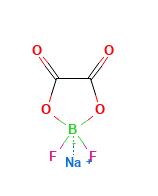 |
| CAS Registry Number | 2102517-30-4 |
| EINECS Number | No data available |
| MDL Number | No data available |
| Beilstein Registry Number | No data available |
| Synonyms | sodium difluoro(oxalato)boratesodium difluorooxalate borate |
| Molecular Formula | C2BF2NaO4 |
| Molecular Weight | 159.82 |
| InChI | InChI=1S/C2BF2O4.Na/c4-3(5)8-1(6)2(7)9-3;/q-1;+1 |
| InChI Key | HRRQLROHUSYBRX-UHFFFAOYSA-N |
| Canonical SMILES | [B-]1(OC(=O)C(=O)O1)(F)F.[Na+] |
| Patent Information |
| No data available |
Physical Data
| Appearance | White powder |
| Solubility | No data available |
| Flash Point | No data available |
| Refractive index | No data available |
| Sensitivity | No data available |
Spectra
| No data available |
Route of Synthesis (ROS)
| No data available |
Safety and Hazards
| Pictogram(s) |  |
| Signal | Danger |
| GHS Hazard Statements | H314 (100%): Causes severe skin burns and eye damage [Danger Skin corrosion/irritation] H318 (100%): Causes serious eye damage [Danger Serious eye damage/eye irritation] Information may vary between notifications depending on impurities, additives, and other factors. |
| Precautionary Statement Codes | P260, P264, P264+P265, P280, P301+P330+P331, P302+P361+P354, P304+P340, P305+P354+P338, P316, P317, P321, P363, P405, and P501 (The corresponding statement to each P-code can be found at the GHS Classification page.) |
Other Data
| Transportation | NONH for all modes of transport |
| Under the room temperature and away from light | |
| HS Code | No data available |
| Storage | Under the room temperature and away from light |
| Shelf Life | 2 years |
| Market Price | USD |
| Druglikeness | |
| Lipinski rules component | |
| Molecular Weight | 175.926 |
| logP | 0.905 |
| HBA | 4 |
| HBD | 0 |
| Matching Lipinski Rules | 4 |
| Veber rules component | |
| Polar Surface Area (PSA) | 52.6 |
| Rotatable Bond (RotB) | 0 |
| Matching Veber Rules | 2 |
| Use Pattern |
| Research on Electrolytes for Lithium and Sodium Batteries |
| NaPF₆ serves as an electrolyte salt for Sodium-ion Batteries (SIBs) and acts as a supporting electrolyte in electrochemical research. For instance, it is soluble in carbonate-based solvent systems such as EC/DEC, PC, and DMC. Due to the superior electrochemical stability and high ionic conductivity of the PF₆⁻ anion, NaPF₆ is frequently utilized in the development of laboratory-scale battery systems. |
| Anion Exchange Agents in Organic Synthesis |
| As PF₆⁻ is classified as a weakly coordinating anion, NaPF₆ is commonly employed to: convert halide salts into hexafluorophosphate salts, synthesize quaternary ammonium PF₆ salts, prepare ionic liquids, and facilitate anion exchange in metal complexes. |
| Supporting Electrolytes in Electrochemistry |
| It functions as a conductive salt in various electrochemical applications, including cyclic voltammetry (CV), electrodeposition, supercapacitors, and electrocatalysis research. |
| Functional Materials and Coordination Chemistry |
| It is utilized in the construction of PF₆⁻ coordination systems within the fields of metal-organic frameworks (MOFs), coordination chemistry, OLED materials, and luminescent materials. |
| Intermediates for Ionic Liquids |
| Many PF₆-based ionic liquids are synthesized via anion exchange reactions utilizing NaPF₆. |
试剂采购 | |
| 没有试剂厂商? | 向凯望发送快速询价 |
| 想要被列为试剂厂商? (付费服务) | 点击这里联系凯望 |
认证生产商 | |
| Warshel Chemical Ltd | http://www.warshel.com/ |
| 想要被列为认证生产商 (需要通过认证)? | 请下载并填写 这份表格并发邮件到approved-manufacturers@chemwhat.com |
其他供应商 | |
| Watson International Limited | 访问Watson官网 |
如需其他帮助,请联系我们 | |
| 联系我们获取其它信息或服务 | 点击这里联系凯望 |