TETRAKIS(DIETHYLAMINO)HAFNIUM CAS#: 19824-55-6
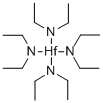
Identification
| 英文名 | TETRAKIS(DIETHYLAMINO)HAFNIUM |
| IUPAC Name | diethylazanide;hafnium(4+) |
| 分子结构 |  |
| CAS编号 | 19824-55-6 |
| MDL Number | MFCD00799095 |
| 别名 | Hafnium, tetrakis(diethylamino)- 19824-55-6 Tetrakis(diethylamino)hafnium diethylazanide;hafnium(4+) Tetrakis(diethylamido)hafnium(IV) 19962-12-0 Ethanamine, N-ethyl-, hafnium(4+) salt (4:1) tetrakis-diethylaminohafnium SCHEMBL57242 Tetrakis(diethylamino)hafnium(IV) MFCD00799095 Tetrakis(diethylamino)hafnium 99.999% Tetrakis(diethylamido)hafnium(IV), 99.99% |
| 分子式 | C16H40HfN4 |
| 分子量 | 467 |
| InChI | InChI=1S/C5H6N2/c6-5-2-1-3-7-4-5/h1-4H,6H2InChI=1S/4C4H10N.Hf/c4*1-3-5-4-2;/h4*3-4H2,1-2H3;/q4*-1;+4 =1S/C5H6N2/c6-5-2-1-3-7-4-5/h1-4H,6H2 |
| InChI Key | VBCSQFQVDXIOJL-UHFFFAOYSA-N |
| Isomeric SMILES | CC[N-]CC.CC[N-]CC.CC[N-]CC.CC[N-]CC.[Hf+4] |
Physical Data
| Appearance | Yellow liquid |
Spectra
No data available
Route of Synthesis (ROS)

| Conditions | Yield |
| In toluene at -79 – 20℃; for 4h; Inert atmosphere; Schlenk technique; Glovebox; | 76% |
Safety and Hazards
| Pictogram(s) |  |
| Signal | Danger |
| GHS Hazard Statements | H225 (100%): Highly Flammable liquid and vapor [Danger Flammable liquids] H260 (33.85%): In contact with water releases flammable gases which may ignite spontaneously [Danger Substances and mixtures which in contact with water, emit flammable gases] H261 (92.31%): In contact with water releases flammable gas [Danger Substances and mixtures which in contact with water, emit flammable gases] H300 (33.85%): Fatal if swallowed [Danger Acute toxicity, oral] H310 (33.85%): Fatal in contact with skin [Danger Acute toxicity, dermal] H314 (40%): Causes severe skin burns and eye damage [Danger Skin corrosion/irritation] H315 (60%): Causes skin irritation [Warning Skin corrosion/irritation] H319 (60%): Causes serious eye irritation [Warning Serious eye damage/eye irritation] H330 (33.85%): Fatal if inhaled [Danger Acute toxicity, inhalation] H335 (100%): May cause respiratory irritation [Warning Specific target organ toxicity, single exposure; Respiratory tract irritation] |
| Precautionary Statement Codes | P210, P223, P231+P232, P233, P240, P241, P242, P243, P260, P261, P262, P264, P264+P265, P270, P271, P280, P284, P301+P316, P301+P330+P331, P302+P335+P334, P302+P352, P302+P361+P354, P303+P361+P353, P304+P340, P305+P351+P338, P305+P354+P338, P316, P319, P320, P321, P330, P332+P317, P337+P317, P361+P364, P362+P364, P363, P370+P378, P402+P404, P403+P233, P403+P235, P405, and P501 (The corresponding statement to each P-code can be found at the GHS Classification page.) |
Other Data
No data available
| Druglikeness | |
| Lipinski rules component | |
| 分子量 | 471.042 |
| HBA | 4 |
| HBD | 0 |
| Matching Lipinski Rules | 3 |
| Veber rules component | |
| Polar Surface Area (PSA) | 12.96 |
| Rotatable Bond (RotB) | 12 |
| Matching Veber Rules | 1 |
| Use Pattern |
| TETRAKIS(DIETHYLAMINO)HAFNIUM CAS 19824-55-6 are frequently used in thin film deposition, particularly in the semiconductor manufacturing industry. They serve as precursor materials for thin film preparation, for example, in the fabrication processes of integrated circuits and other electronic devices. |