APCI (atmospheric pressure chemical ionization), spectrum
high resolution mass spectrometry (HRMS), electrospray ionisation (ESI), time-of-flight mass spectra (TOFMS), liquid chromatography mass spectrometry (LCMS), spectrum
electrospray ionisation (ESI), spectrum
Route of Synthesis (ROS)
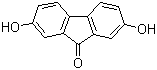
Route of Synthesis (ROS) of 2,7-Dihydroxy-9-fluorenone CAS 42523-29-5
Conditions
Yield
With trifluorormethanesulfonic acid at 150℃; for 10h; Inert atmosphere;
Experimental Procedure 1.1 Synthesis of 2,7-dihydroxy-9,9-bis-(4-aminophenyl)fluorene 0.05 mol of 2,7-dihydroxy-9-fluorenone,0.40 mol of aniline and 0.015 mol of trifluoromethanesulfonic acid were successively added to a flask equipped with a stirred rotor,Condenser,Thermometer and gas inlet in a four-necked flask,Access to nitrogen,Reaction at 150 ° C for 10 h,Then cooled to room temperature,The product was poured into a 100 mL solution of 5 g / L sodium hydroxide in ethanol,The precipitate is filtered,Ethanol wash,Vacuum drying,To give 2,7-dihydroxy-9,9-bis- (4-aminophenyl) fluorene (M-1)The yield was 92.3%.
92.3%
With methanesulfonic acid at 150℃; for 10h;
86%
With aniline hydrochloride at 180℃; for 1h;
73.6%
With methanesulfonic acid at 150℃; for 10h;
With methanesulfonic acid at 150℃; for 14h;
Safety and Hazards
Pictogram(s)
Signal
Danger
GHS Hazard Statements
H301 (25%): Toxic if swallowed [Danger Acute toxicity, oral] H302 (25%): Harmful if swallowed [Warning Acute toxicity, oral] H312 (50%): Harmful in contact with skin [Warning Acute toxicity, dermal] H315 (50%): Causes skin irritation [Warning Skin corrosion/irritation] H319 (50%): Causes serious eye irritation [Warning Serious eye damage/eye irritation] H332 (50%): Harmful if inhaled [Warning Acute toxicity, inhalation] H335 (25%): May cause respiratory irritation [Warning Specific target organ toxicity, single exposure; Respiratory tract irritation] Information may vary between notifications depending on impurities, additives, and other factors.
Precautionary Statement Codes
P261, P264, P270, P271, P280, P301+P310, P301+P312, P302+P352, P304+P312, P304+P340, P305+P351+P338, P312, P321, P322, P330, P332+P313, P337+P313, P362, P363, P403+P233, P405, and P501 (The corresponding statement to each P-code can be found at the GHS Classification page.)
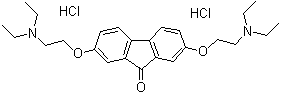
Route of Synthesis (ROS) of Tilorone dihydrochloride CAS 27591-69-1
Conditions
Yield
Stage #1: 2,7-bis(2-iodoethoxy)fluoren-9-one; diethylamine In N,N-dimethyl-formamide at 20℃; for 120h; Stage #2: With hydrogenchloride In 1,4-dioxane
Experimental Procedure 4.1.8. 2,7-bis[2-(diethylamino)ethoxy]fluoren-9-one dihydrochloride (3a) Diethylamine (0.73 g, 0.01 mol) was added to a solution of 2f(1.10 g 0.002 mol) in DMF (5 mL). The reaction mixture was kept atroom temperature for 5 days, diluted with H2O (200 mL), and thenacidified with HCl to achieve a pH of 2-3. The acidic solution waswashed with CHCl3 (3×50 mL), and then basified with aqueous NaOHuntil pH was 12-13. The product was extracted with CHCl3(3×50 mL). The combined CHCl3 layers were washed with H2O untilpH of aqueous layer was about 7, dried (Na2SO4) and evaporated underreduced pressure. The resultant residue was dissolved in anhydrousdioxane (20 mL) and then saturated anhydrous solution of HCl in dioxanewas added to the resulting solution while stirring. The solventwas evaporated under reduced pressure to give a crude gummy residuethat was suspended in acetone. A stirred suspension was refluxed for15 min, followed by filtration to give a solid material. The procedurewas repeated until a pure reddish solid product (3a) was afforded;(0.80 g, Yield: 83%); mp 236-237 °C (Lit. mp 235 -236 °C [22]; FABMSm/z: M+ = 411.
83%
Safety and Hazards
Pictogram(s)
Signal
Warning
GHS Hazard Statements
H302 (100%): Harmful if swallowed [Warning Acute toxicity, oral] H312 (100%): Harmful in contact with skin [Warning Acute toxicity, dermal] H315 (100%): Causes skin irritation [Warning Skin corrosion/irritation] H319 (100%): Causes serious eye irritation [Warning Serious eye damage/eye irritation] H332 (100%): Harmful if inhaled [Warning Acute toxicity, inhalation] H335 (97.56%): May cause respiratory irritation [Warning Specific target organ toxicity, single exposure; Respiratory tract irritation] H351 (97.56%): Suspected of causing cancer [Warning Carcinogenicity] Information may vary between notifications depending on impurities, additives, and other factors.
Precautionary Statement Codes
P201, P202, P261, P264, P270, P271, P280, P281, P301+P312, P302+P352, P304+P312, P304+P340, P305+P351+P338, P308+P313, P312, P321, P322, P330, P332+P313, P337+P313, P362, P363, P403+P233, P405, and P501 (The corresponding statement to each P-code can be found at the GHS Classification page.) For more detailed information, please visit ECHA C&L website
Source: European Chemicals Agency (ECHA) License Note: Use of the information, documents and data from the ECHA website is subject to the terms and conditions of this Legal Notice, and subject to other binding limitations provided for under applicable law, the information, documents and data made available on the ECHA website may be reproduced, distributed and/or used, totally or in part, for non-commercial purposes provided that ECHA is acknowledged as the source: “Source: European Chemicals Agency, http://echa.europa.eu/”. Such acknowledgement must be included in each copy of the material. ECHA permits and encourages organisations and individuals to create links to the ECHA website under the following cumulative conditions: Links can only be made to webpages that provide a link to the Legal Notice page. License URL: https://echa.europa.eu/web/guest/legal-notice Record Name: (1-Cyano-2-ethoxy-2-oxoethylidenaminooxy)dimethylamino-morpholino-carbenium hexafluorophosphate URL: https://echa.europa.eu/information-on-chemicals/cl-inventory-database/-/discli/details/213446 Description: The information provided here is aggregated from the “Notified classification and labelling” from ECHA’s C&L Inventory. Read more: https://echa.europa.eu/information-on-chemicals/cl-inventory-database
Other Data
Transportation
NONH for all modes of transport
Under the room temperature and away from light
HS Code
294200
Storage
Under the room temperature and away from light
Shelf Life
1 year
Market Price
USD
Druglikeness
Lipinski rules component
分子量
483.478
logP
5.234
HBA
3
HBD
0
Matching Lipinski Rules
3
Veber rules component
Polar Surface Area (PSA)
42.01
Rotatable Bond (RotB)
12
Matching Veber Rules
1
Bioactivity
In vitro: Efficacy
Quantitative Results
pX
Parameter
Value (qual)
Value (quant)
Unit
6.96
IC50
110
nM
6.35
IC50
0.45
µM
6.03
EC50
0.94
µM
5.6
EC50
2.5
µM
4.72
IC50
19
μM
4.15
IC50
70
μM
3.81
ID50
=
75
μg/ml
1
IC50
>
50
μM
1
nH (Hill coefficient)
1.1
Emax
6.7
viable cell percentage(Stationary phase bacteria)
44
%
Protein binding (%)
52
%
tested
Not Published
viable cell percentage(at 72hpi)
>=
90
%
Quantitative Results
1 of 5
Effect
antiviral agent
2 of 5
Effect
Cytotoxic
Biological material
bovine fibroblast
Assay Description
Bioassay : for morphological studies cell seeded into 35-mmplastic culture dishes; for ultrastructural exam.cells grown on the plastic surface used; for radiochemical and biochemical experiments cells seeded into plastic flasks of 25ml and 75 ml, respectively fibroblasts obtained from explants of bovine corneae; cells cultivated in Eagle’s minimal essential medium (MEM) suppl.with 10 percent fetal calf serum, non-essential amino acids, penicillin and streptomicin at 37 degC; pH 7.1-7.2
Results
induces lisosomal GAG contents.
3 of 5
Results
Surviving curves of T2 phage with the compound at 37 deg C.
4 of 5
Results
inhibition of cAMP-phosphodiesterase in cell homogenates of peritoneal macrophages and L 1210 aszites: 50percent inhibition at concentrations 440.2 and 792.4 μmol/l, respectively
5 of 5
Results
effect of title compound pretreatment on body weight loss and antipyrine disposition in vivo (rat); pharmacokinetic parameters
Toxicity/Safety Pharmacology
Quantitative Results
pX
Parameter
Value (qual)
Effect
1
body weight loss
Not active
Toxic
body weight gain(Survivors)
Active
toxic substance
Use Pattern
Tilorone dihydrochloride CAS#: 27591-69-1 as Pharmaceuticals
Tilorone dihydrochloride CAS#: 27591-69-1 treating a Zika viral infection