TRIETHANOLAMINE BORATE CAS#: 15277-97-1; 凯望编码 (ChemWhat Code): 151792

Identification
| 英文名 | TRIETHANOLAMINE BORATE |
| 分子结构 | 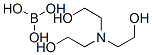 |
| CAS编号 | 15277-97-1 |
| 别名 | 15277-97-1 Triethanolamine monoborate 10049-36-2 2-[bis(2-hydroxyethyl)amino]ethanol;boric acid Boric acid triethanolamine salt (1:1) Boric acid, triethanolamine salt Triethanolaminoborate 68413-80-9 EINECS 233-175-9 EINECS 270-252-6 Orthoboric acid, compound with 2,2′,2”-nitrilotriethanol SCHEMBL272394 BN (CUTTING LUBRICANT) DTXSID70893103 HJVAFZMYQQSPHF-UHFFFAOYSA-N TRIETHANOLAMINE BORATE (SALT) AKOS030228372 AS-44365 NS00091637 A11467 Q27260402 BORIC ACID (H3BO3), CMPD. WITH 2,2′,2”-NITRILOTRIS(ETHANOL) (1:3) |
| 分子式 | C6H18BNO6 |
| 分子量 | 211.02 |
| InChI | InChI=1S/C6H15NO3.BH3O3/c8-4-1-7(2-5-9)3-6-10;2-1(3)4/h8-10H,1-6H2;2-4H |
| InChI Key | HJVAFZMYQQSPHF-UHFFFAOYSA-N |
| Isomeric SMILES | B(O)(O)O.C(CO)N(CCO)CCO |
Physical Data
| Appearance | White crystal |
Spectra
| Description (NMR Spectroscopy) | Nucleus (NMR Spectroscopy) | Solvents (NMR Spectroscopy) | Temperature (NMR Spectroscopy), °C | Frequency (NMR Spectroscopy), MHz |
| Chemical shifts | 1H | chloroform-d1 | 500 | |
| Chemical shifts | 13C | chloroform-d1 | 125 | |
| 11B | chloroform-d1 | 25 | ||
| 13C | chloroform-d1 | 25 | ||
| 1H | chloroform-d1 | 25 | ||
| Chemical shifts | 1H | chloroform-d1 | 400 | |
| Chemical shifts | 13C | chloroform-d1 | 100.6 |
Route of Synthesis (ROS)
| Conditions | Yield |
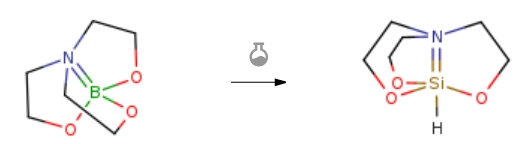
| With aluminum (III) chloride; Triethoxysilane In 5,5-dimethyl-1,3-cyclohexadiene for 4h; Inert atmosphere; Reflux; Experimental Procedure 1 Synthesis of Silatrane Via Boratrane To an oven-dried, argon-flushed 100 mL flask containing boratrane (5 mmol) in mixed xylenes (40 mL), was added triethoxysilane (6 mmol) and anhydrous AlCl3 (0.05 mmol). The reaction was refluxed over 4 h and then cooled to room temperature. The resulting solids were filtered and further recrystallized from xylene to give silatrane as white fibrous crystals. The experimental data collected are in agreement with those described in the literature.[19] 88%. 1H NMR (500 MHz, CDCl3): δ=3.94 (s, 1H), 3.83 (t, J =6 Hz, 6H), 2.89 (t, J =6 Hz, 6H). 13C NMR (125 MHz, CDCl3) 57.2, 51.2. IR (ATR) 2975, 2936, 2886, 2087, 1487, 1457, 1347, 1268, 1090, 1047, 1020, 926, 860, 748, 630, 591. | 88% |
Safety and Hazards
| Pictogram(s) |   |
| Signal | Danger |
| GHS Hazard Statements | H315 (29.9%): Causes skin irritation [Warning Skin corrosion/irritation] H318 (43.7%): Causes serious eye damage [Danger Serious eye damage/eye irritation] H319 (29.9%): Causes serious eye irritation [Warning Serious eye damage/eye irritation] H335 (28.7%): May cause respiratory irritation [Warning Specific target organ toxicity, single exposure; Respiratory tract irritation] |
| Precautionary Statement Codes | P261, P264, P264+P265, P271, P280, P302+P352, P304+P340, P305+P351+P338, P305+P354+P338, P317, P319, P321, P332+P317, P337+P317, P362+P364, P403+P233, P405, and P501 (The corresponding statement to each P-code can be found at the GHS Classification page.) |
Other Data
| Transportation | Under the room temperature and away from light |
| HS Code | |
| Storage | Under the room temperature and away from light |
| Shelf Life | 1 year |
| Market Price |
| Druglikeness | |
| Lipinski rules component | |
| 分子量 | 156.977 |
| logP | |
| HBA | 4 |
| HBD | 0 |
| Matching Lipinski Rules | 3 |
| Veber rules component | |
| Polar Surface Area (PSA) | 27.69 |
| Rotatable Bond (RotB) | 0 |
| Matching Veber Rules | 2 |
| Use Pattern |
| Triethanolamine borate CAS 15277-97-1 is a compound formed by the reaction of triethanolamine and boric acid. Acts as a corrosion inhibitor, preventing metal corrosion in machining fluids. Enhances lubrication and extreme-pressure properties, improving the performance of metalworking fluids and extending equipment lifespan. Serves as an extreme-pressure additive in lubricants, reducing friction and wear between metal surfaces. Improves antioxidant and anti-corrosion properties in coolants, protecting system pipelines and equipment. |
试剂采购 | |
| 没有试剂厂商? | 向凯望发送快速询价 |
| 想要被列为试剂厂商? (付费服务) | 点击这里联系凯望 |
认证生产商 | |
| 想要被列为认证生产商 (需要通过认证)? | 请下载并填写 这份表格并发邮件到approved-manufacturers@chemwhat.com |
其他供应商 | |
| Watson International Limited | 访问Watson官网 |
如需其他帮助,请联系我们 | |
| 联系我们获取其它信息或服务 | 点击这里联系凯望 |