TRIETHANOLAMINE BORATE CAS#: 283-56-7; 凯望编码 (ChemWhat Code): 57505

Identification
| 英文名 | TRIETHANOLAMINE BORATE |
| IUPAC Name | 2,8,9-trioxa-5-aza-1-borabicyclo[3.3.3]undecane |
| 分子结构 | 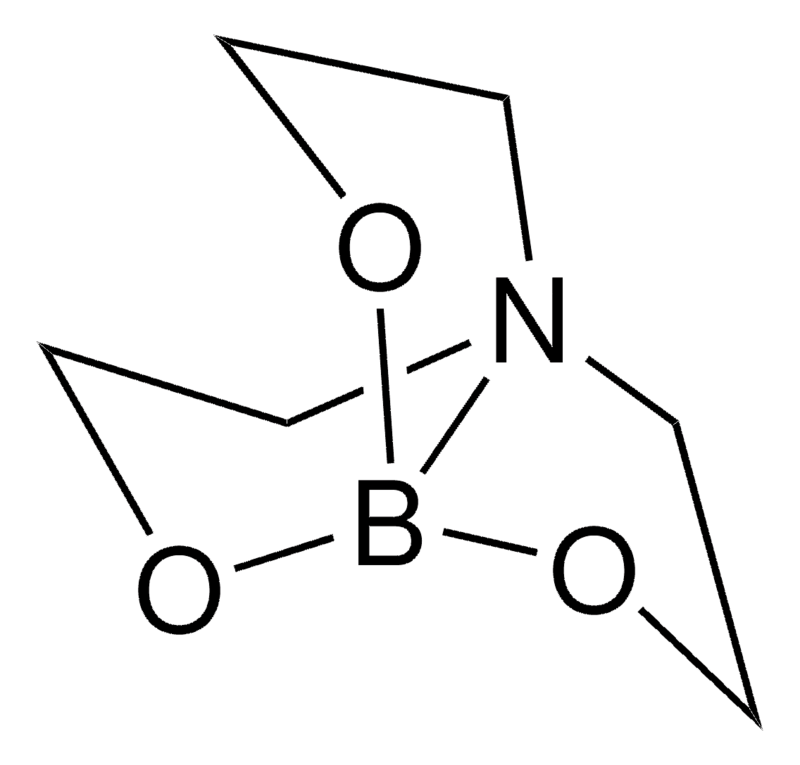 |
| CAS编号 | 283-56-7 |
| EINECS Number | 239-317-6 |
| MDL Number | MFCD00003272 |
| Beilstein Registry Number | 774536 |
| 别名 | 2,8,9-trioxa-5-aza-1-borabicyclo[3.3.3]undecanetriethanolamine borateboratrane |
| 分子式 | C6H12BNO3 |
| 分子量 | 156.978 |
| InChI | InChI=1S/C6H12BNO3/c1-4-9-7-10-5-2-8(1)3-6-11-7/h1-6H2 |
| InChI Key | NKPKVNRBHXOADG-UHFFFAOYSA-N |
| Canonical SMILES | C1CN2CCOB(O1)OCC2 |
| Patent Information |
| No data available |
Physical Data
| Appearance | White powder |
| Solubility | No data available |
| Flash Point | No data available |
| Refractive index | No data available |
| Sensitivity | No data available |
| Melting Point, °C | Solvent (Melting Point) |
| 227 | |
| 242 | 3-methyl-butan-1-ol |
| 236 | acetonitrile |
| 236.5 – 237.5 | pyridine |
| Density, g·cm-3 | Reference Temperature, °C | Measurement Temperature, °C |
| 1.423 | 4 | 20 |
Spectra
| Description (NMR Spectroscopy) | Nucleus (NMR Spectroscopy) | Solvents (NMR Spectroscopy) | Temperature (NMR Spectroscopy), °C | Frequency (NMR Spectroscopy), MHz |
| Chemical shifts, Spectrum | 1H | chloroform-d1 | 23.04 | 500 |
| Chemical shifts, Spectrum | 13C | chloroform-d1 | 24.04 | 125 |
| 2D-NMR | 11B | |||
| Spectrum | 11B | |||
| Spectrum | 1H | D2O | 30 – 90 | 399.78 |
| Description (IR Spectroscopy) | Solvent (IR Spectroscopy) | Comment (IR Spectroscopy) | Signals, cm-1 |
| ATR (attenuated total reflectance), Bands | |||
| Bands | CHCl3 | 1363 | |
| Spectrum | nujol | 4000 – 400 cm**(-1) |
| Description (UV/VIS Spectroscopy) | Solvent (UV/VIS Spectroscopy) | Comment (UV/VIS Spectroscopy) | Absorption Maxima (UV/VIS), nm | Ext./Abs. Coefficient, l·mol-1cm-1 |
| Absorption maxima | H2O, H2SO4 | Ratio of solvents: 66percent | 258 | 5740 |
| Absorption maxima | H2O, NaOH | Ratio of solvents: 0.1N | 232, 290 | 8600, 3120 |
Route of Synthesis (ROS)
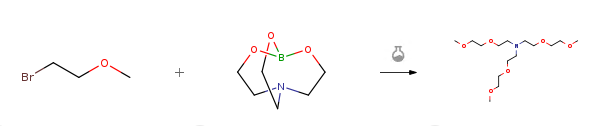
| Conditions | Yield |
| With tetrabutyl-ammonium chloride; sodium hydroxide In sulfolane at 60 – 120℃; Reagent/catalyst; Experimental Procedure 2.1 139 g (1 mol) of 2-bromoethyl methyl ether was placed in the reaction flask.Triethanolamine borate 31.4g (0.2mol), tetrabutylammonium chloride 5.6g (0.02mol) and350 g of sulfolane, heated to 60 ° C,Start adding 32g (0.8mol) of sodium hydroxide in batches.After heating to 120 ° C for 3 to 4 hours, sampling GC detection,By rectification, 59.9 g of tris(3,6-dioxaheptyl)amine was obtained as a yellow oily liquid.Nuclear magnetic purity: 99.3%, yield: 92.7%. | 92.7% |
Safety and Hazards
| Pictogram(s) |  |
| Signal | Warning |
| GHS Hazard Statements | H315 (100%): Causes skin irritation [Warning Skin corrosion/irritation] H319 (100%): Causes serious eye irritation [Warning Serious eye damage/eye irritation] H335 (100%): May cause respiratory irritation [Warning Specific target organ toxicity, single exposure; Respiratory tract irritation] Information may vary between notifications depending on impurities, additives, and other factors. |
| Precautionary Statement Codes | P261, P264, P264+P265, P271, P280, P302+P352, P304+P340, P305+P351+P338, P319, P321, P332+P317, P337+P317, P362+P364, P403+P233, P405, and P501 (The corresponding statement to each P-code can be found at the GHS Classification page.) |
Other Data
| Transportation | NONH for all modes of transport |
| Under the room temperature and away from light | |
| HS Code | |
| Storage | Under the room temperature and away from light |
| Shelf Life | 2 years |
| Market Price | USD |
| Druglikeness | |
| Lipinski rules component | |
| 分子量 | 156.977 |
| logP | -0.411 |
| HBA | 4 |
| HBD | 0 |
| Matching Lipinski Rules | 4 |
| Veber rules component | |
| Polar Surface Area (PSA) | 30.93 |
| Rotatable Bond (RotB) | 0 |
| Matching Veber Rules | 2 |
| Use Pattern |
| The uses of triethanolamine borate (CAS No. 283-56-7) mainly rely on its structural characteristics, which is composed of triethanolamine (TEA) and boric acid or borate groups. The following are the main uses of this compound : |
| Main uses : Flame retardant : Due to the flame-suppressing properties of borates, triethanolamine borate is often used as a flame retardant in materials such as plastics and textiles to help improve the fire resistance of materials. |
| Corrosion inhibitor : Triethanolamine and borates are used as corrosion inhibitors in liquids such as metalworking fluids and coolants to effectively prevent oxidative corrosion of metals. |
| Lubricants and lubricant additives : As an additive in industrial lubricants such as lubricating oils and greases, triethanolamine borate helps to improve lubrication, reduce wear, and increase the stability and service life of lubricants. |
| Personal care and cosmetic formulations : Due to the good emulsification and pH adjustment capabilities of triethanolamine, triethanolamine borate may be used in cosmetics and personal care products such as creams, shampoos, skin care products, etc., acting as a pH regulator or emulsifier. |
| Water treatment and adhesives : Triethanolamine borate can also be used as a component of industrial chemicals such as water treatment agents, adhesives, sealants, etc., using its surface activity and buffering capacity to improve performance. |
| Summary : Triethanolamine borate is a versatile chemical that is mainly used in flame retardant, anti-corrosion, lubrication, cosmetic formulations and other fields, playing a role in adjusting pH, improving stability and protecting materials. |
试剂采购 | |
| 没有试剂厂商? | 向凯望发送快速询价 |
| 想要被列为试剂厂商? (付费服务) | 点击这里联系凯望 |
认证生产商 | |
| 想要被列为认证生产商 (需要通过认证)? | 请下载并填写 这份表格并发邮件到approved-manufacturers@chemwhat.com |
其他供应商 | |
| Watson International Limited | 访问Watson官网 |
如需其他帮助,请联系我们 | |
| 联系我们获取其它信息或服务 | 点击这里联系凯望 |